Roland CAHEN

Catégorie : Voyage

  • Coda

    Sitting on the plane going back from Haneda Airport, Tokyo, I still don’t have quite enough perspective to take one step back from our journey to take stock. One of the things I have enjoyed has been living in the present and composing, or improvising each day as it comes. Time has been suspended in a never-ending present, giving us a certain kind of freedom, as well as its internal limitations, such as where will we sleep tonight or, even more banal, what will we eat and where will we find it?

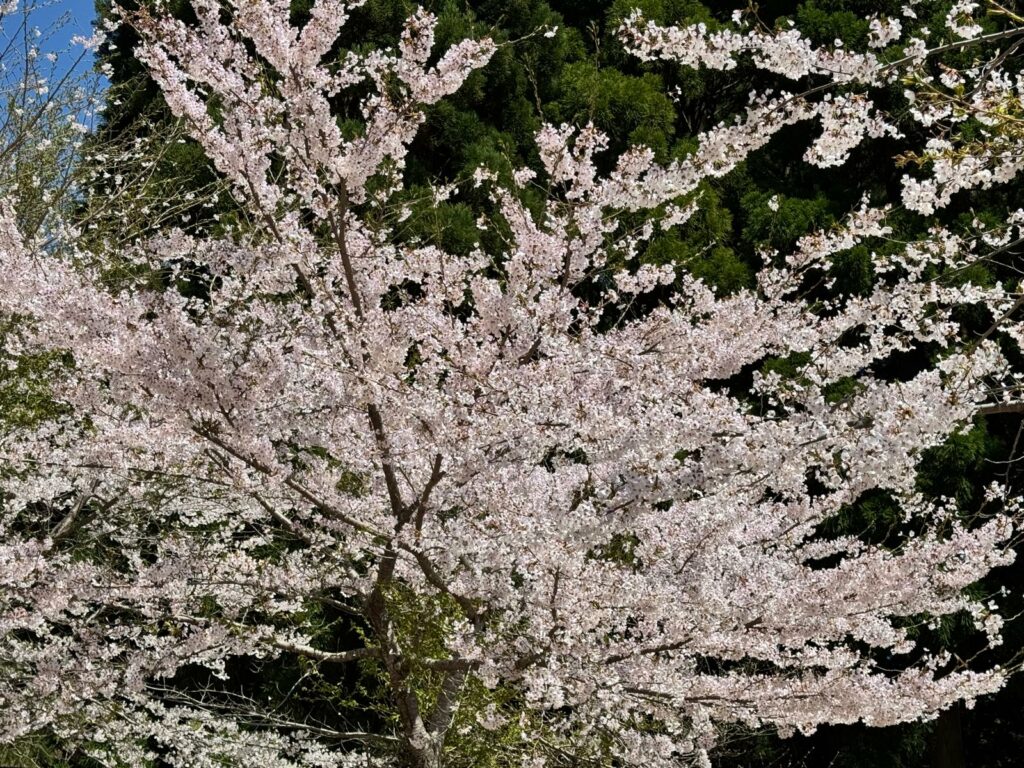
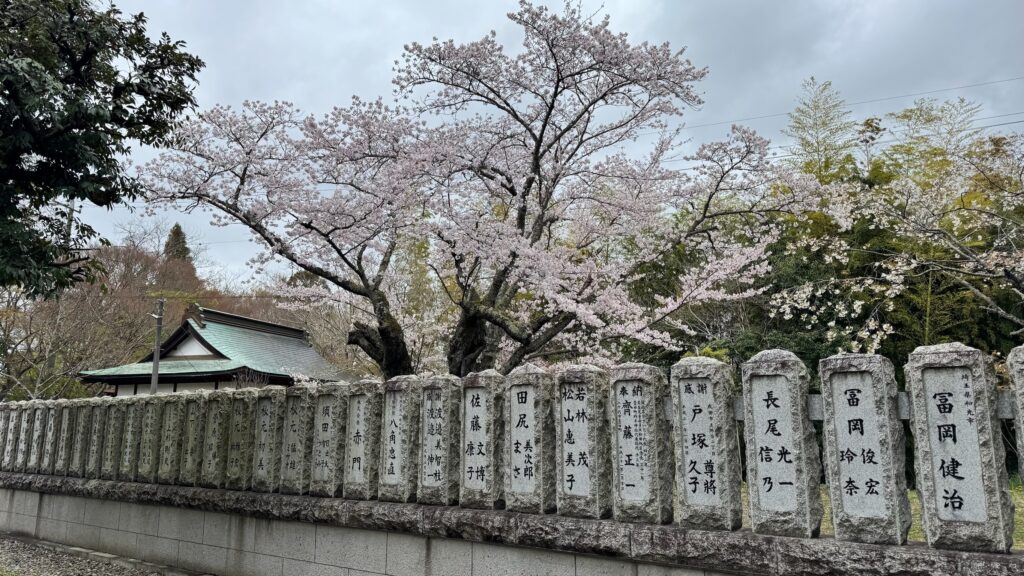
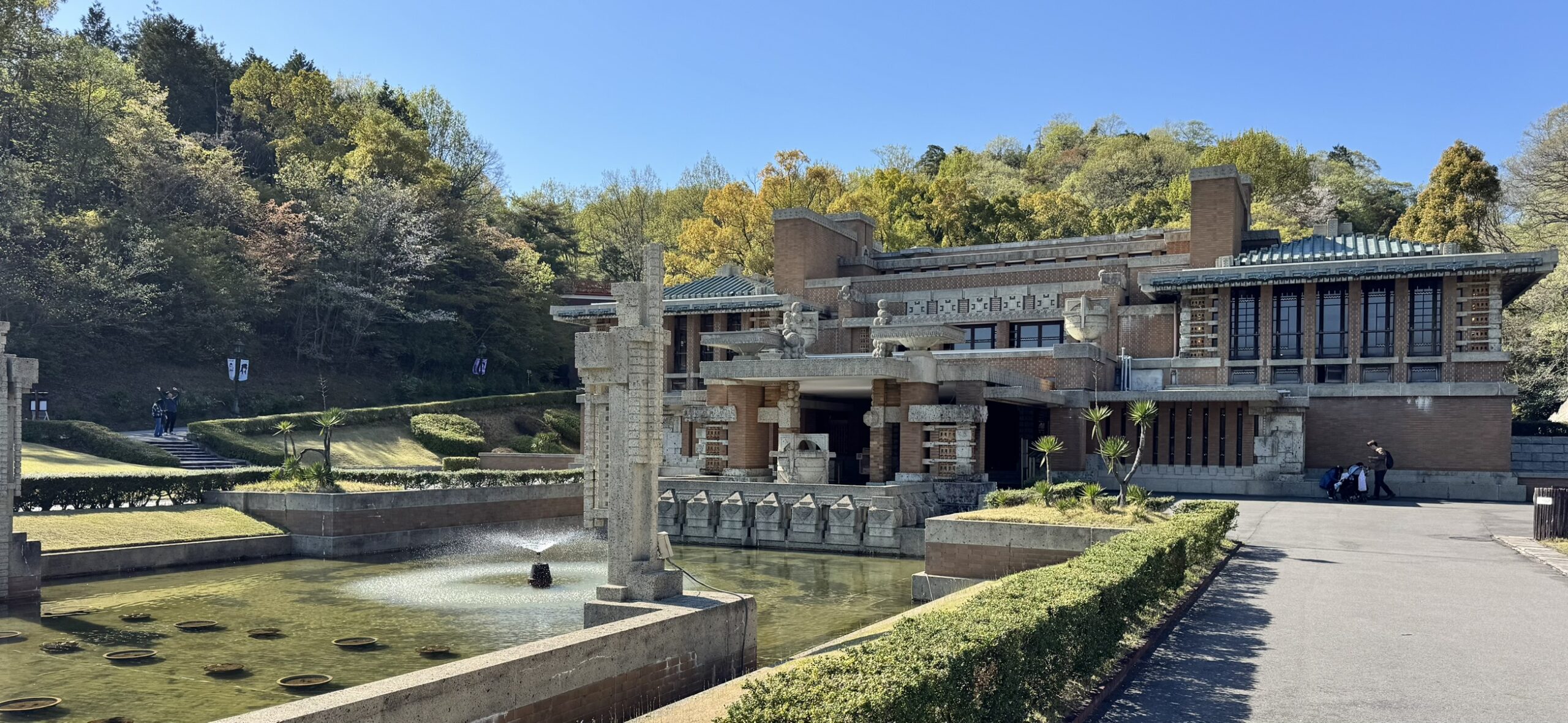
    We have been travelling around Japan for the last two weeks since I last wrote. These last couple of weeks have turned into a blur, though numerous experiences stick out. Perhaps the metaphor of mist is more appropriate, the shelves of mist being an iconic Japanese sight that has stayed with me. The day at the Meiji-Mura architectural museum, near Nagoya. A bright blue sky sunny Spring day, where walking around exploring the reconstructed, transported and rebuilt buildings from the Meiji era until the 1920s, was accompanied by sunlit cherry blossom views. We got a sense of the mutual inspiration and imitation of Japanese and European cultures and traditions. Our visit culminated with a visit inside and out of Frank Lloyd Wright’s Imperial Hotel, built in Tokyo in 1923. The building was made of porous stone and honeycomb bricks and was a wonder to behold.
    I also got to try out some traditional Japanese clothing. I thought naively the interior was a reconstructed shop and we were allowed to try on the clothes. It turned out the collection was for rental and people rent the costumes to dress up and take photos as they wander round the reconstituted streets.
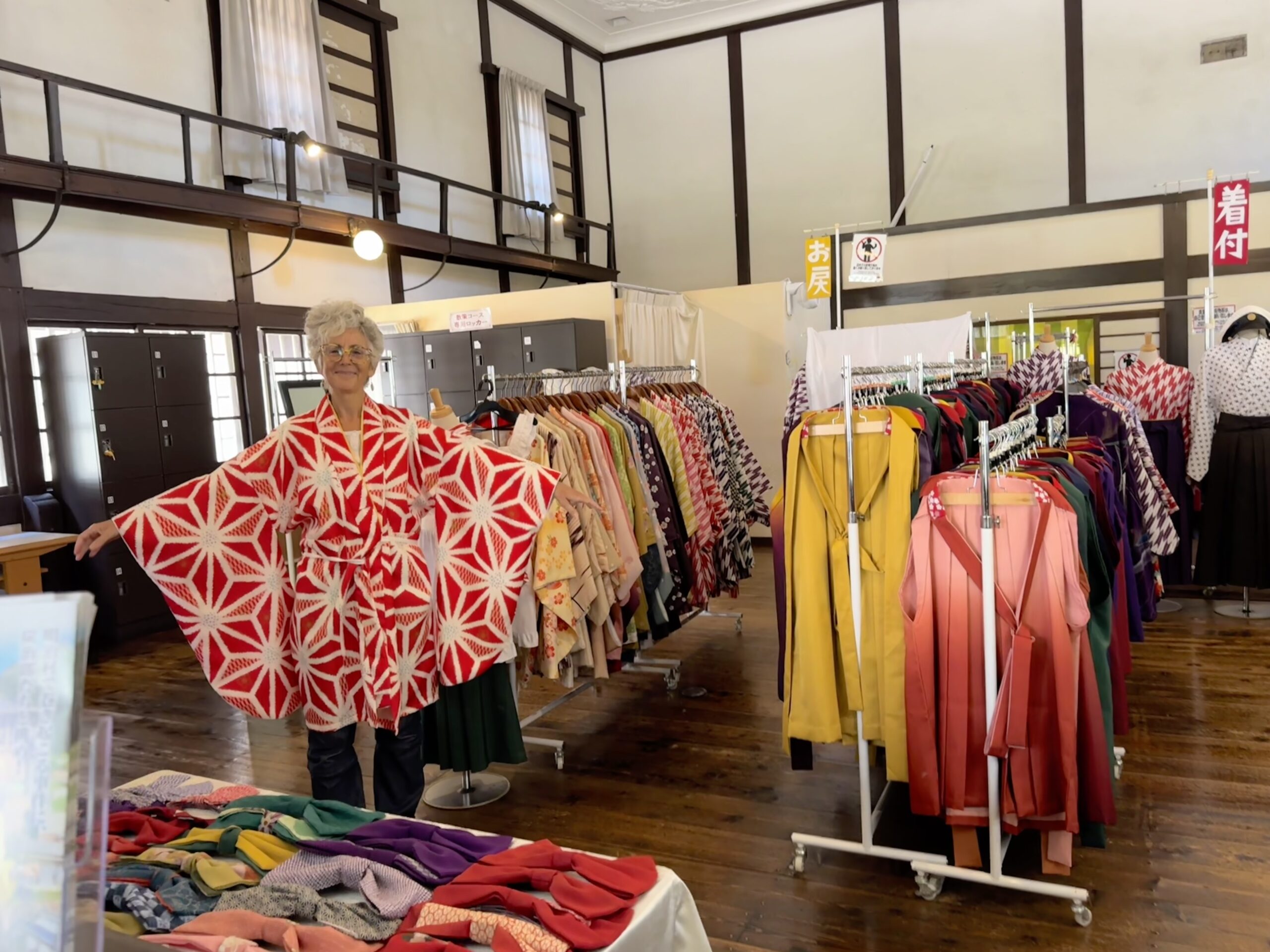
    Being told off for costume trespassing was an infantilising epiphenomenon, because by the end of our stay, I had the distinct impression that the Japanese were always telling us what to do: there are instructions about how to go to the toilet (excuse the scatological reference), every visit involves an IKEA-style designed tour where you cannot step out of line or go in the opposite direction, more about what you can and cannot do in your hotel room, for example, you have to take your shoes off the minute you enter the room, but when the door opens inwards and you are carrying your luggage and the room is compact-sized, following the instructions to the letter proves somewhat problematic. I was often self-conscious about how I handled my chopsticks, I did progress while I was there, but it is unseemly to touch food with your hands (as I understood it) and desiccating fish from their fish bones with chopsticks was challending. Japanese Breakfast in general was somewhat difficult for me, so a plain bowl of rice with tea often was the simplest solution, leaving my coffee-addicted desires to one side. When we did find place which served coffee, sometimes it would take a very long time to prepare because of the way they pour one drop of water in at a time to brew it. Once, in an incongruous coffee shop in a village in the middle of nowhere, the end-result was worth it, brought to us after half an hour (there were only two other people in the cafe) in gold and porcelain cups. I felt particularly un-zen at this point because I had been getting impatient for it to arrive and asked myself exactly what I had learned on our trip.

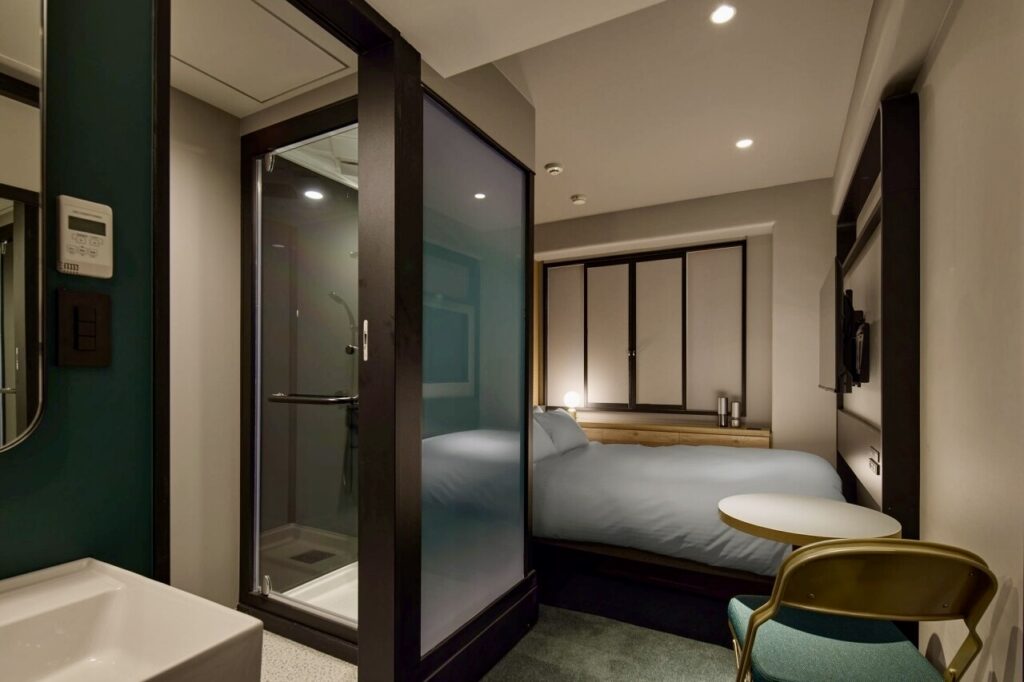
    I liked Nagoya for its urban style: it was the first of our every centimeter counts in the hotel room experiences, which Roland has described.
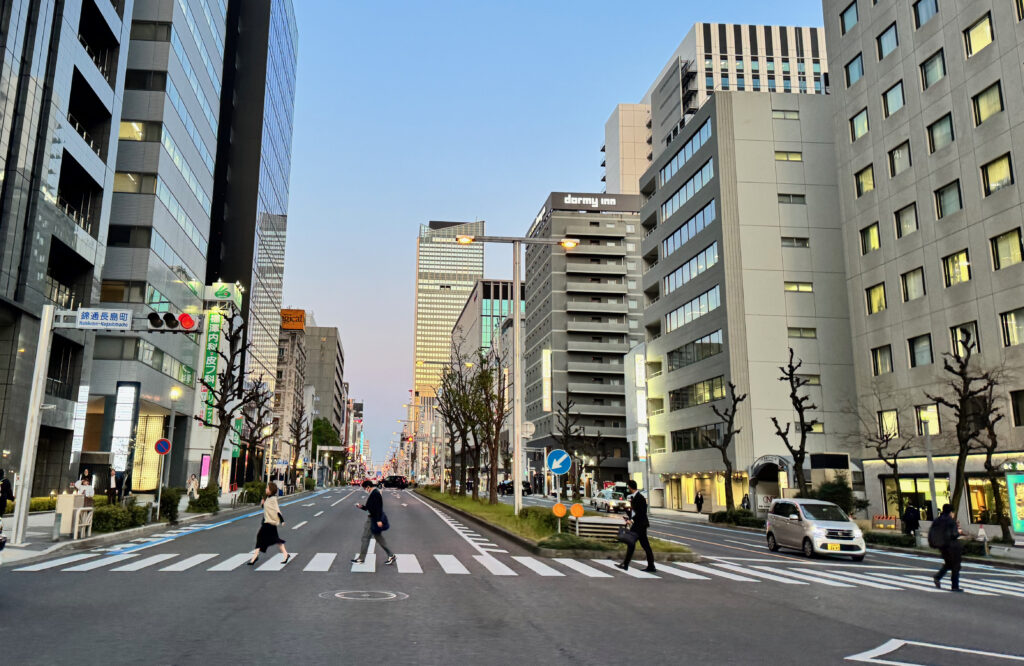
    I remember the besuited men with over-sized shoes, like clown shoes, clacking and flapping at they were on their way to work. There were besuited women too, of course, but their shoes fit their feet better. I induced, perhaps erroneously, that it was smart or virile for men to have big feet.
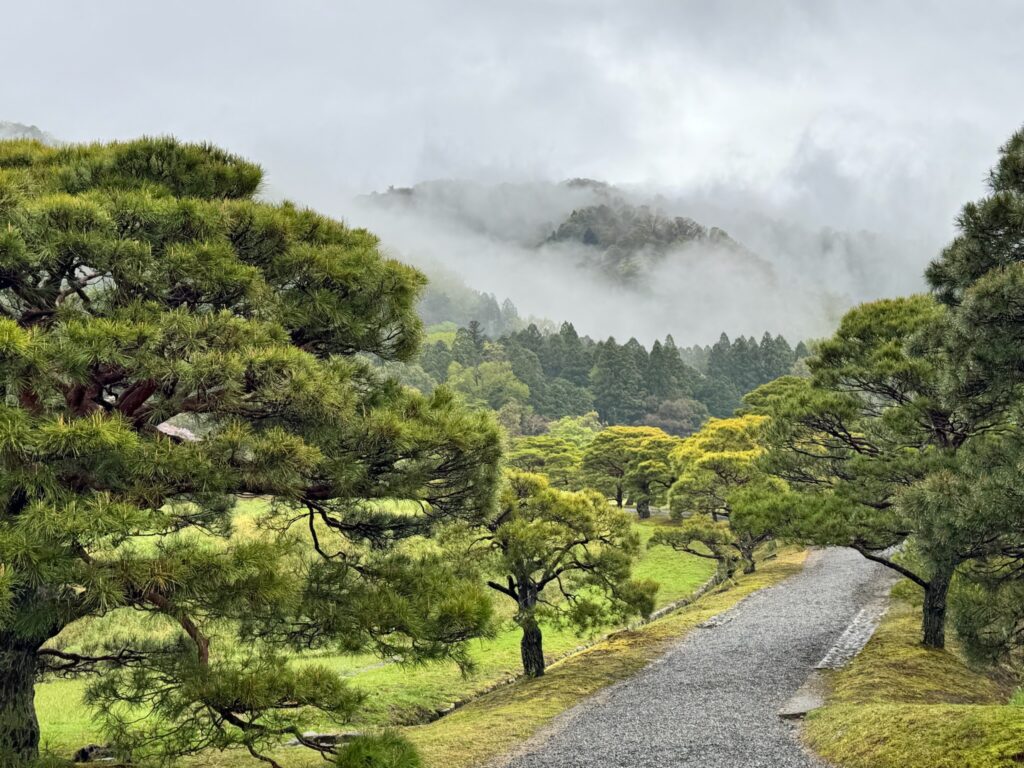
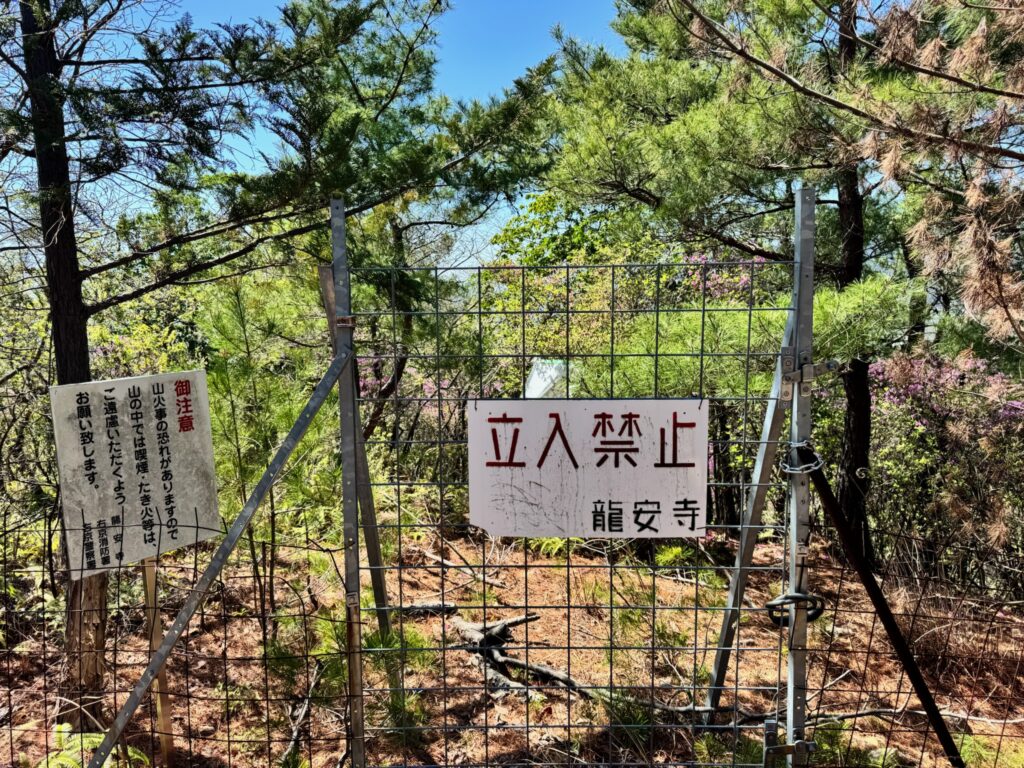
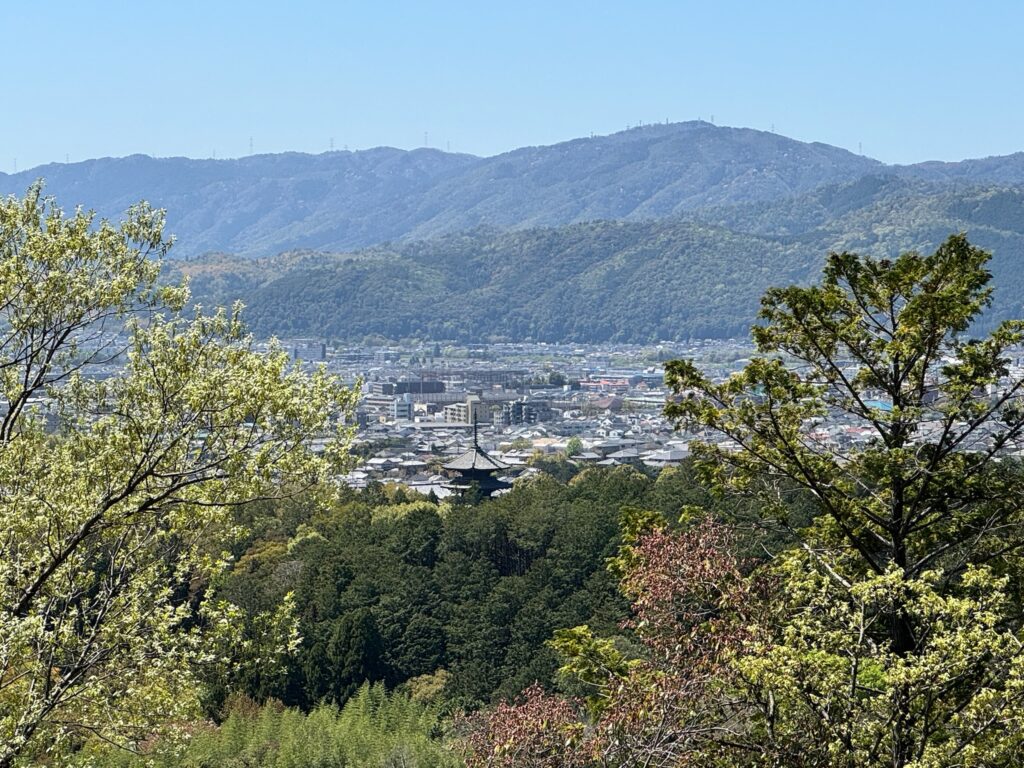
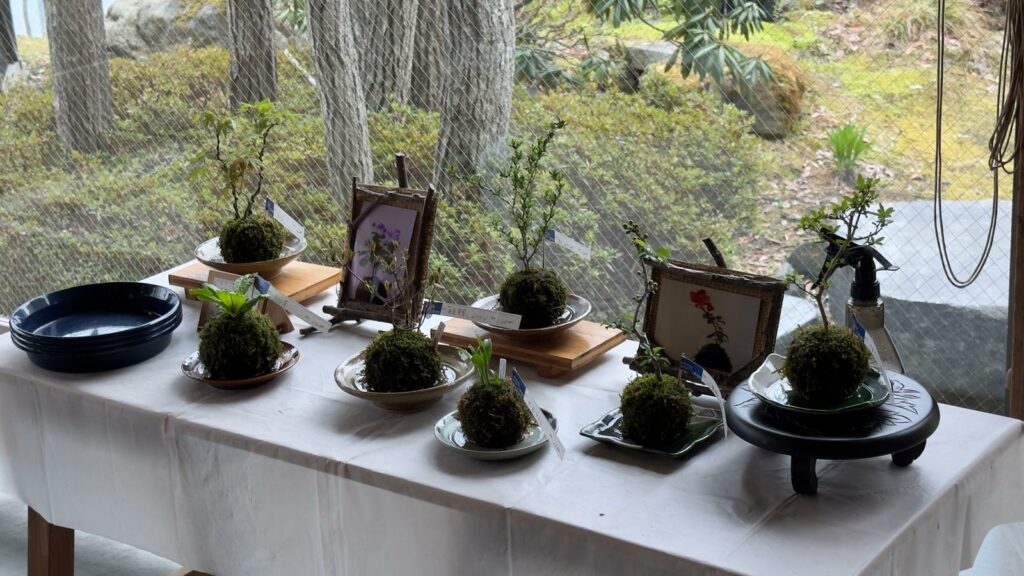
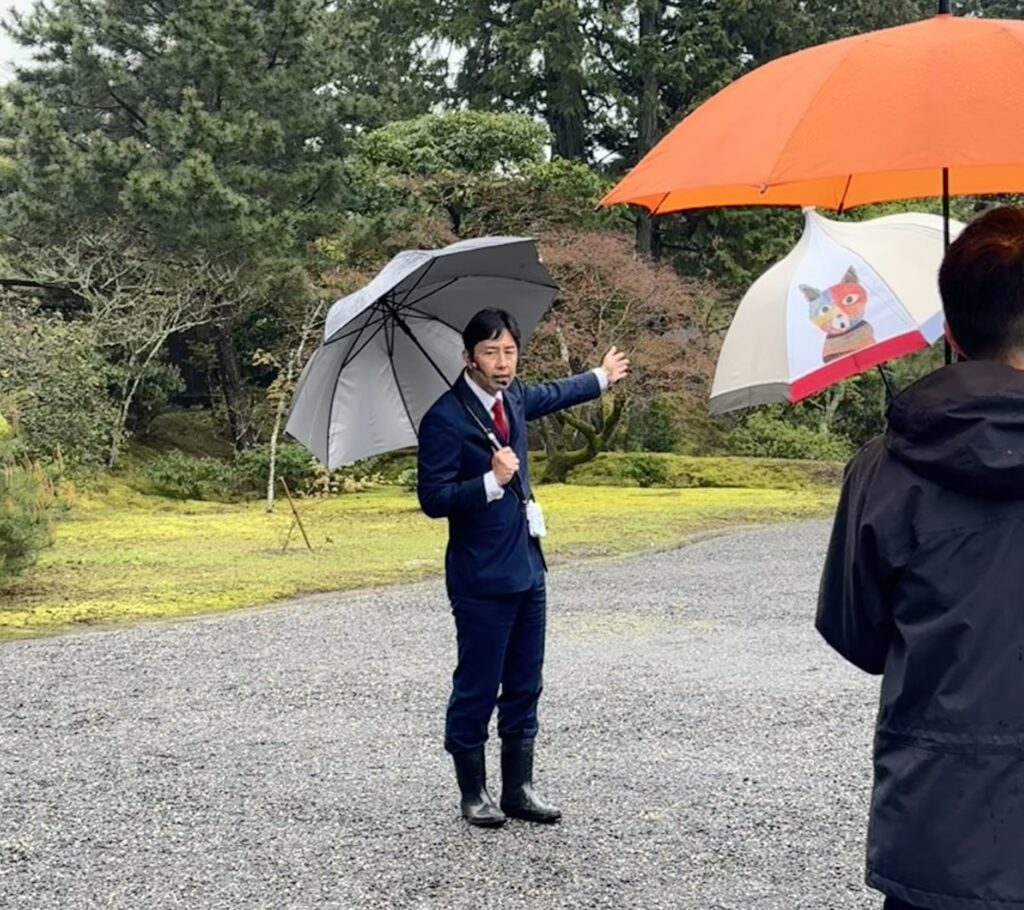
    During our stay in Kyoto, the next chronological event, aside our fruitless trip up a hillside to get a view, on a day much warmer than we were expecting, one visit that stuck in my mind was the bonsai garden. We came across it by accident, thanks to overhearing a very smooth-talking guide. Wandering round the garden and looking at those age-old trees produced a sense of bewilderment. Is it a form of perfectionism that involves cruelty, as a friend suggested to me, or is it also a sense of devotion to nature and the duty to keep a tree alive to enable a kind of immortality, or both? Another Kyoto experience involved tearing across the city in a number of buses in the rain, at 7h30 in the morning (no one will recognise me from this description) to get to the imperial villa at the appointed hour. We had booked this visit months in advance (thank you Aki for the tip) and we had to work quite hard to make it work. It was worth it, even if the guided tour (we used the recorded version in English of course) involved a great deal of ceremony and locking and unlocking of doors. Notice th guide in a suit with wellies and an umbrella. The three villas themselves are not as memorable as the landscape shaped and ordered, so that the different levels create a sense of harmony and serenity. The trees are pruned to create perfect dimensions. This visit was the first of many which enabled us to observe a Japanese fascination with mastering nature so that nature and the artificial (man-made) gardens merge into one.
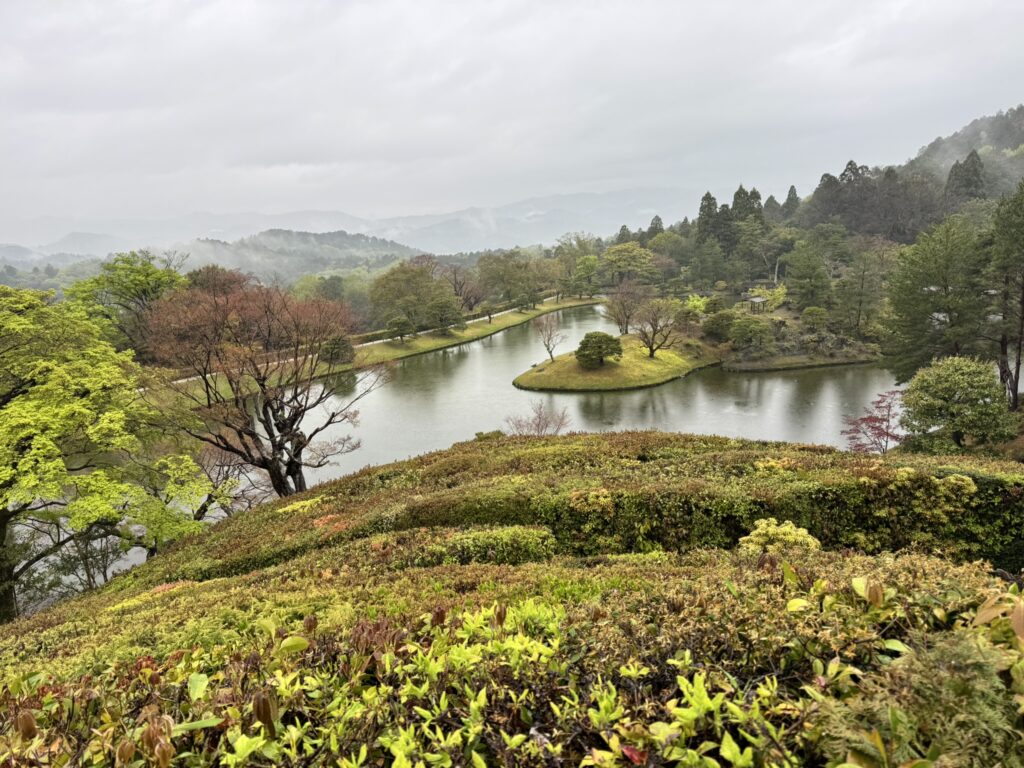
    Later we discovered that this attempt at domination only extends to ground level and the trees and hills and mountains are left to their own wild devices. Roland did some research and thinks it’s because the Japanese are afraid of the mountains inhabited by powerful spirits, or maybe because it is impossible to sublimate nature in the mountains: nature is too powerful.
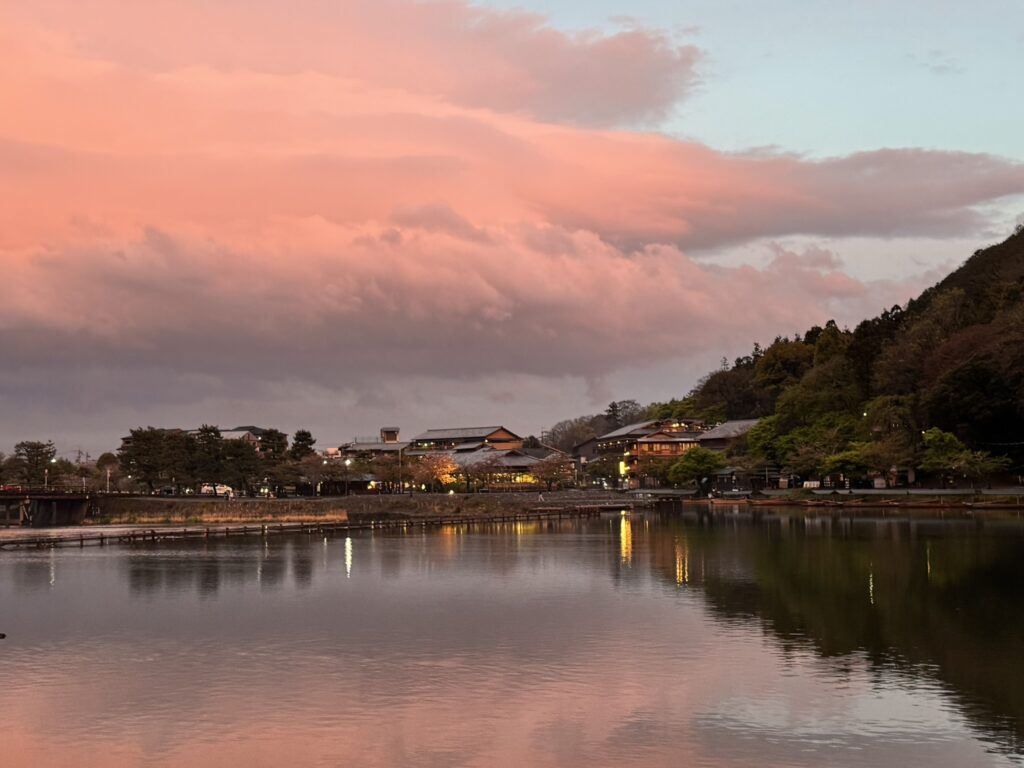
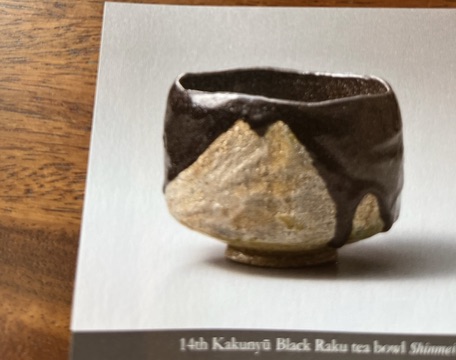
    Other enjoyable moments in Kyoto involved walking along the Philosopher’s path amongst the cherry blossom and visiting the Raku museum (thank you Julianna and Hocine as we wouldn’t have found it without you) where twelve generations of potters lived and worked. No photos of their powerful and modern-looking work (even though dating from the 17th c) since no photos were allowed in the museum. I attach a Ruth-like photo of my entrance ticket.
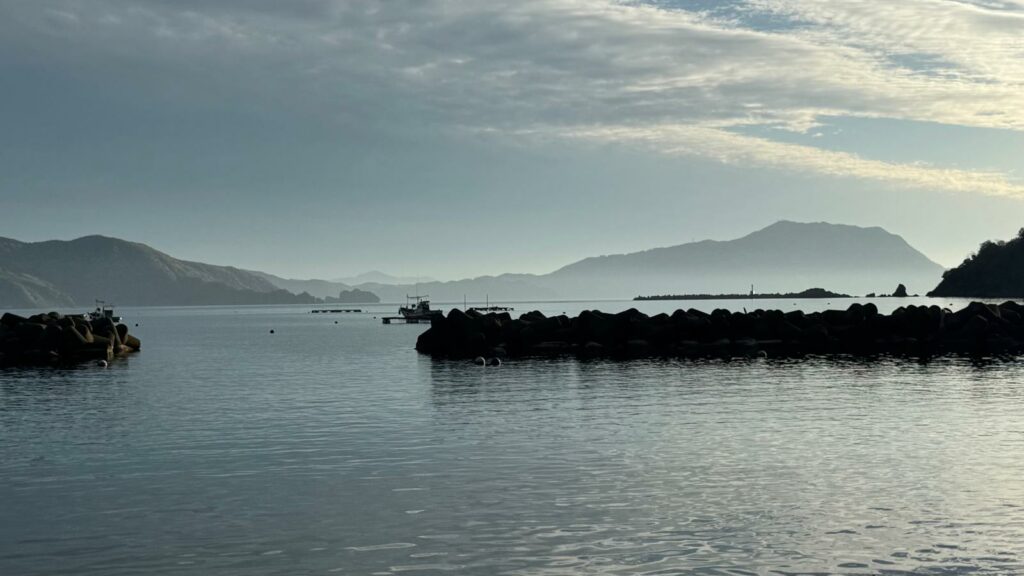
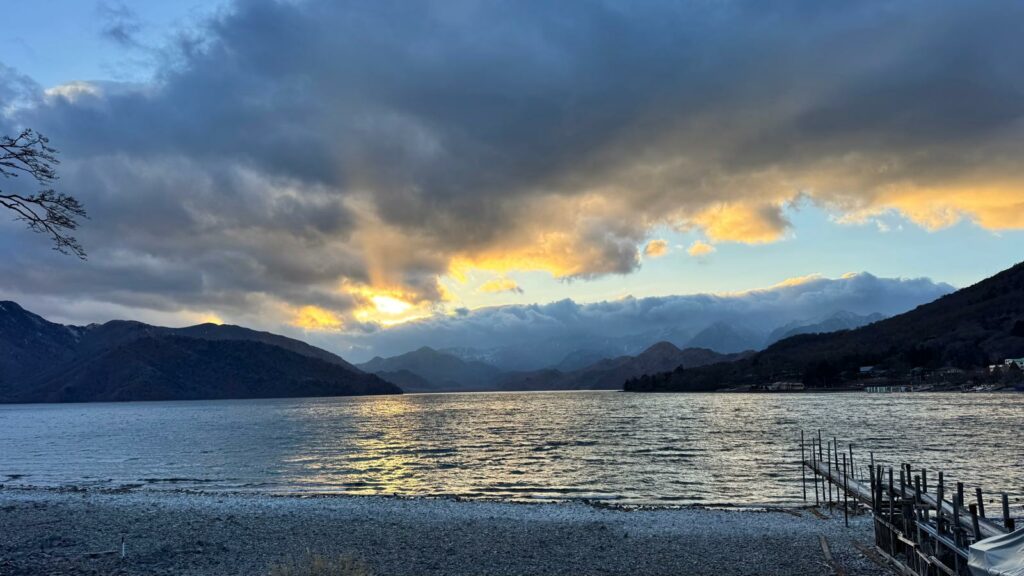
    We left Kyoto by car to go North. The first evening we stayed at a hotel with a sublime view of the lake and went for a nice easy, flat, walk the next day. Before our arrival we decided to drive up the coastal road which turned out to be more cliff-like and rockier than we had imagined. Roland suggested it was like driving in Corsica until a family of red-faced macaques crossed the road. More monkeys that didn’t like having their photos taken, so you’ll have to take my word for it.
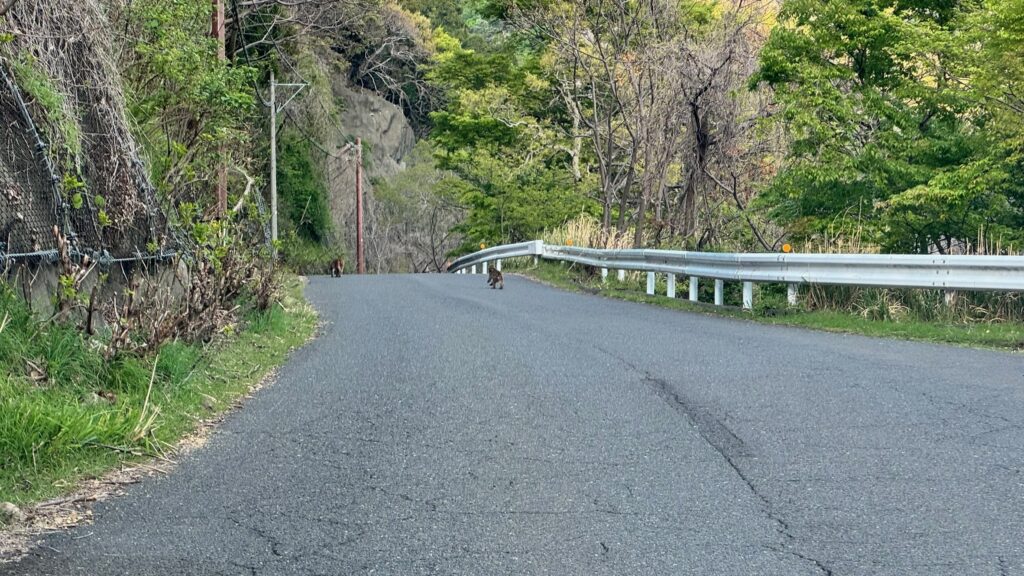
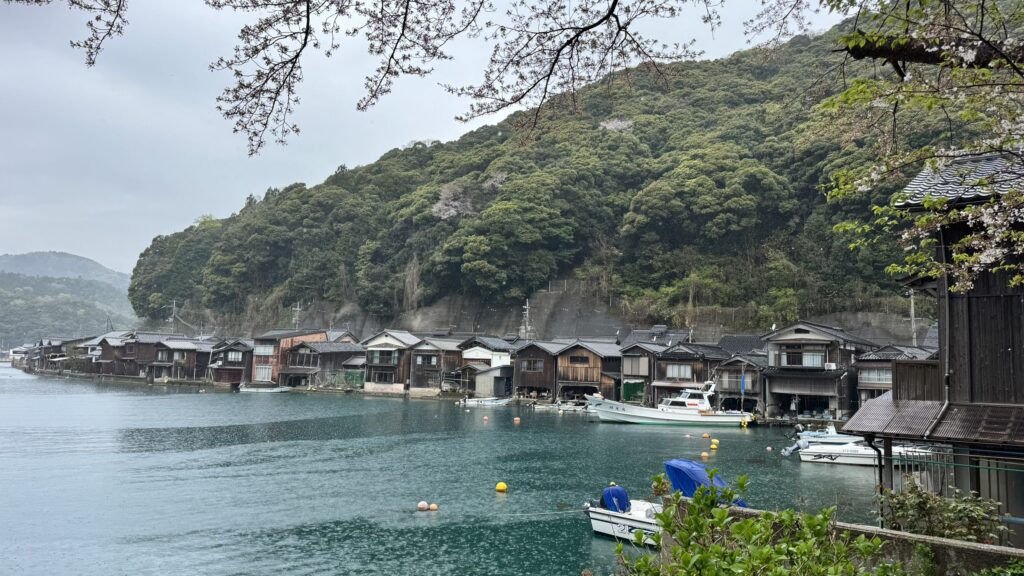
    Not like Corsica at all. We explored the coast over the next few days, which included a sunny picnic on a beach, full of debris, where an old woman literally appeared out of nowhere to collect a parking due, as well as a visit to Ine, a pretty, picturesque village under a deluge.
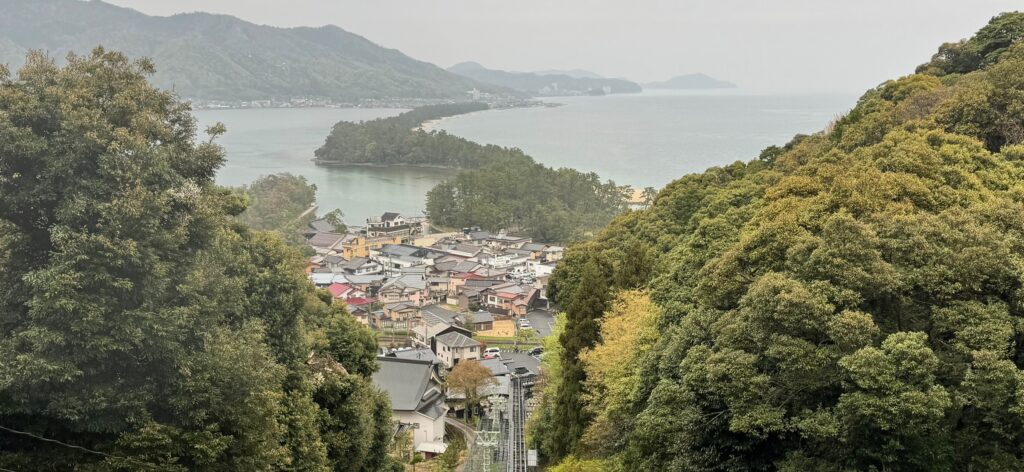
    I chose to visit Amanoshidate, because it was listed as one of the three scenic sites in Japan. For someone who was having (a claustrophobic-inducing) difficulty with the crowds in Kyoto, this could be listed as a monumental casting error. Luckily the monorail only lasted 7 minutes. The views were worth it, as was the sight of the sandy passage that creates a bridge across the estuary where we walked at the end of the afternoon, the previous evening.
    Our collision with fierce rain confirmed that umbrellas are a national treasured habit. We saw small children going to school in wellies with umbrellas, just as we saw bigger ones in clusters, in school uniform, no coats, just umbrellas.
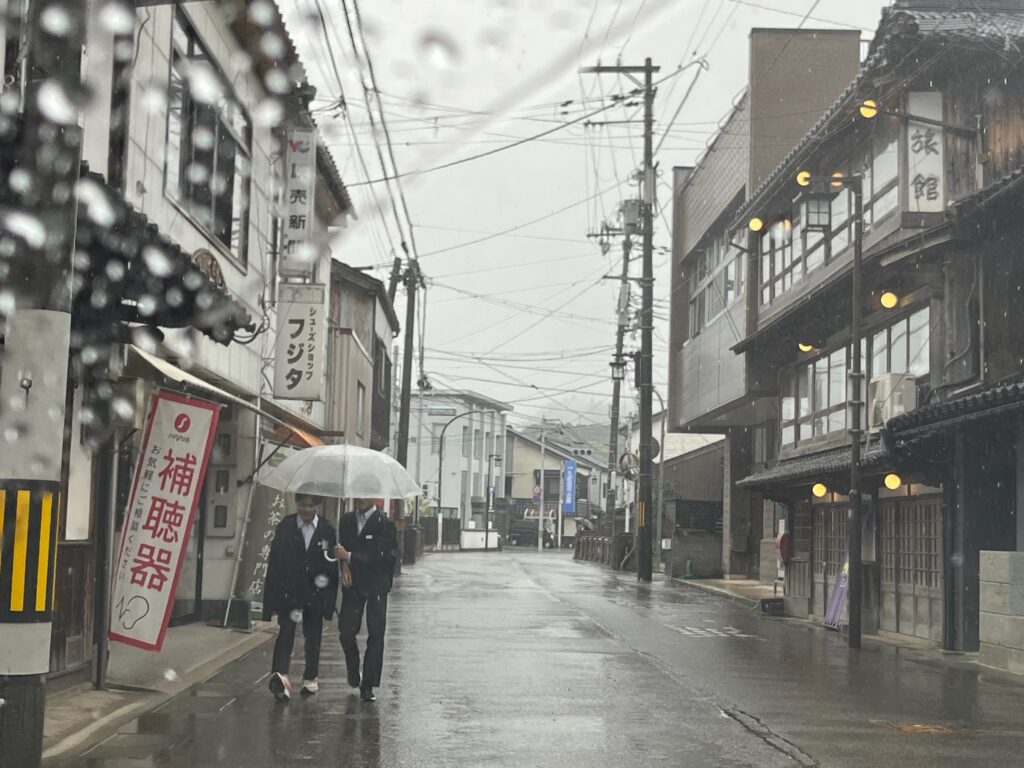
    Needless to say umbrellas are also used, mostly, but not exclusively, by women as soon as the sun comes out. I infer protecting oneself from the sun is important in Japan. I am not poking fun at the Japanese, although it might sound as if I am. Everything in Japan was exotic and surprising. I cannot begin to understand how life works, but I was struck by the imposition of societal order and a strong sense of entrenched and coded hierarchy.

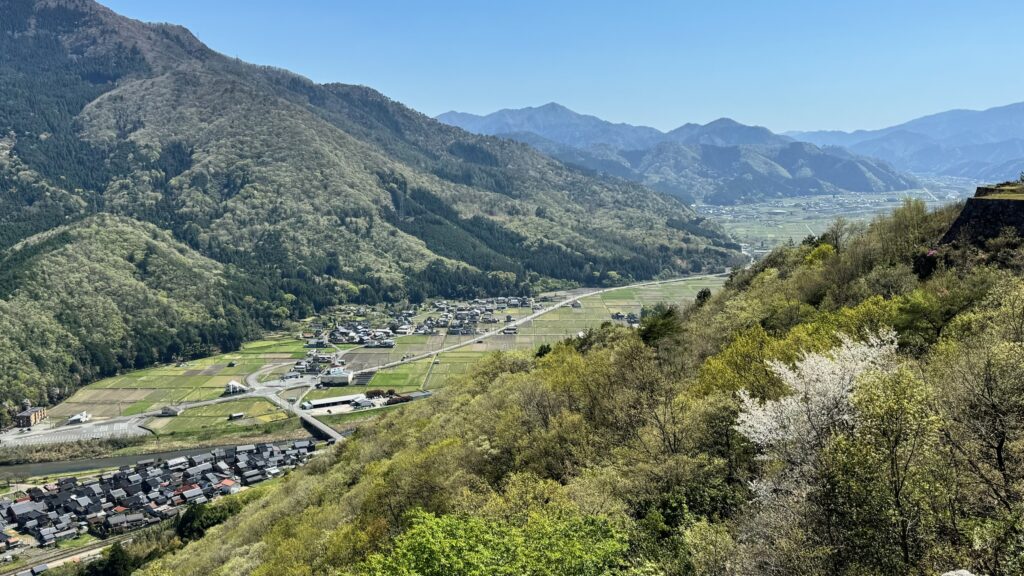
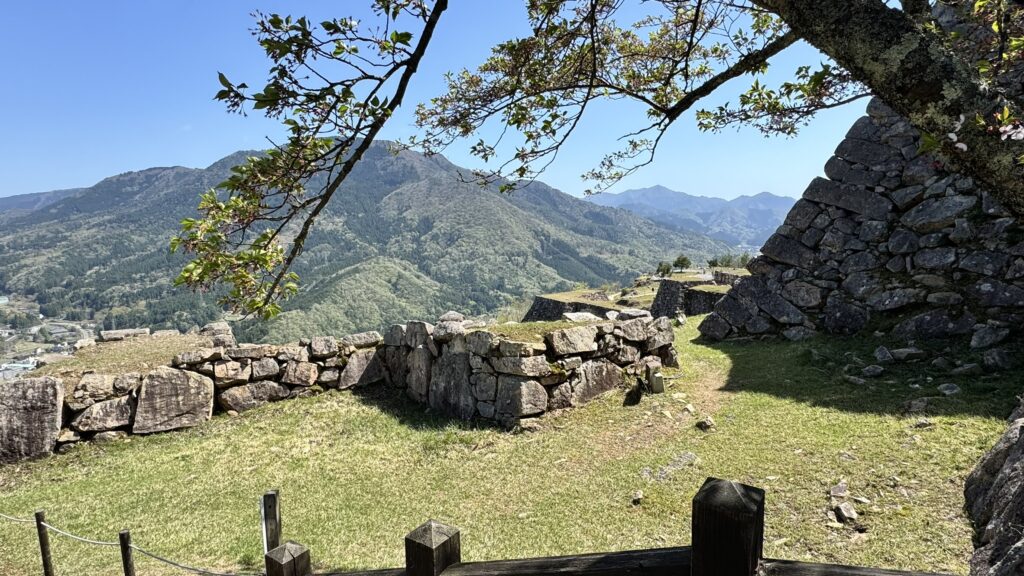
    Visiting the ruins of a castle at Takeda was another sunny memorable event. We walked up and down to the massive stone remains of the moat and castle walls and walking round the ruins in the right direction of course, along with signs telling us to be careful of slippery stones, enabled us to get some good views of our surroundings.
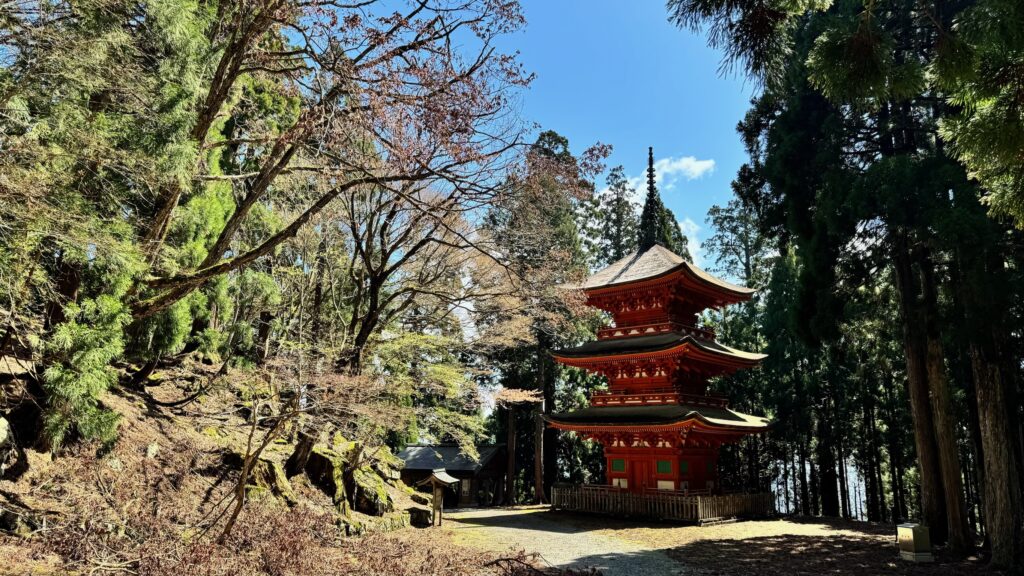
    One of our most breathtaking temple experiences was not the Temple of Enryakuji on Mount Hiei, the birthplace of the Tendai sect, but a tiny little temple, newly renovated, one part red, the other orange.
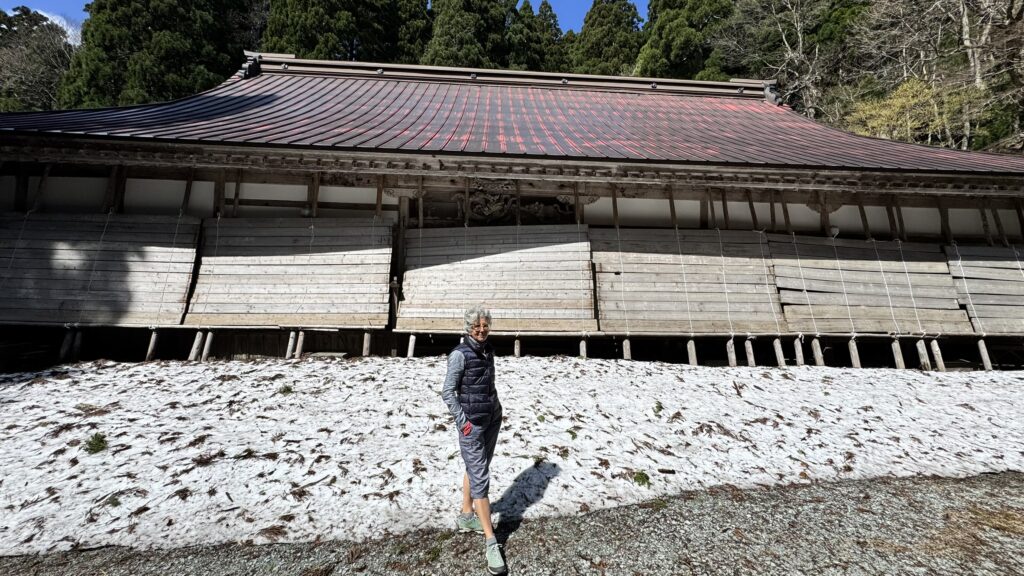
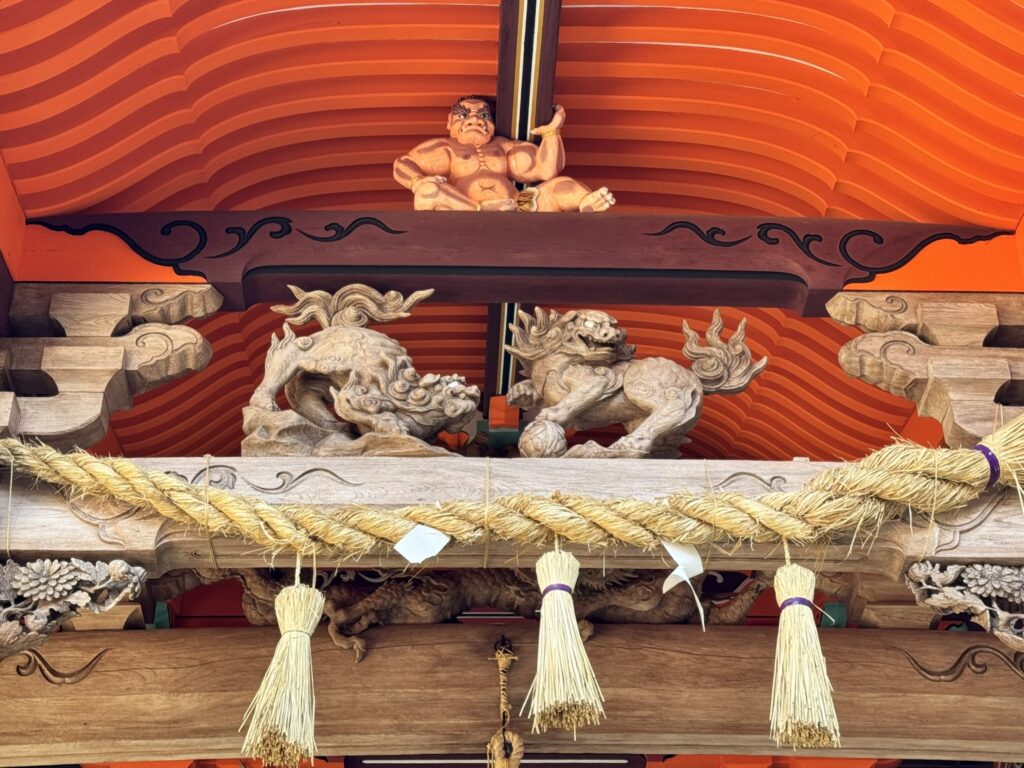
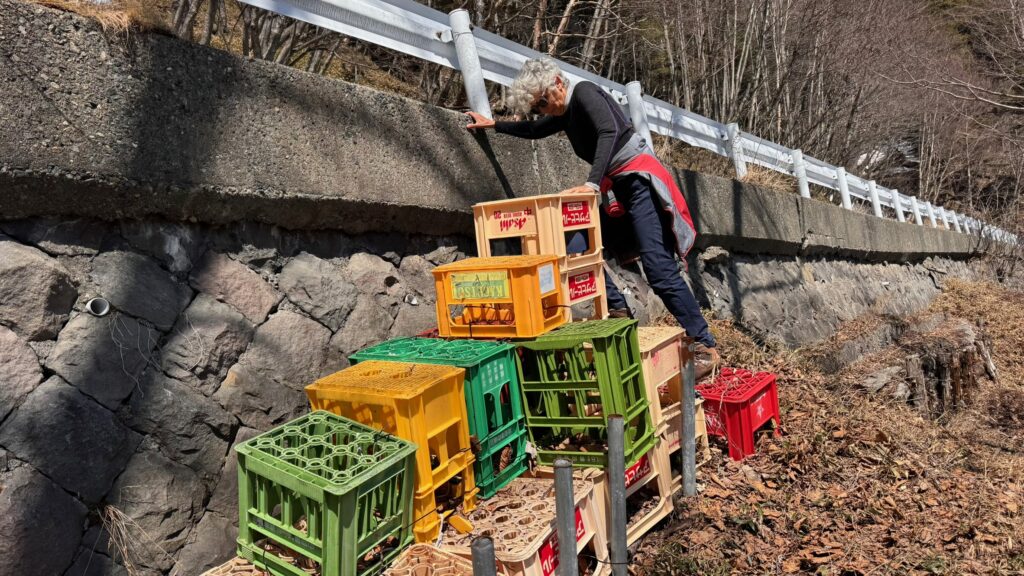
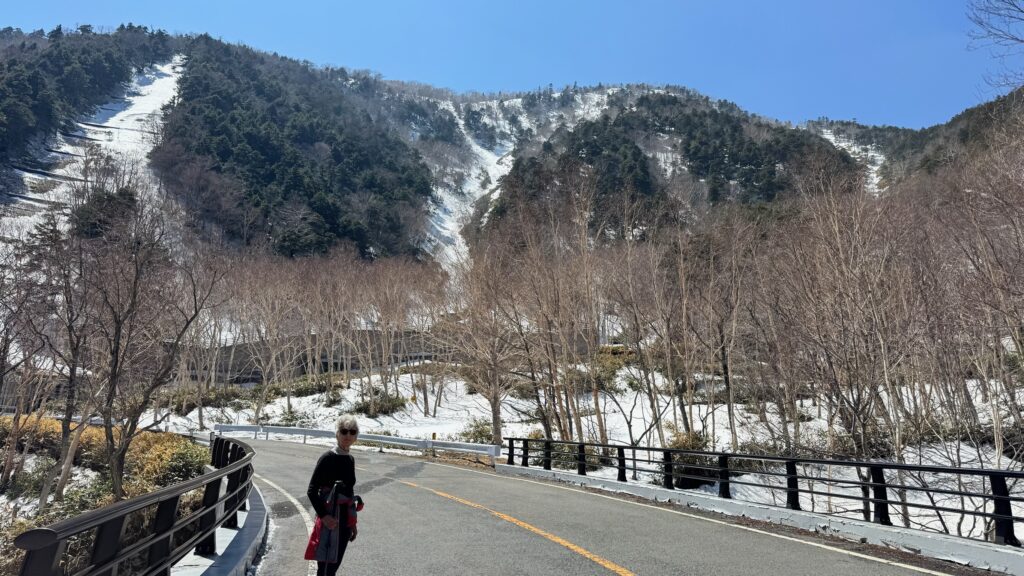
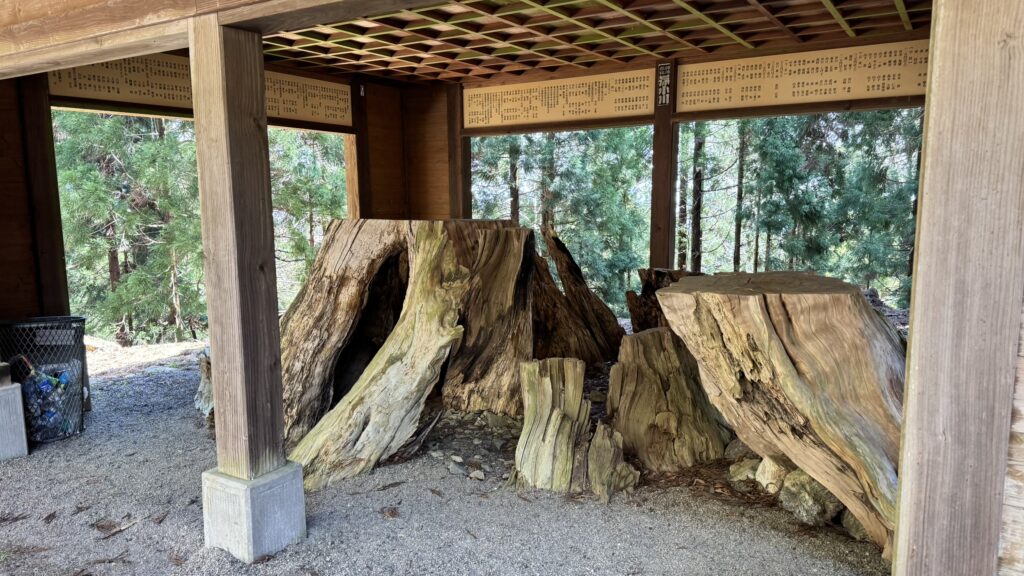
    This visit is memorable for numerous reasons: the journey to get there was an epic winding drive up a narrow mountain road which had suffered heavy rainfall, falling branches and displaced stones the day beforehand. There was no one there. We were in the sunshine with snowy remains and there was the stump of a 1500 year-old cedar (the Myoken cedar) carefully preserved in its own little hut.
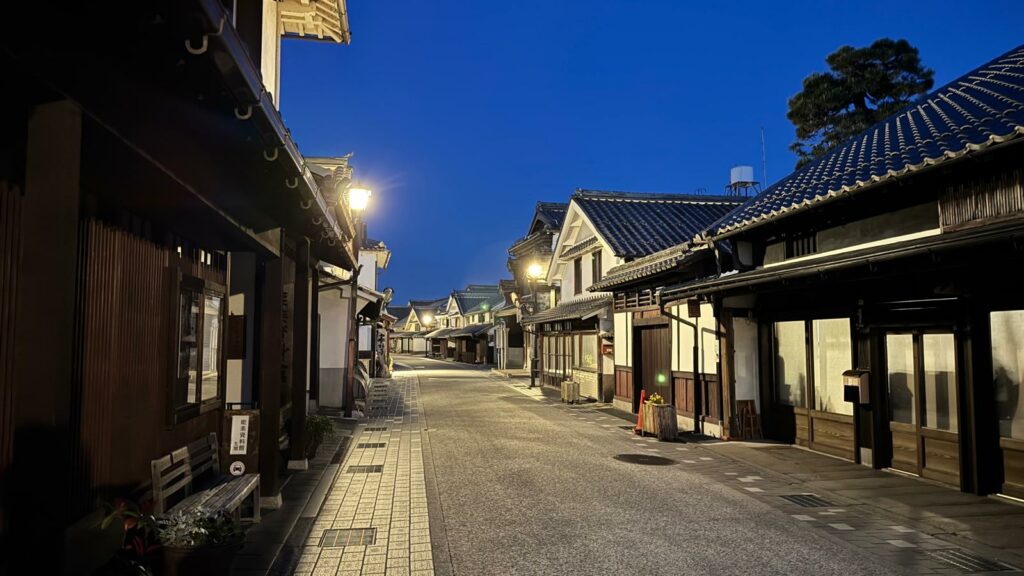
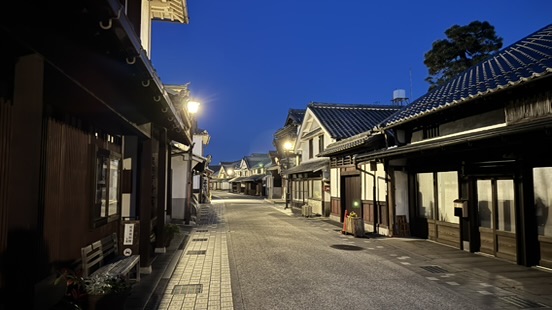
    Our short journey ended in Sassayama, which turned out to contain some pretty traditional streets and not too many people. The people were friendlier in the daytime than the evening where we found it impossible to find somewhere to eat, even at 19h.
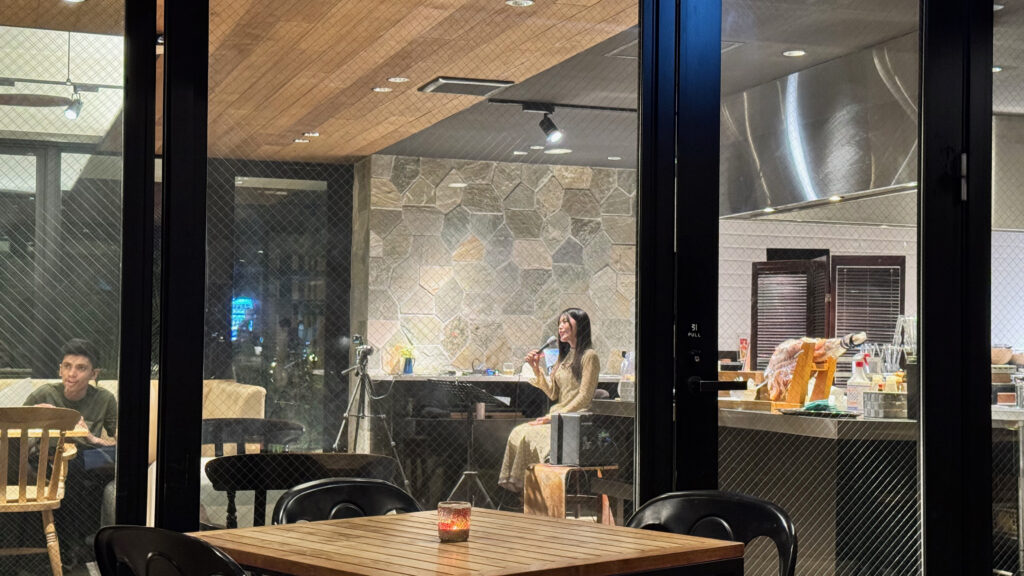
    The blur rolls into our return to Kyoto, giving the rented car back and staying in a central modern stylish hotel, where we listened to a crooning jazz singer over a sake, though I couldn’t understand the words, some of which were definitely meant to be in English.
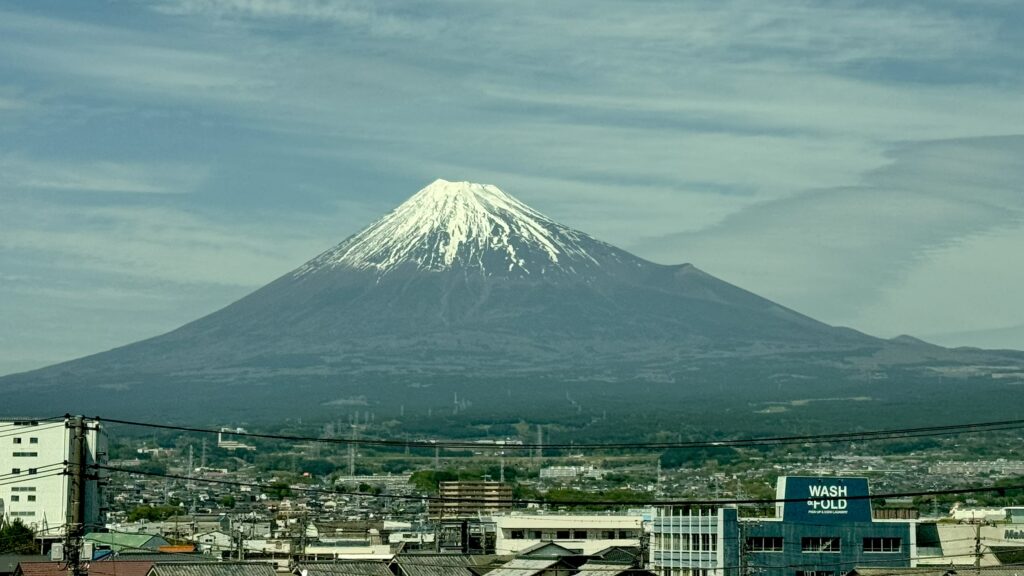
    Then the very fast train to Tokyo, from which we caught sight of Mount Fuji, as Roland has already shown.
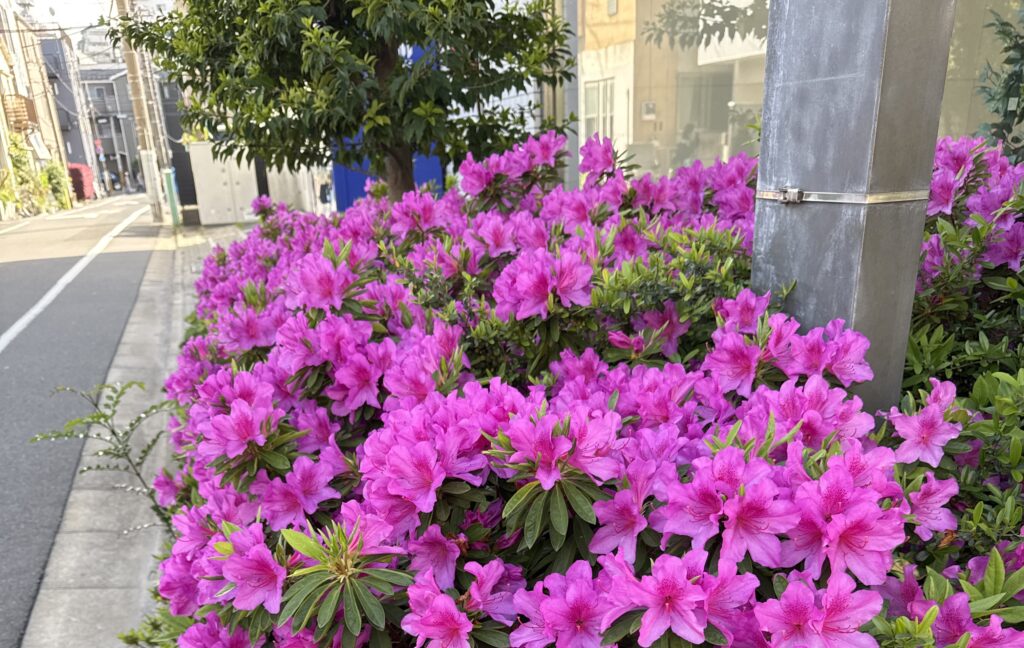
    We spent our last few days wandering and covering considerable distances in Tokyo. We stayed in a very hip hotel, thanks to Judy and Itsik, in the Nezu area. We liked the neighborhood a lot, and found many others which were not too populated, by the canal, or around the the museum of contemporary art, where the Tokyo we saw and walked through, did not correspond to my sky scraper, overly dense, expectations.
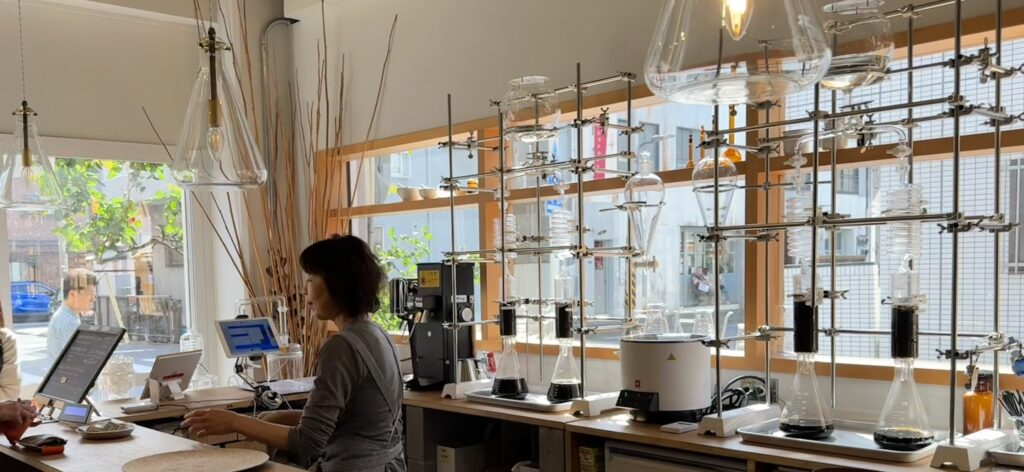
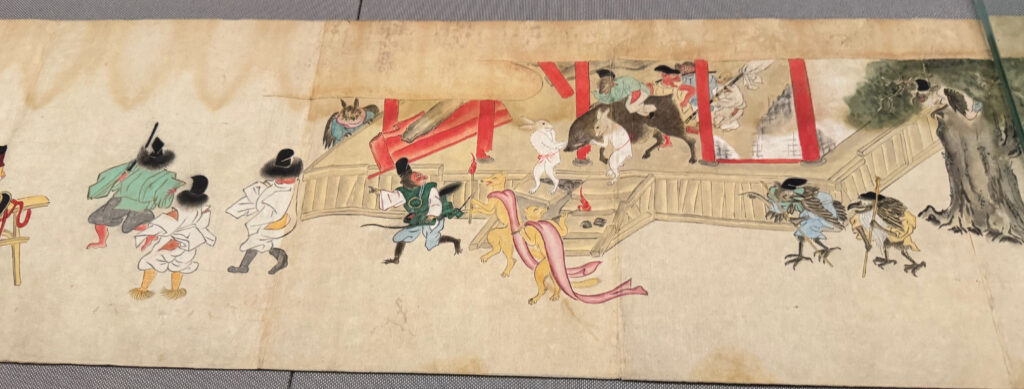
    Visiting the National Museum of Tokyo, a short walk from the hotel, made me realise how our journey had found its end. Looking at the statues of Buddha and relics from earlier eras (before the 6th c), reminded me of our first museum visit in Bangkok, where we also saw many statures of Buddha. They were not the same kind of statues but created a sense of coming full circle.
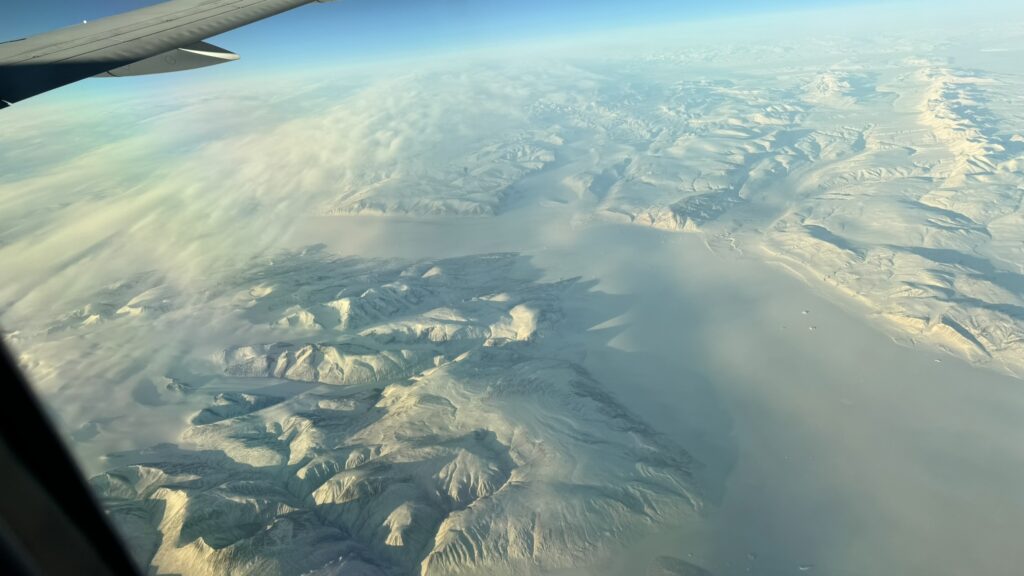
    On that note, also on the longest of our plane journeys so far, which may not be conducive to the most acute mental clarity, I bring my narrative to an end.
  • Voyage – Acte 3 : 3 semaines découverte au Japon dans les régions de Tochigi et Hyogo

    Prendre ses repères était le leitmotiv de la première semaine, observer et analyser celui des deux suivantes.

    Il serait vain de prétendre synthétiser un pays et ses habitants après seulement quelques semaines de tourisme. Tout ce que l’on croit voir ou comprendre est pipé, partial voire hallucinatoire. Il y a déjà trop de Japon pour les nuls. L’idée est donc de raconter ce qu’on croit comprendre, autrement dit peu de choses, les jeter ici brut de décoffrage, avouer son ignorance et assumer ses quiproquos. 

    J’aurais aimé pénétrer dans la contre culture des plus jeunes, mais en retraité moyen, je n’ai croisé et interagi qu’avec des vieux. Donc ma vision est sans doute bien éloignée des enjeux culturels contemporains et se réfère probablement à la culture d’un temps déjà révolu.

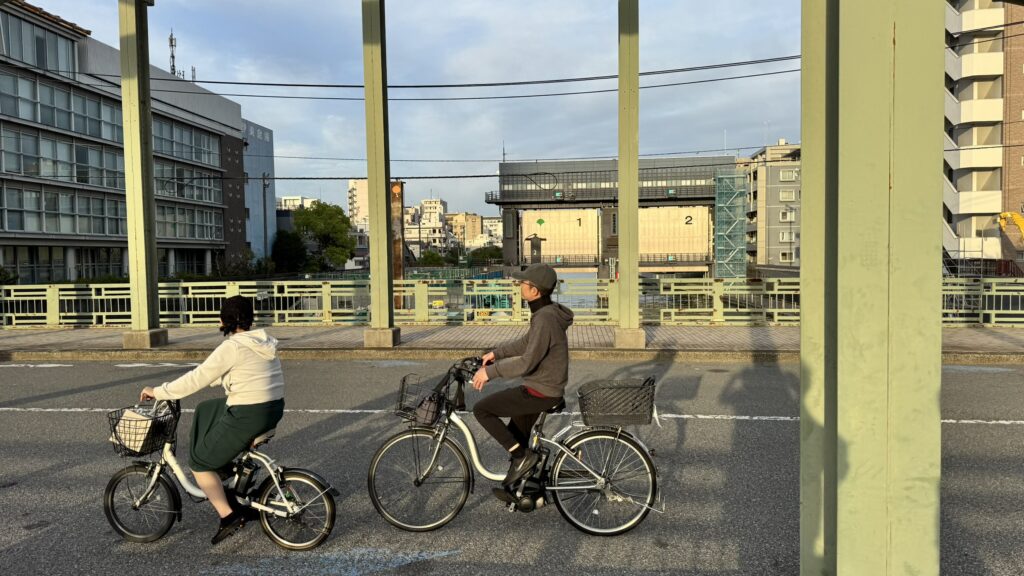
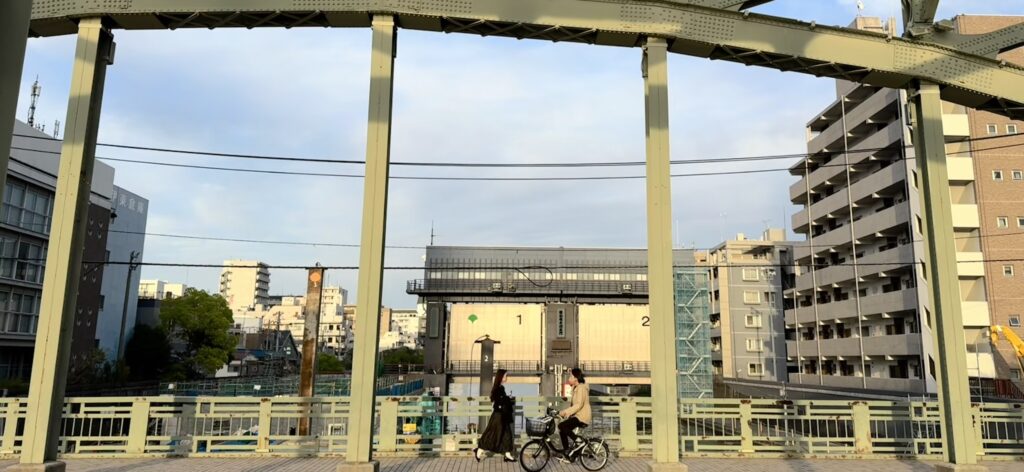
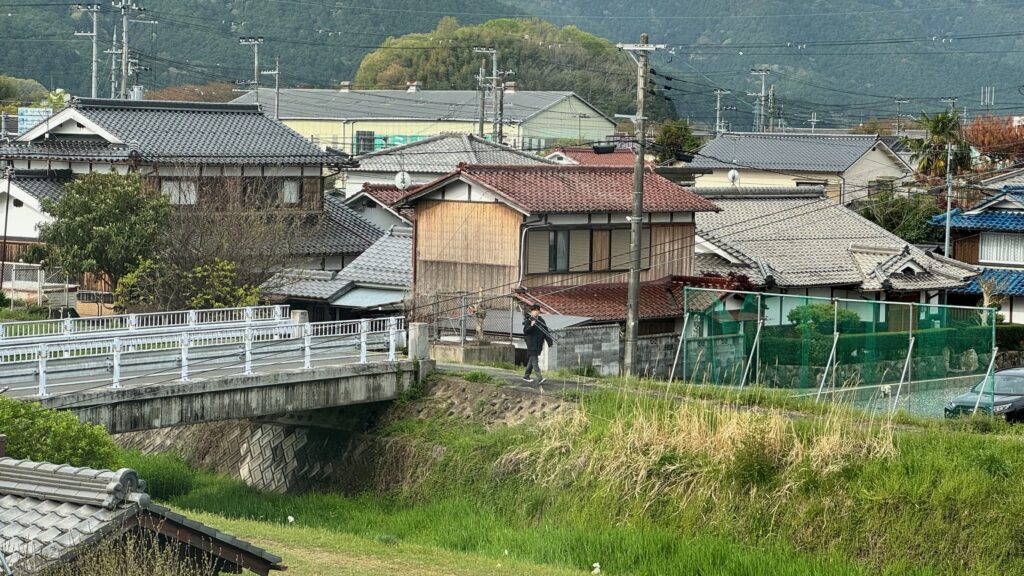
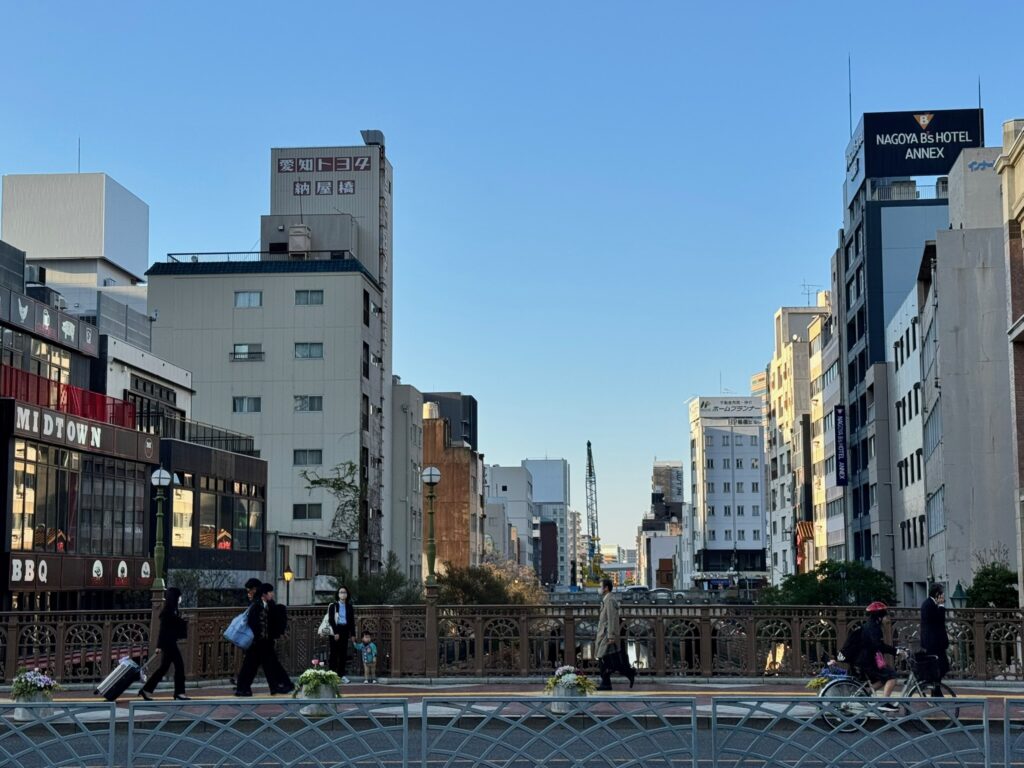
    Pont sur la rivière Hori- Kawa à Nagoya

    Après une nuit dans un Boeing 787 bruyant de la compagnie japonaise ANA, coincé entre le couloir et une grande jeune femme blonde australienne qui avait tendance à s’étaler de mon côté plutôt que de celui de son compagnon, l’arrivée à Tokyo Narita fût brumeuse et tendue, de passer des largeurs australiennes au compactage japonais. 

    La surcharge et la technicité des dispositifs et des services se sont montrées d’emblée assez fascinantes. A part l’écriture et la langue,toujours aussi cryptique après 3 semaines, il est vrai que nous avons fait peu d’efforts pour apprendre davantage que les quelques locutions minimales, je n’ai pas été en terra incognita. Au contraire j’ai trop vite perçu des structures, contraintes, tensions ou biais, sur lesquelles je ne m’attarderai pas davantage, préférant inscrire sur ces pages les bonnes surprises, découvertes et étonnements, de découvrir ce que je ne connaissais que par les ouïe dires d’amis, la littérature, le cinéma et les créations industrielles.

    Chaque action routinière, comme prendre le train, tirer de l’argent, acheter à manger, commander au restaurant, utiliser les toilettes, louer une voiture, conduire, randonner, chercher un logement…etc. demande ici de reconsidérer des apprentissages de base et souvent changer de paradigme. Par exemple conduire : les panneaux de circulation, les marquages au sol, les règles de conduites diffèrent assez radicalement d’autres pays, mais dans l’ensemble, c’est mieux ici. Tout est plus précis, plus complexe, plus régulé, même si notamment les limites de vitesse, souvent drastiques, sont rarement respectés par la plupart des japonais (80 km/h sur les autoroutes à 4 voies). Paradoxalement, on rencontre aussi de nombreuses incohérences, peut-être apparentes comme de longs tronçons de grande route de campagne limités à 50 km/h avec une grosse ligne jaune interdisant tout le temps les dépassements et aucune limite sur les petites routes de montagne ou des lignes pointillées en agglomérations, probablement pour permettre aux voitures sortant des maisons ou parkings quasiment ininterrompus sur le bord de certaines routes de traverser la chaussée pour sortir de chez-eux. Selon Pascal, Bertrand Russell et Pierre Dac (enfin réunis), toute logique a ses raisons que la raison ne connaît point, et vice et versa dans le désordre. Plus sérieusement, une forme de perfectionnisme accentué touchant l’urbanisme, les objets et la société, semble vouloir résoudre définitivement davantage ici qu’ailleurs les dilemmes humains. La culture japonaise semble accorder une foi résignée, à l’organisation technique, la spécification fonctionnelle et l’optimisation sociale, comme conditions sine qua non de la survie et ciment social. Plus qu’ailleurs l’individuation des artefacts confère à chaque objet sa fonction et sa place assignée. Comme l’espace est compté, il importe de l’optimiser, autrement dit de le réserver à l’essentiel, d’où une esthétique minimaliste à l’opposé des américains, John Cage en tête, orientalistes qui s’inspirent du zen en réaction à la surcharge occidentale. Ici c’est plutôt la forme première du minimalisme qui caractérise le style japonais, comme économie fonctionnelle épurée agrémentée d’un superflu effacé allant de l’élégance au conformisme. La musique de Toru Takemitsu en est pour moi une illustration, constant jeu d’équilibre instable et subtil entre invention et classicisme, naturalisme et constructivisme, dissonance et harmonie.

    Depuis le train entre l’aéroport et la ville de Narita le paysage typique japonais s’étale sous nos yeux. Rizières, bosquets de bambous géants, poteau de fils électriques, mini voitures cubiformes et bien-sûr en ce début avril les cerisiers roses en fleurs. Nous avons passé une nuit dans un petit hotel du quartier de Shinmachi, une petite plaine grisâtre de pavillons en contrebas de la voie ferrée, où j’ai dormi 8 heures d’affilée sur les meilleurs matelas et oreiller du monde. 

    La ville de Narita est assez renommée pour ses temples mastocs et leurs magnifiques jardins, mais les touristes y sont principalement asiatiques et religieux, puisque chaque temple voue une dévotion particulière à tel ou tel personnage du récit bouddhiste. Après la visite sous la pluie, nous avons déjeuné dans un délicieux petit restaurants plein de goûts subtils et d’une extrême propreté 和食 鴨川家. 

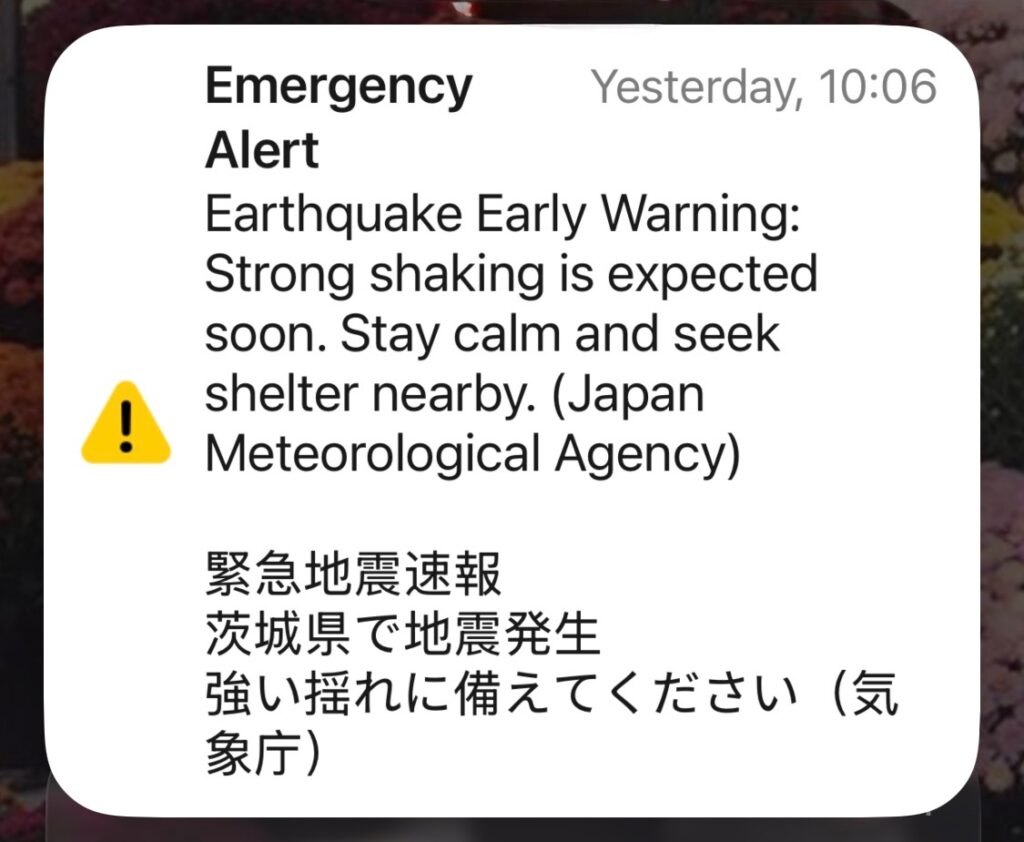
    Le lendemain nous prenions le train pour Nikko sous la pluie. Près quelques minutes à bord, nos téléphones se mettent à sonner en même temps que tous les autres nous annonçant un tremblement de terre imminent. Les autres passagers du train ne bronchent pas. Le train reste quelques minutes en gare et repart comme si de rien n’était. Était-ce un test, une alerte régulière ? Comment savoir ? La correspondance à la gare de Tokyo Kitasenju a été assez folklorique sportive même, étant donnée la complexité du système ferroviaire où chaque train semble appartenir à une marque différente, où les billets des différents trains sont vendus à différents endroits et il faut en plus réserver une place en allant au bout d’un seul quai en suivant un cheminement marqué au sol à travers la gare, où l’affichage des départs est tellement compact qu’il faut décoder chaque signe, où certains trains ne sont pas affichés sur les mêmes panneaux que les autres, où certains quais sont divisées en plusieurs sections d’où partent des trains différents, où enfin l’emplacement portant le numéro des voitures n’est pas le même selon la marque du train. Imaginez donc deux jeunes français retraités et échevelés courant avec valises et sacs à dos dans tous les sens d’un quai à l’autre, d’un escalier à l’autre comme des poules sans tête. Finalement on s’assoit dans le train qui part dans la bonne direction. 

    Après trois  semaines au Japon, il y aurait beaucoup trop de choses à raconter et à exprimer pour cette seule page de blog. Pour les autres pays visités au cours de ce voyage c’était déjà difficile mais pour le Japon, c’est complètement impossible.

    Toute mes “découvertes” / impressions ressenties depuis ma fenêtre naïve de touriste sont déjà sur-référencés par des fondements culturels ancestraux et des évidences culturelles. Comme un touriste japonais découvrant la symétrie des jardins à la française ou que la langue française ressemble à l’italien, l’espagnol, le roumain et le portugais. Par exemple la question du paysage. Augustin Berque (mésologue et fin analyste de la culture japonaise), voit le paysage au Japon comme un environnement immersif dynamique vécu en communion de l’intérieur (Fukkei : vent et lumière) et non un tableau éloigné et fixé qu’on admire. Même si l’argument ne convainc pas, les images ne peuvent traduire l’immersion. Il faut y être, venir et en faire l’expérience. 

    Le paysage est un art, le Sansui (littéralement montagne et eau) et fait donc l’objet d’une fabrication ou d’un arrangement. Inspiré du Taoïsme chinois, dès le XIème siècle, le Shakuteiki, premier manuel de jardinage au monde, l’art de construire les jardins, codifie l’art de disposer les pierres et l’eau pour recréer l’univers en miniature. Ces jardins sont surtout, comme on pourrait s’en douter, ceux des palais et des temples, autrement-dit des lieux de pouvoir emprunts de religiosité et de poésie, malgré leur vocation à contrôler les masse, faire la guerre et rassembler les richesses. Le jardinier dessine le premier plan pour l’accorder au fond, c’est à dire généralement aux collines et aux montagnes. Le temple, les palais et les jardins arrangent la nature pour resembler au monde divin. Les Pagodes à 5 étages ne sont pas habitables par des humains, mais seulement par des dieux. Les montagnes autour des temples, notamment à Kyoto sont donc protégées car elles font partie du monde/paysage du palais ou du temple. Le paysage est tellement bien designé, que tous les points de vues sont sublimes, mais quel que soit la météo, la position la profondeur du regard, tout ce qu’on voit, qu’on entend, ressent en fait partie (Shakkei qui inclue la terre entière et Wabi-Sabi qui inclue toute perfection comme imperfection). Aucun sentier de montagne ne doit être visible depuis les palais ou les temples, autrement dit, on ne trouve presque jamais de point de vue ou de vue dégagés, les chemins de montagne sont dans la forêt et les quelques potentiels vues sont barrées. La cause en est,  pour le coup, plus probablement la raison commerciale et le tourisme qui comme ailleurs nourrit les temples.

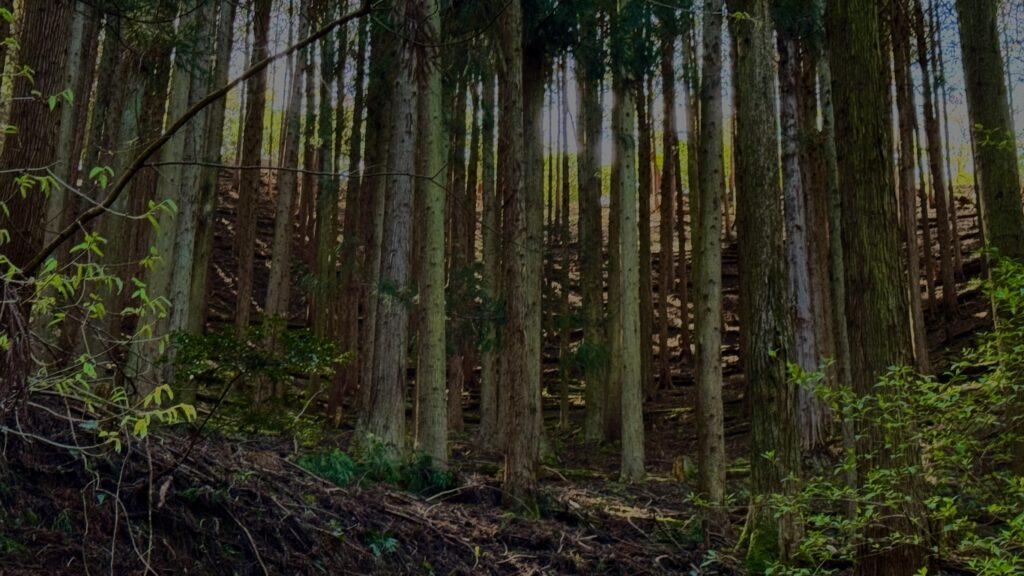
    Les plaines sont donc densément construites, urbanisées au  millimètre, ou sinon cultivées, le plus souvent par les rizières, alors que les reliefs sont laissés à l’état sauvage, à la forêt, en partie exploitée mais peu entretenue, aux ours, aux singes, aux serpents et aux morts. Le monde de Yama; la montagne qui est aussi le nom des démons Bouddhistes, celui de la peur et de la mort, Okuyama la montagne profonde et intérieure, soit 80% du territoire du Japon, lieu ressource d’où tout provient, terre, pierre, eau, bois, oxygène et là où l’on se ressource dans les très nombreux temples qui la bordent  ou l’habitent.

    Tradition et modernité. Comme ailleurs la tradition se perd dans la raison imaginaire, les arbitraires religieux, la poésie et l’art, alors que la modernité pragmatique et réglée comme une partition mécanique régule l’activité profane du plus grand nombre. Les hotels ultra modernes en ville désignés pour qu’aucun cm2 ne soit perdu, où 50 chambres sont gérés par deux personnes et une armée de personnel de ménage, où l’on dine des soupes en sachet déshydratés, sont à l’extrême opposé des ryokans ou auberges traditionnelles, où l’on déguste en kimono des dizaines de états plats au diner comme au petit déjeuner, servis à table, pendant qu’une personne vient dans la chambre installer les futons sur les tatamis à la place de la table basse en bois laqué. Certes le public n’est pas le même, dans le premier cas des jeunes professionnels en déplacement, dans le deuxième des couples japonais plus très jeunes et en voiture.

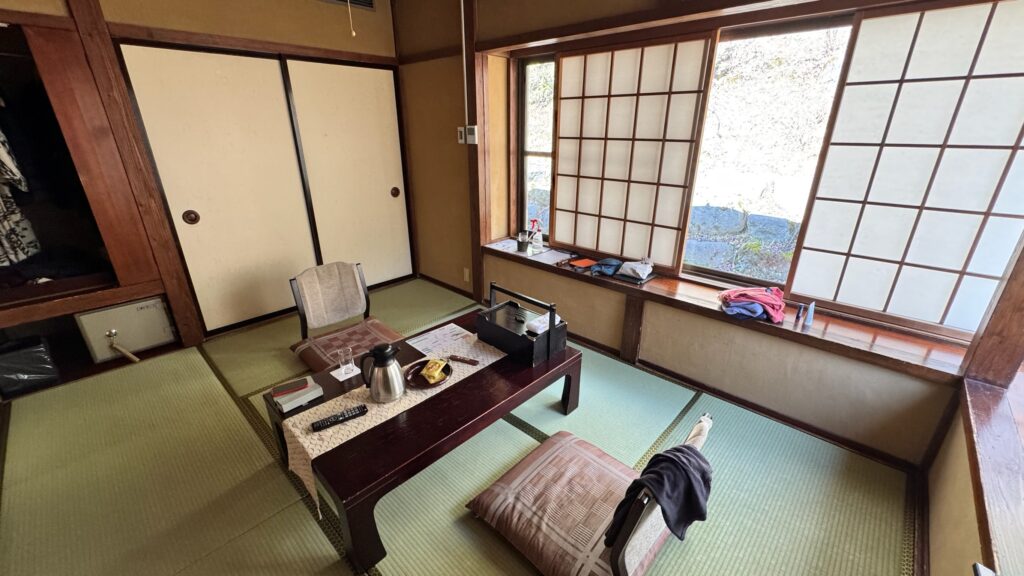
    Panneaux coulissants multiples : portes, fenêtres jusqu’à 5 épaisseurs : volet, moustiquaire, vitre, shōji (cadre à carreaux de papier pour filtrer la lumière du jour) et souvent un rideau intérieur sur tringle. Les portes intérieures et murs coulissants (fusuma) qui permettent de transformer en quelques secondes une grande pièce en plusieurs petites ou créer des configuration adaptables de l’espace pour chaque usage.

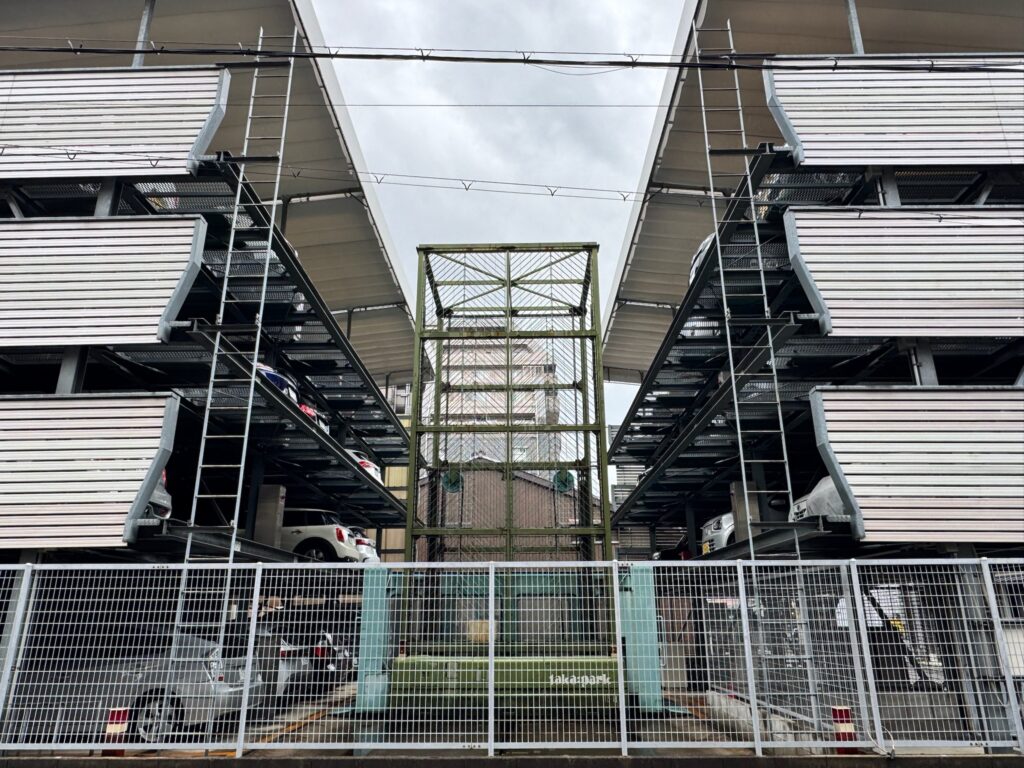
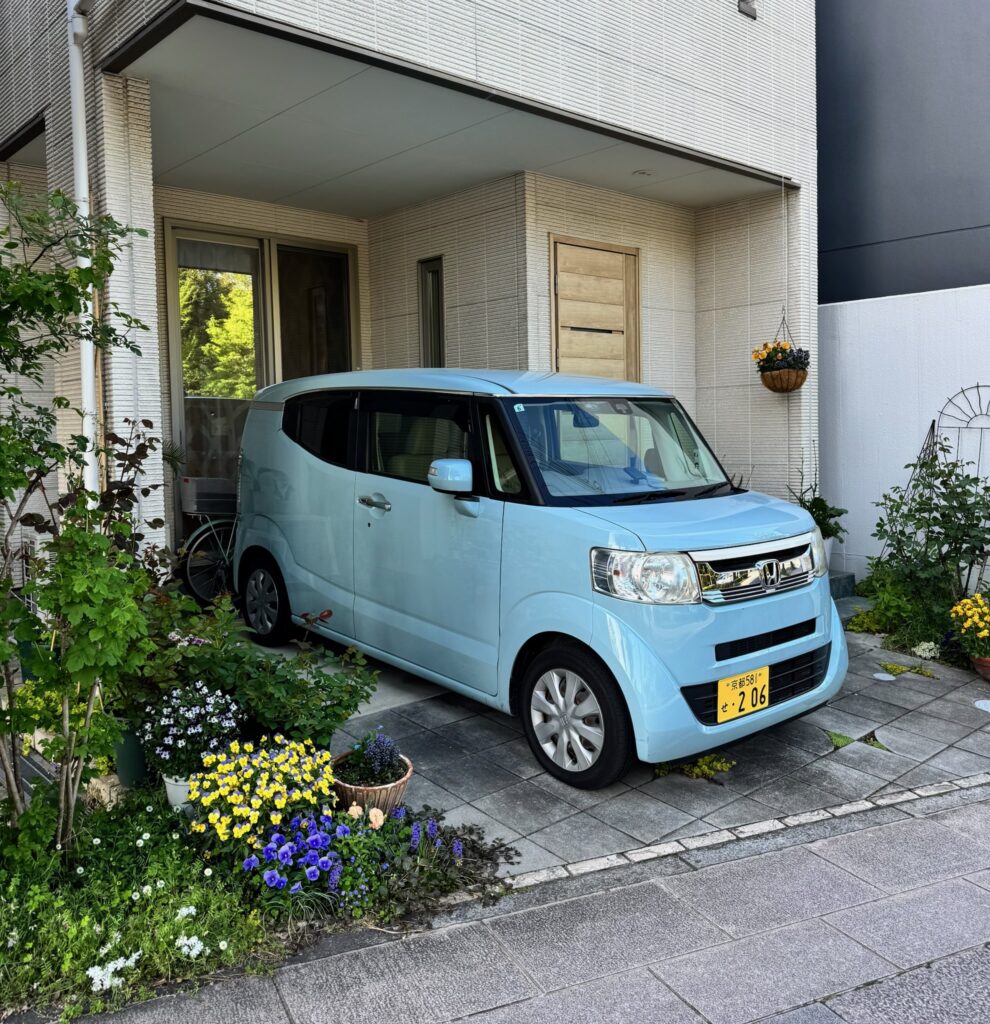
    Les mini voitures Kei cars et leurs demis garages qui peuvent se garer devant des mini maisons de ville notamment à Kyoto.

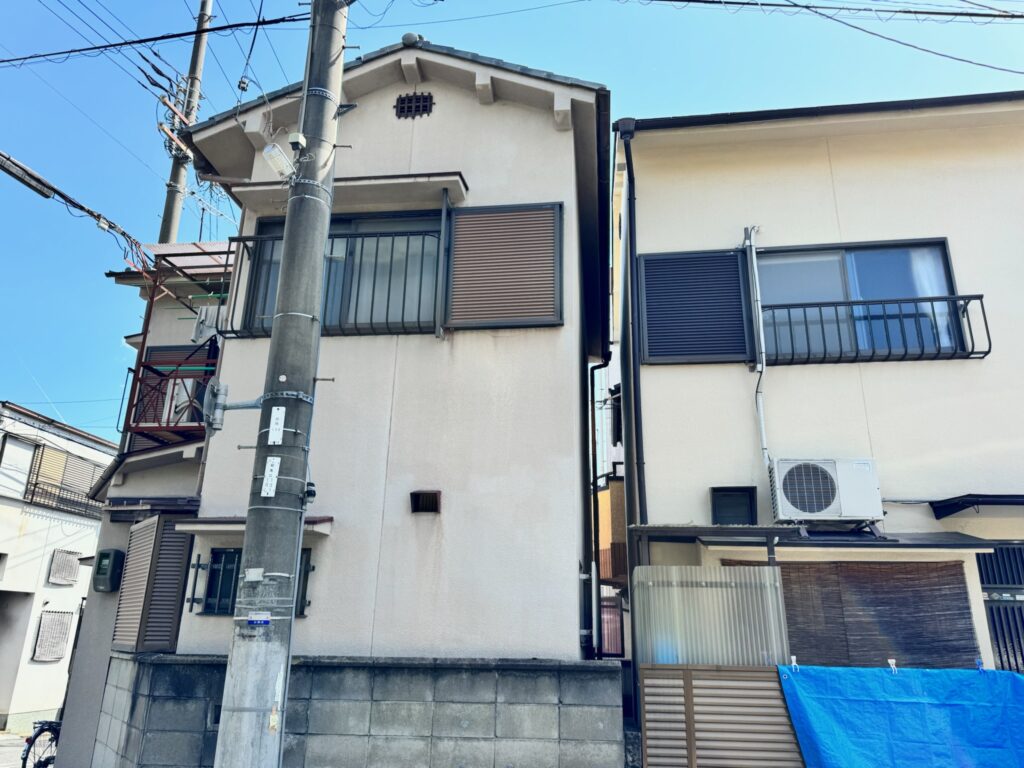
    Comme les personnes, les maisons japonaises ne se touchent pas. Un espace entre chacune quelquefois seulement de quelques centimètres protège historiquement de la propagation des incendies, aide à la ventilation et apporte un peu de lumière naturelle, répond aux normes antisismiques et permet de passage des réseaux, mais surtout manifeste le respect envers l’espace d’autrui. Chaque activité à son uniforme.

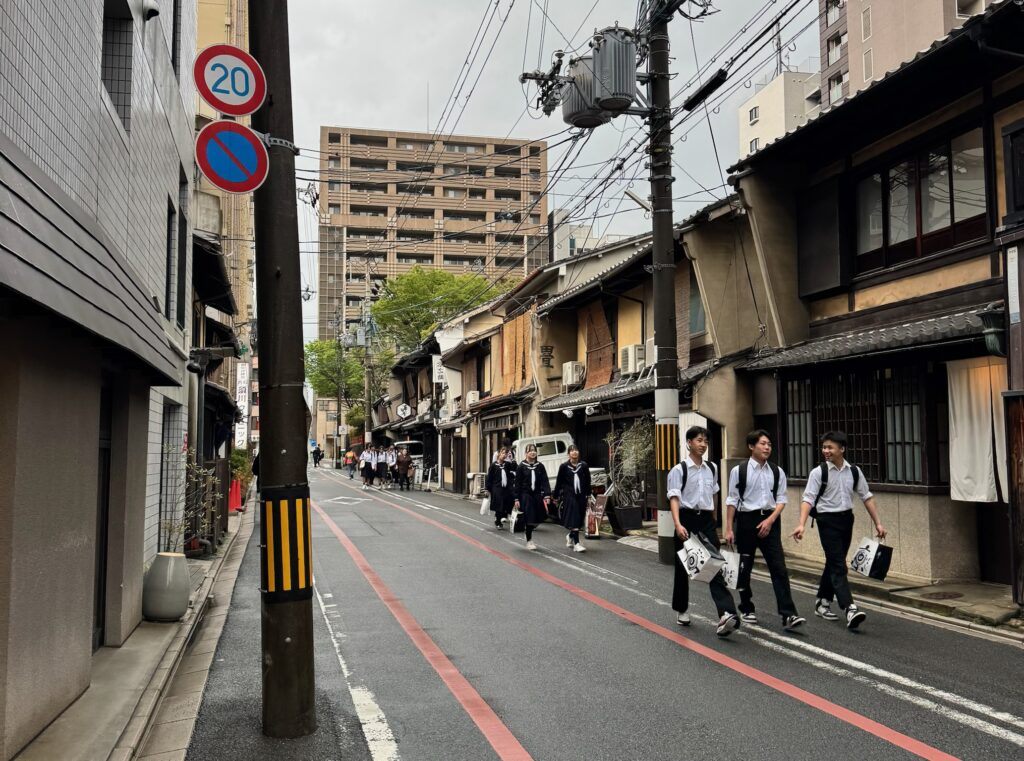
    Le respect est aussi ici celui de l’ordre et de la règle. On ne traverse pas en dehors des clous et seulement quand le petit bonhomme passe au vert. On se met en file indienne à l’arrêt de bus ou devant les portes du train ou du métro. L’effet sur l’efficience des transport est phénoménal. L’arrêt aux stations dure moins d’une minute. Les transports en commun sont très nombreux, fréquents, rapides et super efficients. Le Shinkansen fonctionne comme un métro à 300kmh. On se met en file indienne sur la marque de la bonne voiture du quai pour l’attendre, il arrive, les portes palière s’ouvrent, les passagers descendent, on monte, on s’installe, le train repart, ça n’a pas duré plus qu’une minute, il atteint sa vitesse de croisière en sortant de la gare et la conserve jusqu’au prochain arrêt.  

    Ce qui nous amène à l’hygiène qui est ici un sujet sensible et fondamental. Ne parlons pas des toilettes trop déjà-vus, mais d’une propreté qui dépasse des corps, des intérieurs, de la ville et de la campagne.  C’est un peu comme la Suisse de l’Asie ; la Suisse et le Japon ont beaucoup de choses en commun, les montagnes, l’argent… Prenons l’exemple des masques. Pourquoi donc tant de japonais et surtout de japonaises plus encore qu’en Thaïlande portent-iels des masques, dans les transports en commun, seuls dans leur voiture, en vélo, lorsqu’ils marchent en plein air y compris à la montagne ? Les arguments courants sont que le Covid est encore là, que les masques sont une tradition quand on se sent malade, à cause du rhume des foins, mais ni Ruth ni moi n’arrivons à y croire. Pourquoi les femmes et surtout les personnes ayant des positions sociales et professionnelles subalternes ? Serveuses, gardiens, employés de services. Pourquoi dans les couples l’homme n’en porte pas alors que la femme en porte ? On ne peut s’empêcher de penser au voile islamique, à l’idée de se protéger des regards ou de s’effacer symboliquement.

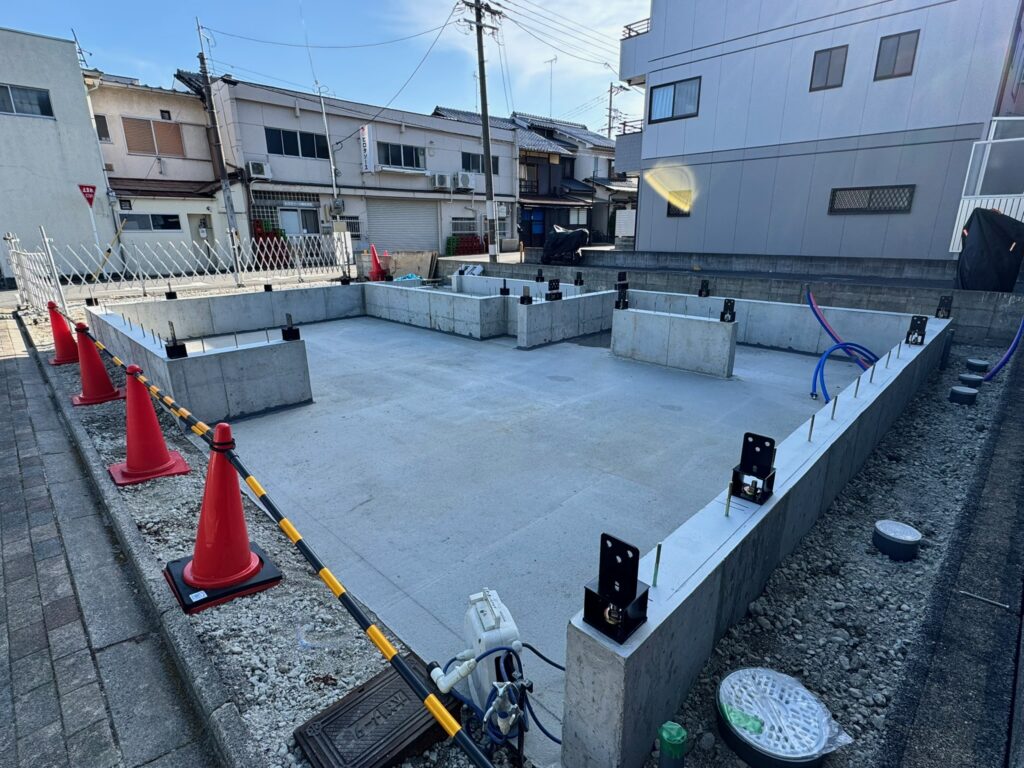
    Mais la propreté et l’ordre, ce sont aussi les chantiers, absolument nickels, rien ne dépasse, ni bruit ni poussière, les compagnons semblent y travailler dans le calme et la concentration selon un planning réglé à l’avance, une action se termine, tout est rangé, nettoyé, une nouvelle commence et ainsi de suite.

  • Cherry blossom and perfectionism: the art of miniature and particularism

    Suggesting that Japan is ‘different’ from Australia is an understatement. I felt as if we had done an about turn, changed gears and been turned upside down. Everything is downsized and infinitely exotic.

    Arrived at  Narita airport in a fog. Made sure to collect a stamp in our passports so as to be able to rent a car and collected the official translation of Roland’s driving licence, which was indeed waiting for us at a counter as planned.

    We then took a train to Narita centre and walked the hotel. This involved walking in small residential streets and crossing a railway line. I felt as if I was in an indie Japanese film. It was too early to check in, even if our short night on the plane and melatonin-induced fog meant we wanted to go to sleep, so we had no choice but to leave our bags and keep moving. We walked to the temple precinct via a touristy road with local delicacies, though not tacky at all and explored the town. The cherry blossom was out and it began to rain lightly which added to the mystery of the Japanese miniature garden. We saw carp and a turtle in the lake, engraved stones by the side of the road, paying hommage no doubt to long gone people.

    Roland found a delicious and very simple place for lunch – our first Japanese eating experience and we began communicating with gestures, and of course Google Translate.

    The next day we took the train, or several trains, to Nikko. At 10h, an emergency earthquake warning  showed on our phones on the Kita -Senja line.

    Screenshot

    Was this a real – or test – alert? No one seemed in the least perturbed, though the train stopped still for a few moments.  Our journey to Nikko involved several changes and then a challenge to find the right sort of express train in Tokyo. We saw more cherry blossom and rice fields. 

    Upon our arrival, we hired a car in Nikko, where it started raining. Renting a car turned out to be simple but started with a police state-like operation. If Roland’s phone hadn’t picked up the renter’s call, we wouldn’t have been able to rent a car. However, there was no credit card guarantee, so lots of officious paperwork corresponded to sort of stream-lined  low cost efficiency. By this time, lunch was not longer being served, so we warmed ourselves up in a tea place  with sweet red bean soup and toast with bean paste. I mention this to assuage the concern that Roland might not find any bread in Japan.

    We then drove to Nikko Beans hotel by Lake Chuzenji. This was one of the few places we had reserved in advance and turned out to be very nice and functional. The hotel was empty and gave me the impression of being in a Murakami novel, where the protagonist hires a car and finds himself in a deserted hotel. We ventured out in the heavy rain with anoraks and the hotel’s transparent umbrellas. Our options for dinner were somewhat limited, as it seemed as though the season had not really started yet. We ended up in a rather stately Europeanised room, where at least we were welcomed, and ate a very nice Japanese version of truite meunière. In retrospect that was lucky as trout is the local speciality but everywhere else we went it was sold out. There was an old Yamaha grand piano in the dining room.

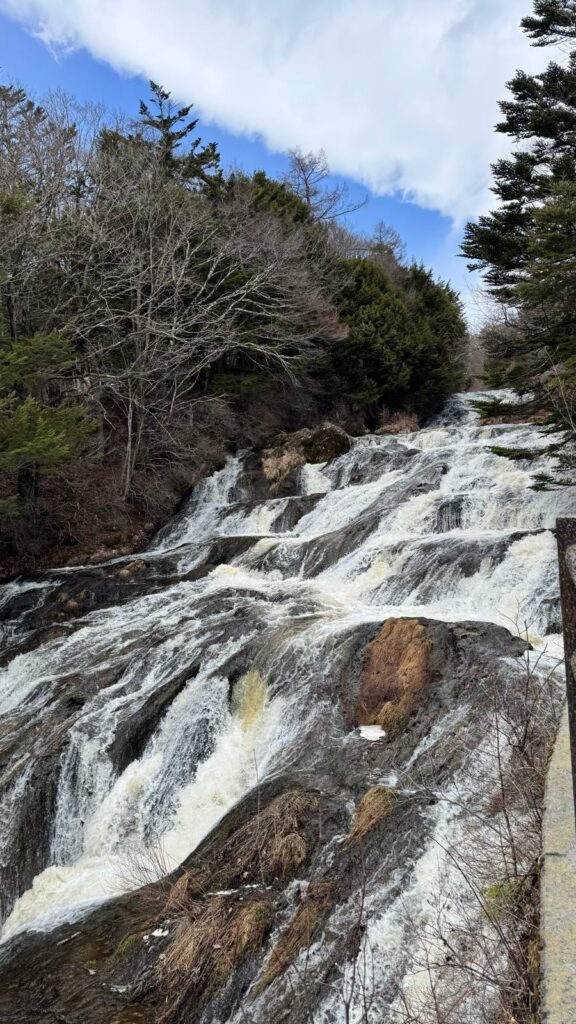
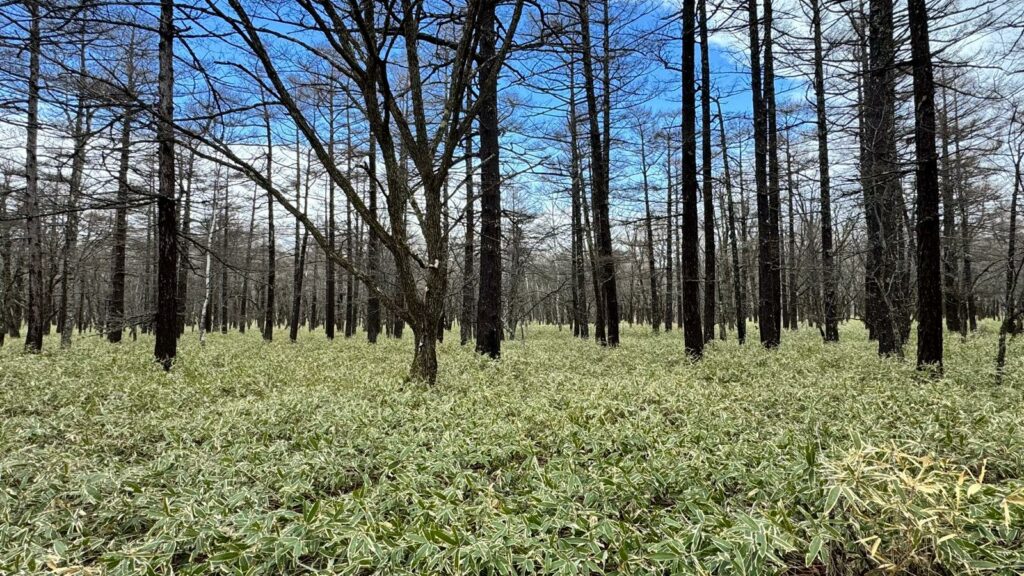
    The next day we visited the Ryuzu Falls and went for a short walk in the woods. The foliage on the ground was unfamiliar, some of the land being a sort of preserved marshland.


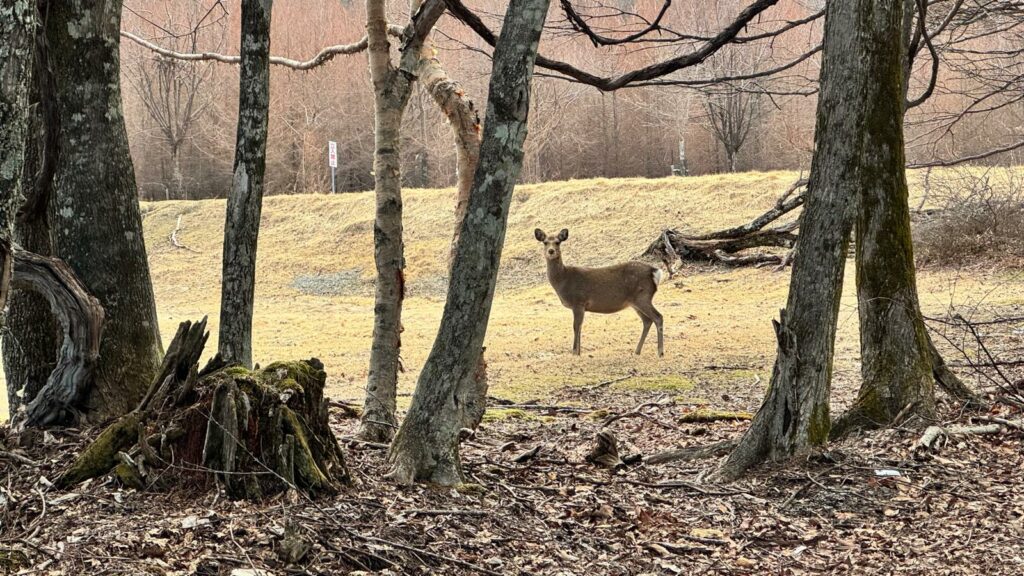
    We were unsettled by the numerous bear warnings, which prevented us from hiking in more isolated areas. I was glad I had brought a bear bell with me. Thank you Tobias, because I believe you bought it  on your travels in Canada. We were also put off by the rain. In the late afternoon we walked in the woods along the side of the lake. Our walk was crowned by an encounter with several Japanese deer, some of which ran away but a few were unbothered by us and even agreed to have their photo taken. Japanese deer are not the same as the European species, and much more friendly.

    The next day was beautiful, crisp and sunny.  We calculated that at 5c , we had descended 35c in a week. We visited Kegon Falls, a, impressive 100m waterfall. We saw a snow monkey crossing the road, with no by your leave. We later sighted several jumping in the trees, but they ran too fast for the camera. Contrary to what one would imagine, snow monkeys are brown and furry, not white.

    We stopped at a visitor centre where it was confirmed that there had been 4 bear sightings recorded over the last few months. I need to record this, in case anyone suggests to me that I have bear phobia.

    After some abortive attempts to walk, due to trail closure, though we really couldn’t understand why, we set out on our own walk in the snow, without snow shoes, which would not have been redundant. Our hike involved a clamber to join the road, which had obviously been practiced by other walkers, perhaps in a different season. 

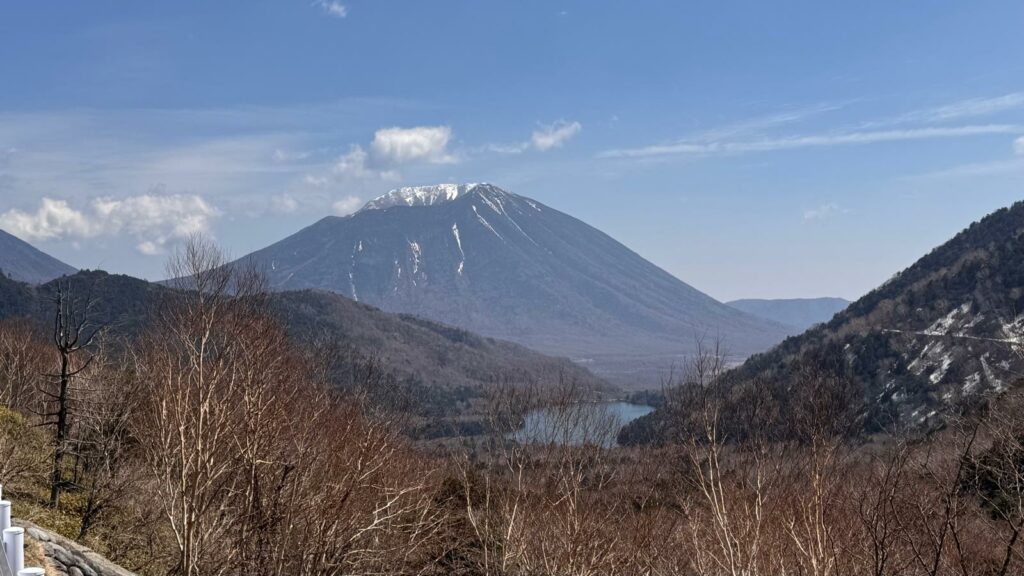
    The Rolandesque path proved well worth it with a glorious view of the snow covered volcano, resembling a picture postcard.

    Our trail off the road took us back to the village of Yumoto, where there are very odorous hot sulphuric springs. We had delicious lunch of plenty of tiny assorted local dishes, all meticulously presented, in a tiny restaurant in the village. We stayed outside as long as we could to make the most of the beautiful day, culminating in a glorious view of  the lake at the end of the afternoon.

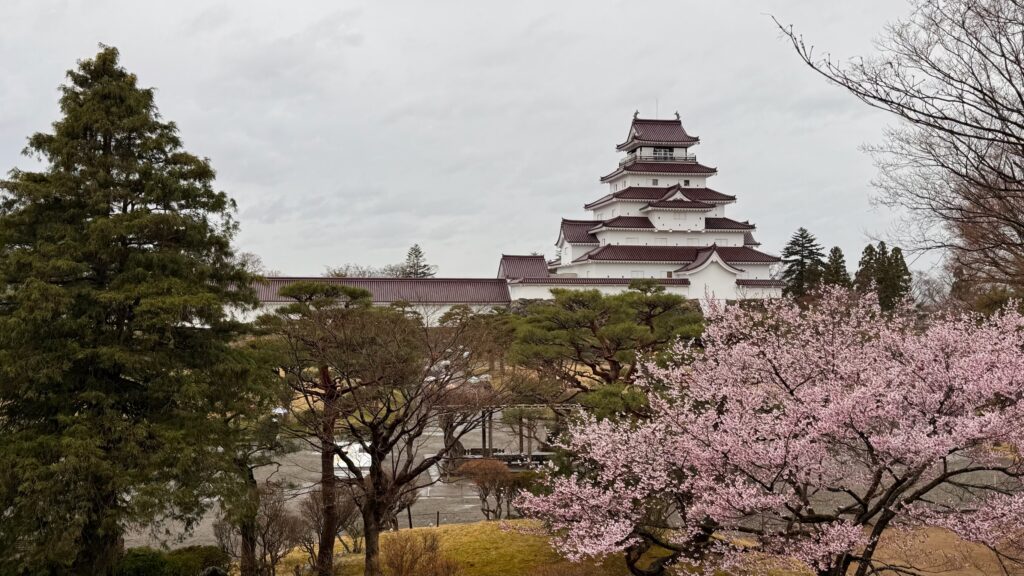
    We left the lake the next day for Aizu-Wakamatsu, the last bastion of Samouraï. If it didn’t rain when we left, it was certainly raining when we arrived. We  visited Tsagara Castle, with an exhibition of impressive and brutal swords – no photos allowed. The castle was reconstructed but interesting nonetheless, with good views at the top.

    As the rain prevented us wandering and window shopping, we decided to do something useful and experience a Japanese launderette. Luckily Gaby, who happened to phone us, and Google translate enabled us not to shrink all our clothes.

    We then set off to the ryokan we thought we had reserved, only to find on setting off, the reservation had been cancelled. We went anyway but the place stank of cigarettes and there was no one around. In the small village, famous for its onsens, we discovered that everything was fully booked up, plenty of hotels and no space whatsoever. We suddenly remembered it was Easter weekend. We had to make do with a room in a hotel tower in the city, the car was stowed away in a lift, as were we on the 11th floor. At least we didn’t end of sleeping in our tiny compact car. 

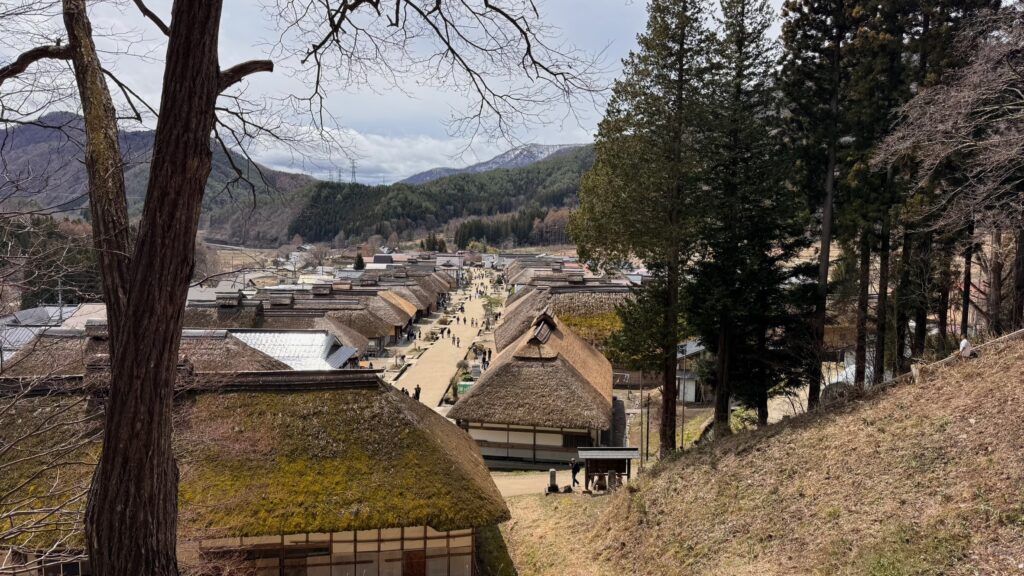
    We then drove to Ouchi juku, a traditional Edo village with thatched roofs and lacquerware. The sun came out and we enjoyed our long awaited ‘flânerie’, with a few other tourists, nearly all Japanese. We have seen very few non Japanese tourists so far in Central Honshu.

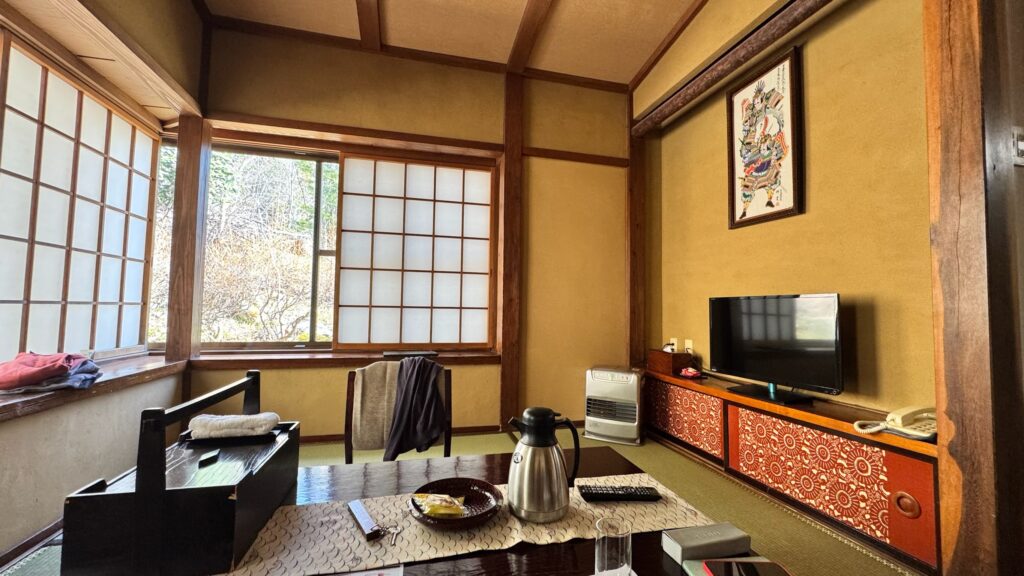
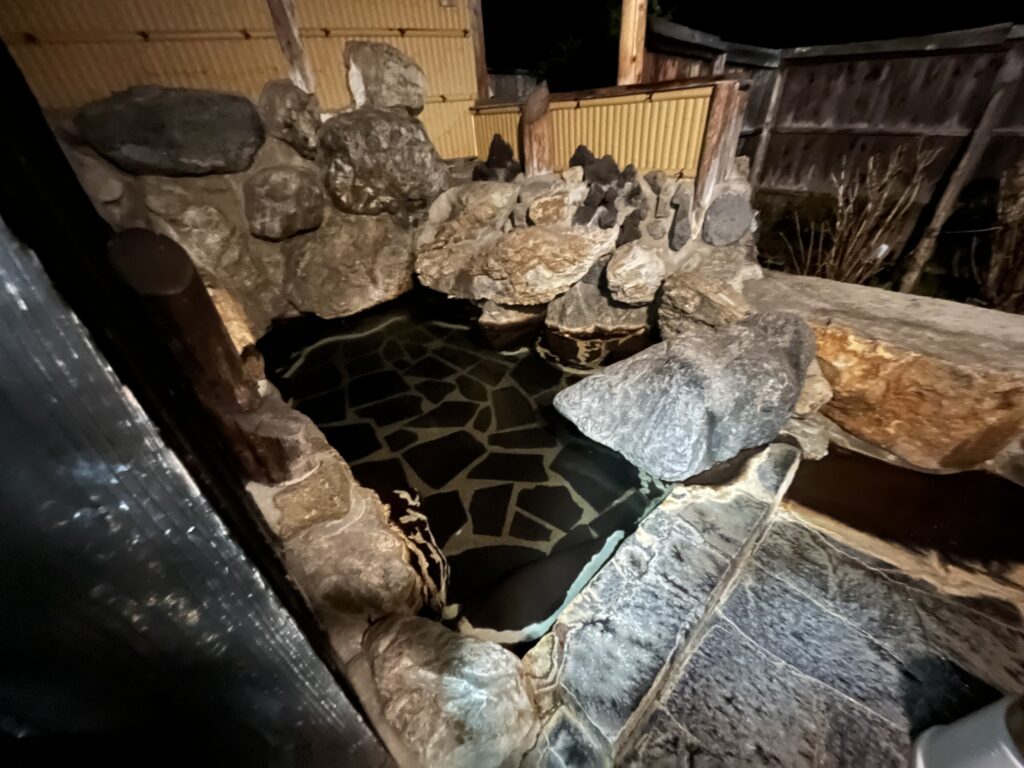
    We then took a windy road and arrived at Yunishigawa mid afternoon. The Kamiyashiki Taira no Takafusa Hotel turned out to be a splendid and luxurious in ryokan style but more chic. We were greeted warmly on our arrival, no question of carrying our own bags. The hotel boasts of indoor and outdoor, public and private onsen. Our traditional room had papered square-paned windows, a little low table and chairs. The futons were laid out on the tatami  and made up while we had a feast of a supper. Roasted fish, meat, potatoes and rice balls in embers of fire ( and 101 other delicacies). We had reserved a private onsen in the evening, thus avoiding any etiquette dilemmas in the single-gendered public baths. The onsen was incredibly naturally hot so we came out pink and throughly relaxed. The hotel contained a marvellous collection of all sorts of objects (I’m sure Roland will set this out in more detail) so I’d like to mention the bonsaï shoots.

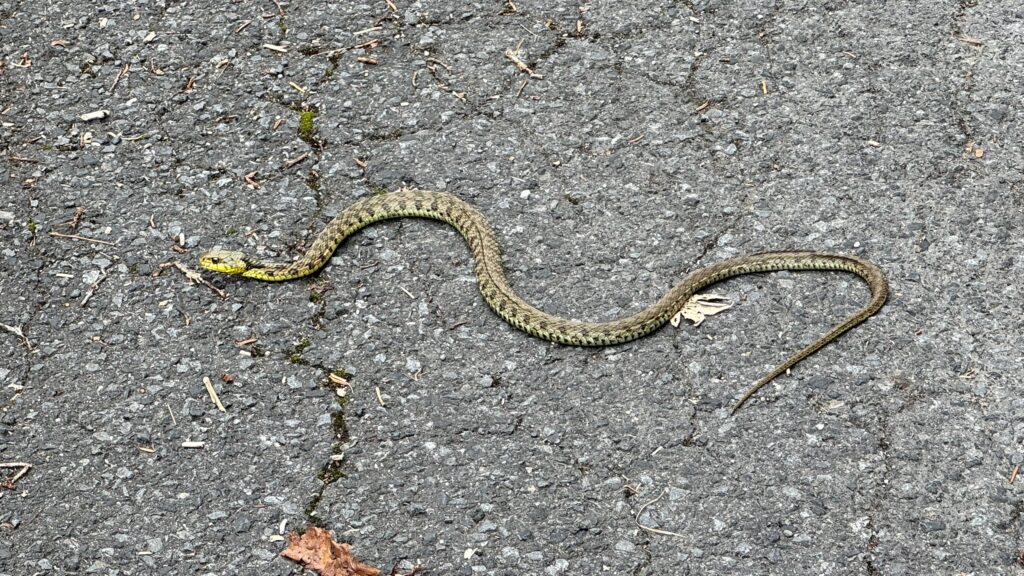
    I wrote part of this post sitting in the  picnic area of Heike no Sato, a reconstituted village in hommage to the Taira clan (for whom it was their last refuge). Beautifully recaptured: a peaceful, empty, quiet place, with thatched roofs and exhibits showing how they made everyday utensils. Earlier on Easter Monday morning we went for a short sunny hike, along the mountain dam.  I confess that our walks in the forest are a little tainted by thoughts of bears. All mountain roads closed for winter until end of month. Do the bears behave differently after that? It’s coming out of hibernation time now, so probably not a good time to meet one and am glad to say we didn’t. I spotted a snake which Roland nearly stepped on, though a close inspection and match of the photo, confirmed it was a Japanese variety of a grass snake.

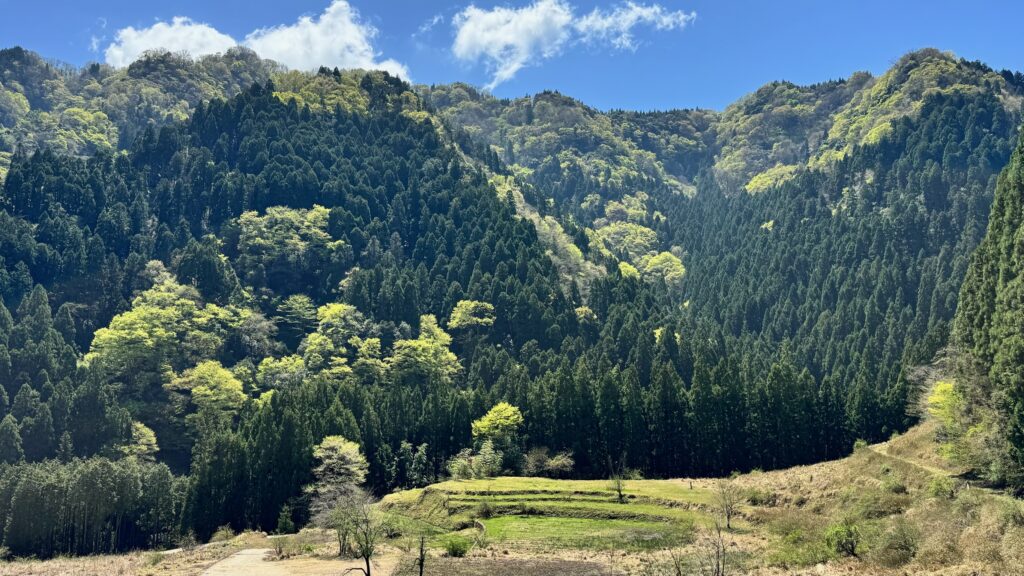
    Our stay in the Japanese Alps was very peaceful and calm. We saw huge bamboo shoots next to all sorts of pine trees. The cherry blossom  was out in the plains and on our way back on the hillsides and mountain slopes too. There were plenty of rice fields, some slightly terrraced further North-East.  Everything and everyone has its place and function, from the parking wardens ushering the pedestrians across the road to the gardener scrupulously weeding in between the stones at the magnificent temple complex we visited in Nikko before we left. Not only does each person have their part to play, but each one does what s/he has to do with perfection, or at least, that is how it seemed to me.

  • The long road to the deep red North (WA)

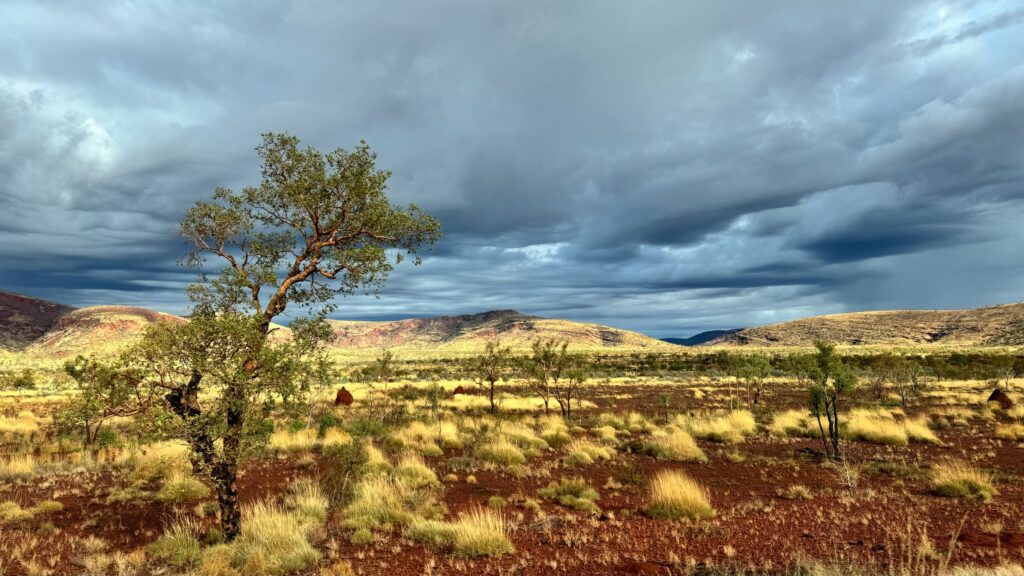
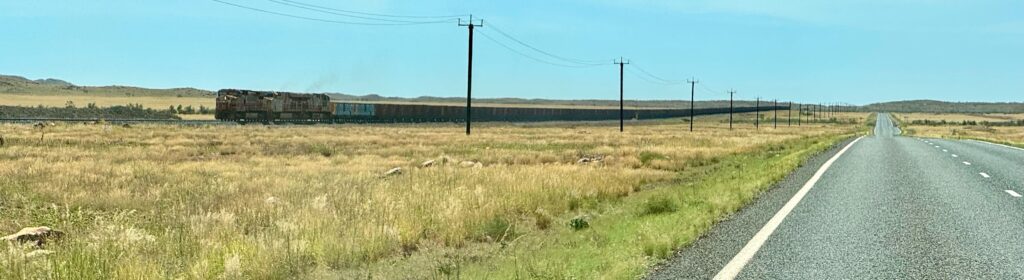
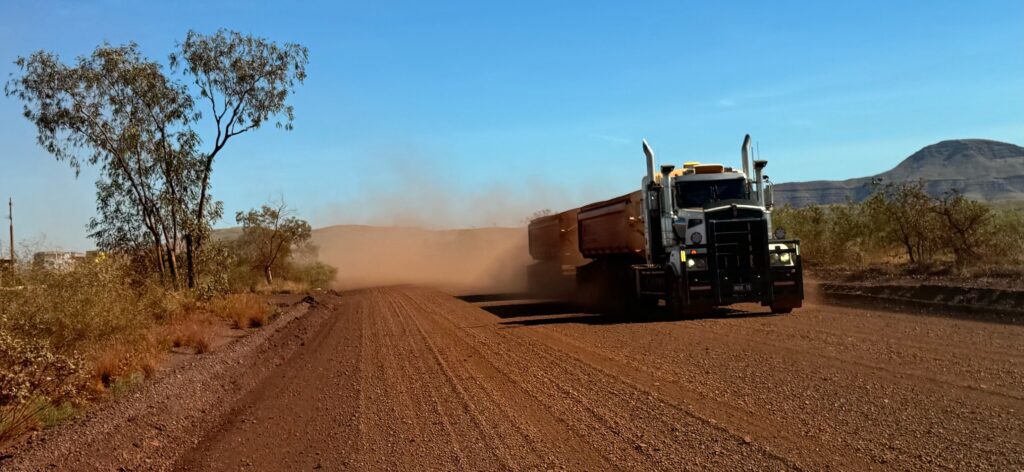
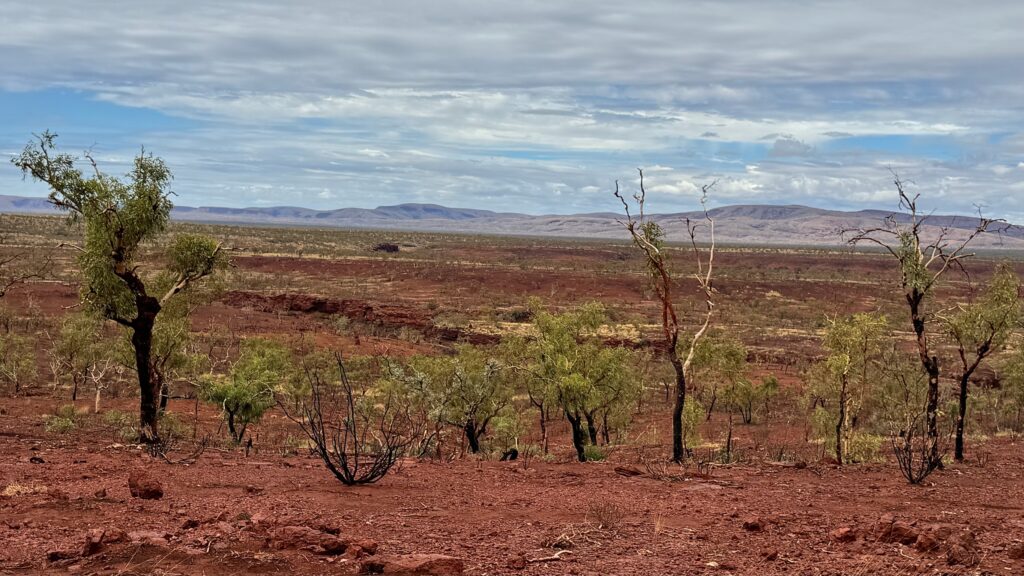
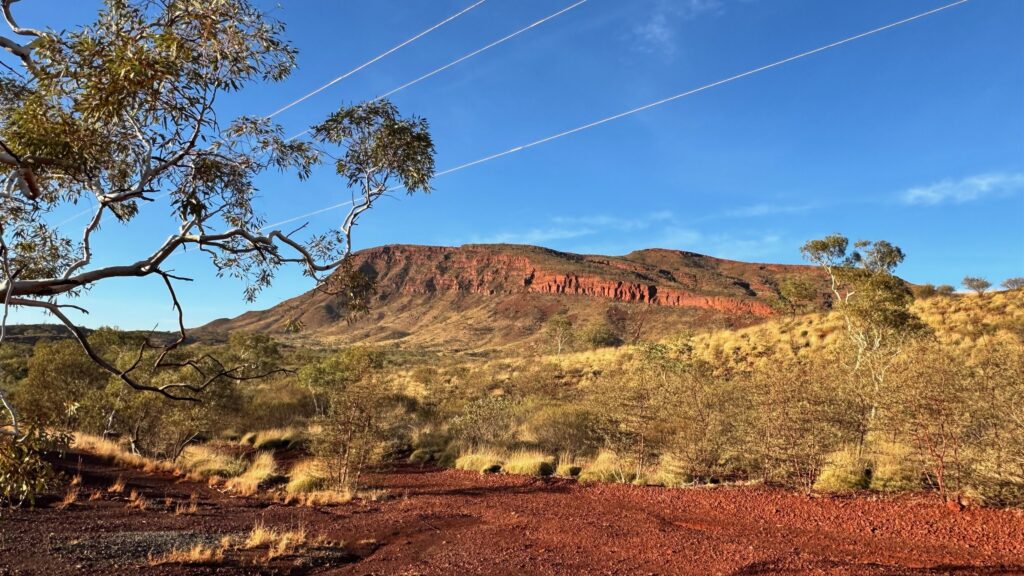
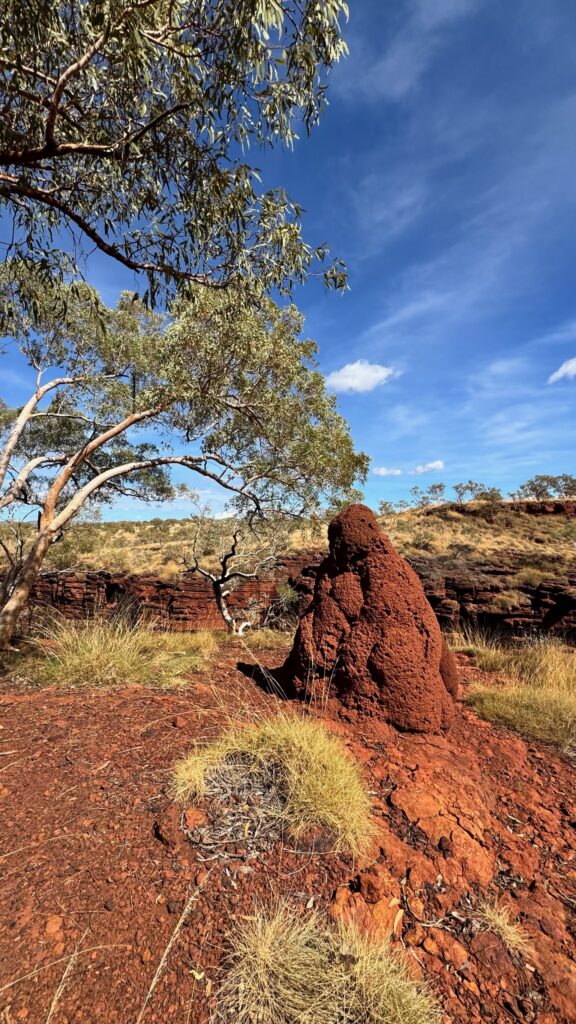
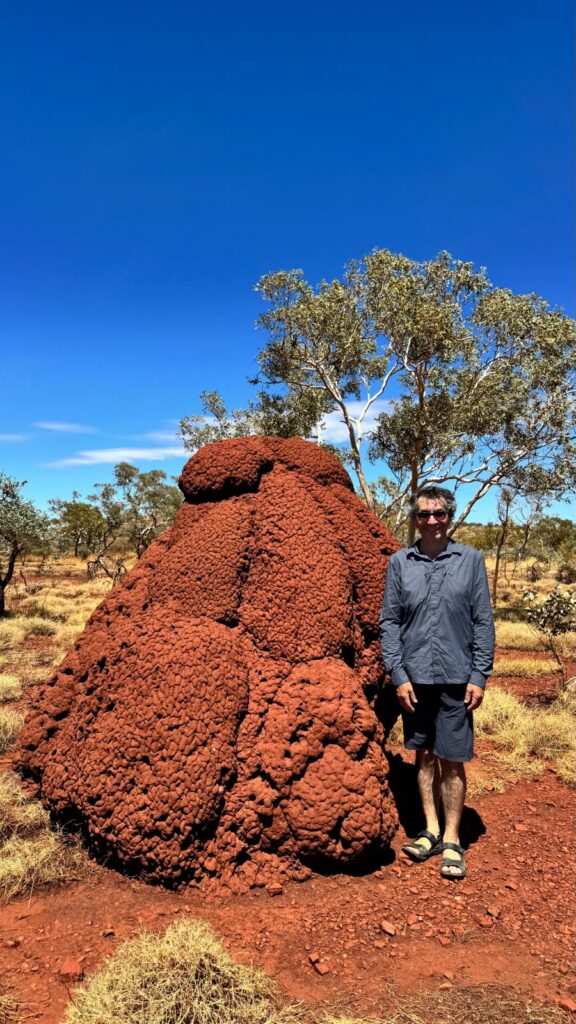
    Some of you (the literati) may recognise the borrowed and converted title. For me, the North of WA is encapsulated in redness. Red earth, red stones, red metal, red dust, generated by the km long mining trains and dirt (on our shoe soles and transported to Japon). The deep earthy brown red (my colour vocabulary being perhaps less knowledgeable than my eye) is engraved in my memory. The redness is contrasted by surprising greenness at times, shrubs, small trees and spinifex, as well as by the constant deep blue of the sky, often accompanied by cotton like picture-perfect white fluffy clouds The huge termite mounds stick out regularly like friendly gnomes. The redness has a tang, a dryness of the desert, an unforgettable image of nothingness. The birdsong is constant, the quiet also punctuated by trains and heavy trucks hurtling past, though the image of the never-ending trains and road trains is more visual than auditory, as they can be seen for a long  time and from afar. The buzzing swarms of flies were a less enjoyable constant  sound. Thank you Julian,  the purchase of the fly nets proved indispensable. 

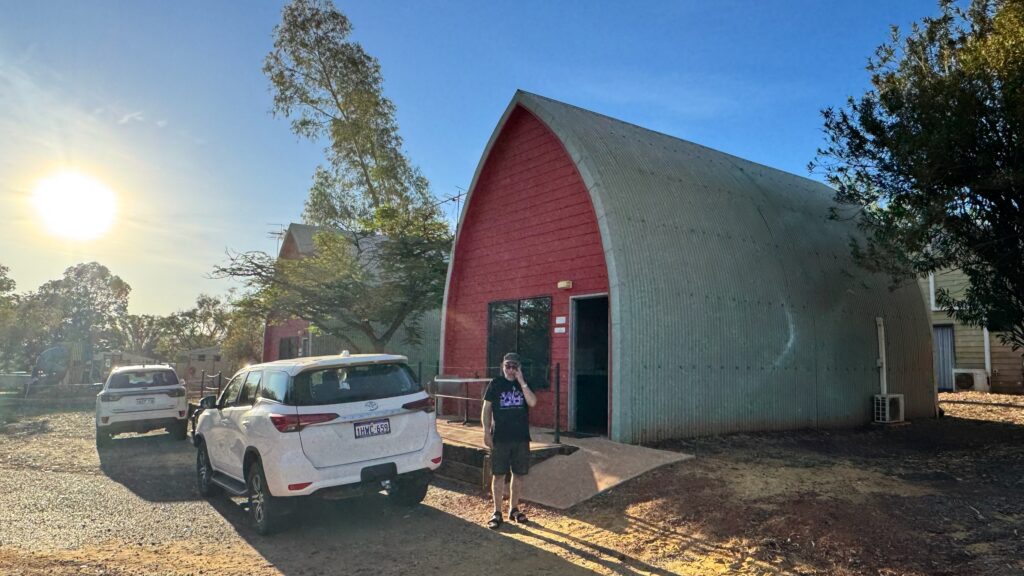
    We arrived at Tom Price Tourist Park after a long day’s drive on Wednesday 18th March in honour of Dylan’s fourth birthday. We had worked out by now that the idea of a picnic lunch stop was out of the question, due to the deep heat and flies. Roland has already described the campsite, so I will limit my observations to the birdsong, the goannas, the mice in the kitchen (which actually woke Julian up), the friendly nocturnal frog in the bathroom and the gecko on the window. Sitting on the terrace was a challenge, because of the flies, fortunately they disappear with the daylight, when the mosquitos come on stage. Watching the mine bee workers, some of whom lived for temporary durations in the campsite, made us think. Rather like Zola’s blackened miners, those of Tom Price were of course tainted red. However, these workers supervise big machines rather than manipulating a pick or a spade.

    The next day,  we visited Kalimina Gorge in our sturdy 4 wheel drive which involved playing at bumper cars for the men. An impression corroborated by a drive later that day up the Nameless Mountain. A few days later Roland and Julian discovered the proper four wheel function on the car by fiddling with the right button. There is indeed a knack to driving on corrugated roads.

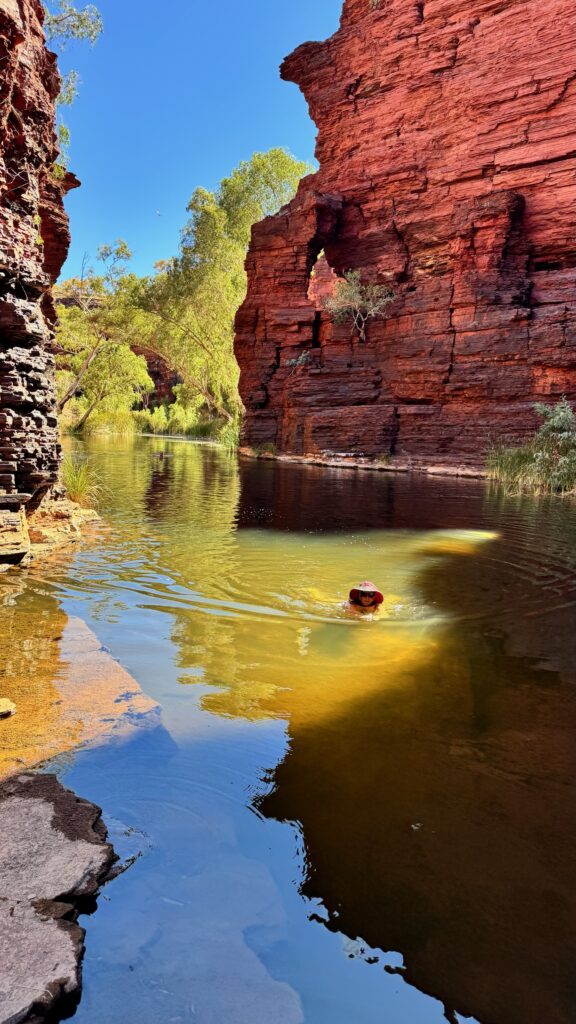
    We saw a dingo from the car on our way early in the morning, no question of it wanted to have its photo taken. We had the gorge to ourselves which enhanced the magic of the experience. Kalamina is deemed to be the modt ‘culturally significant’ gorge. There was a palpable ambiance in the air. The trail was not very challenging, despite the multiple warning signs, and ended with a swim as a reward. Julian and I swam to the end. The place was magical. I remember a unique quality of stillness and quiet. It is an indescribable: a mystical place.
    A short visit to the visitor centre was instructive. I learned that First Nations people make a special wax from spiniflex, an endemic prickly grass, and put it to many herbal and functional uses. I also learned that massive pythons apparently inoffensive inhabit the park, but luckily for me we didn’t see any of them. We established a routine of getting back after a long morning, followed by a late lunch and a nap. After that we could explore the very limited shops in Tom Price and found on our first day that you need some form of identification to buy a beer. You can’t even go into a bottle shop without one! We also sometimes chilled out in the campsite by the swimming pool, a good antidote to the flies who don’t like water. Lots of time for engaging and thought-provoking conversations with Julian, one of his specialities, as those of us who know him, know only too well.

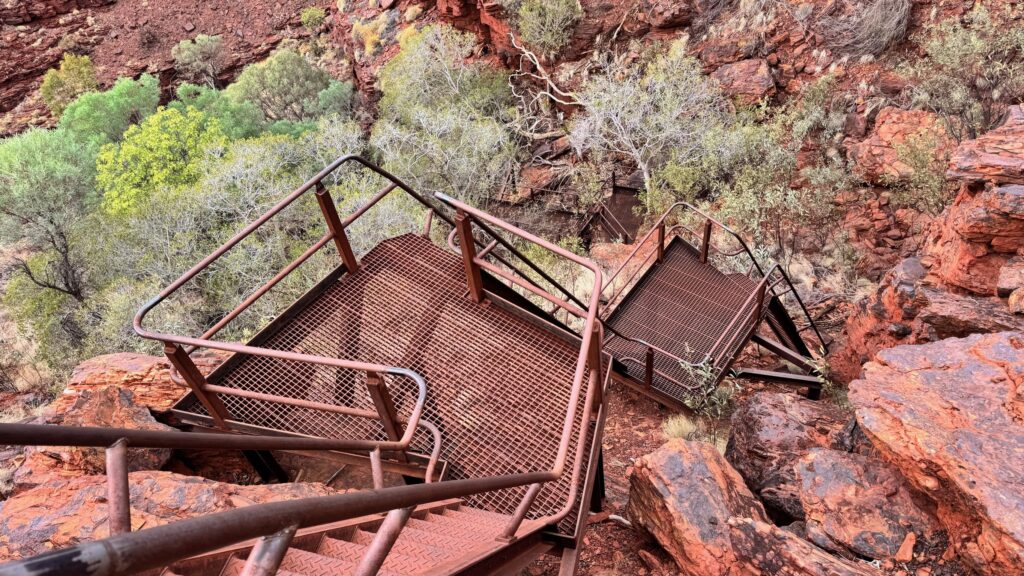
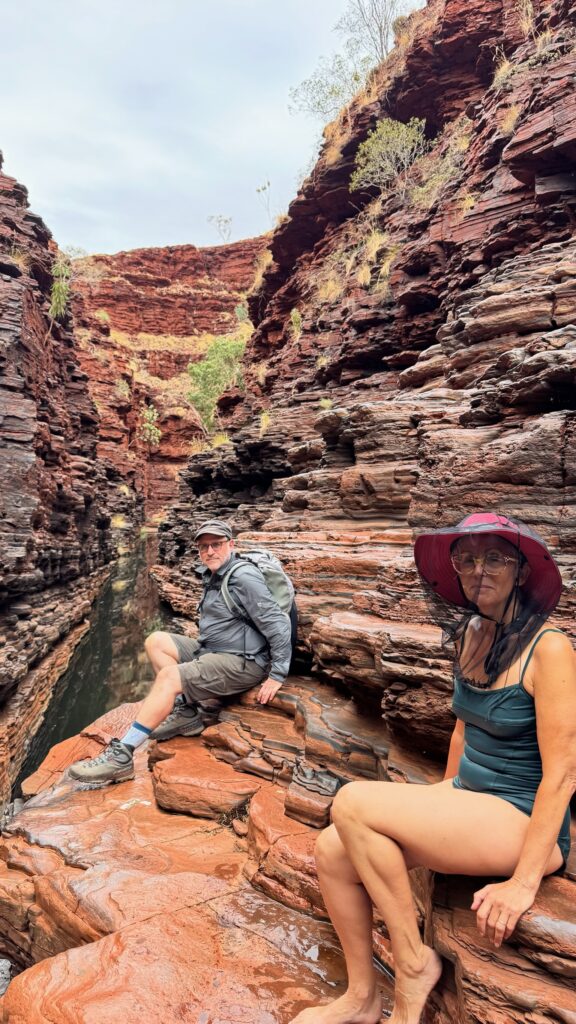
    Our most challenging trail, one we remember well, was to Dales Gorge via the  Fortescue Falls. Everyone else came down to the pool the easy way, by the steps. We saw our first flying foxes (bats) in ghost gum trees. We crossed over to Fern Pool where we swam, along with the dragonflie. The pool was deep and cooled us down. There is a beautiful natural waterfall at the end which only Julian managed to climb up into. We noticed a sign on the way back explaining that you shouldn’t sit by the water fall, since it is of cultural significance to First Nations people. Needless to say the brochure of Karijini Park shows two beautiful white women in the  falls, which sums up the double standards. We walked back to the car on tastefully designed metal steps that merged into the landscape.

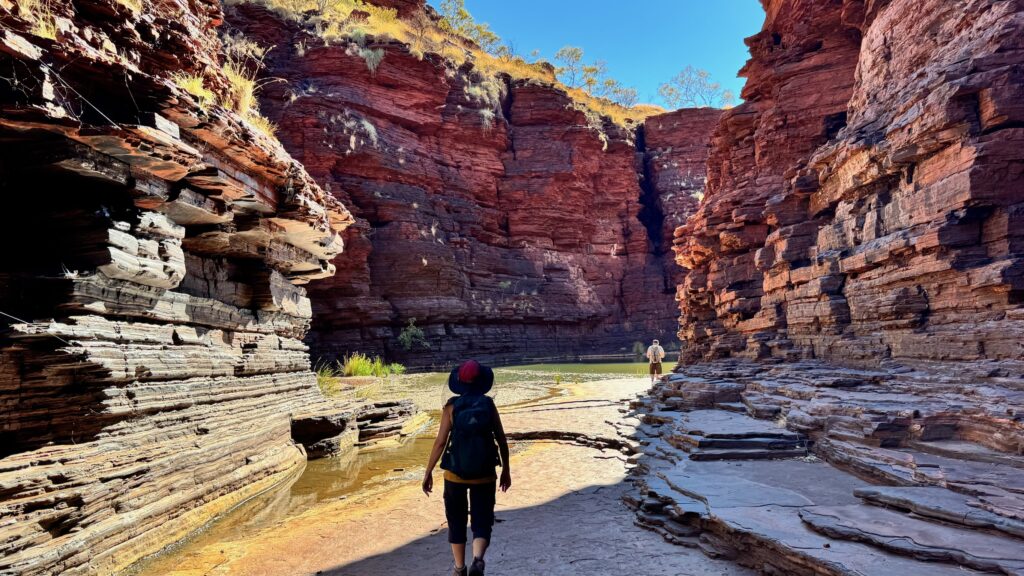
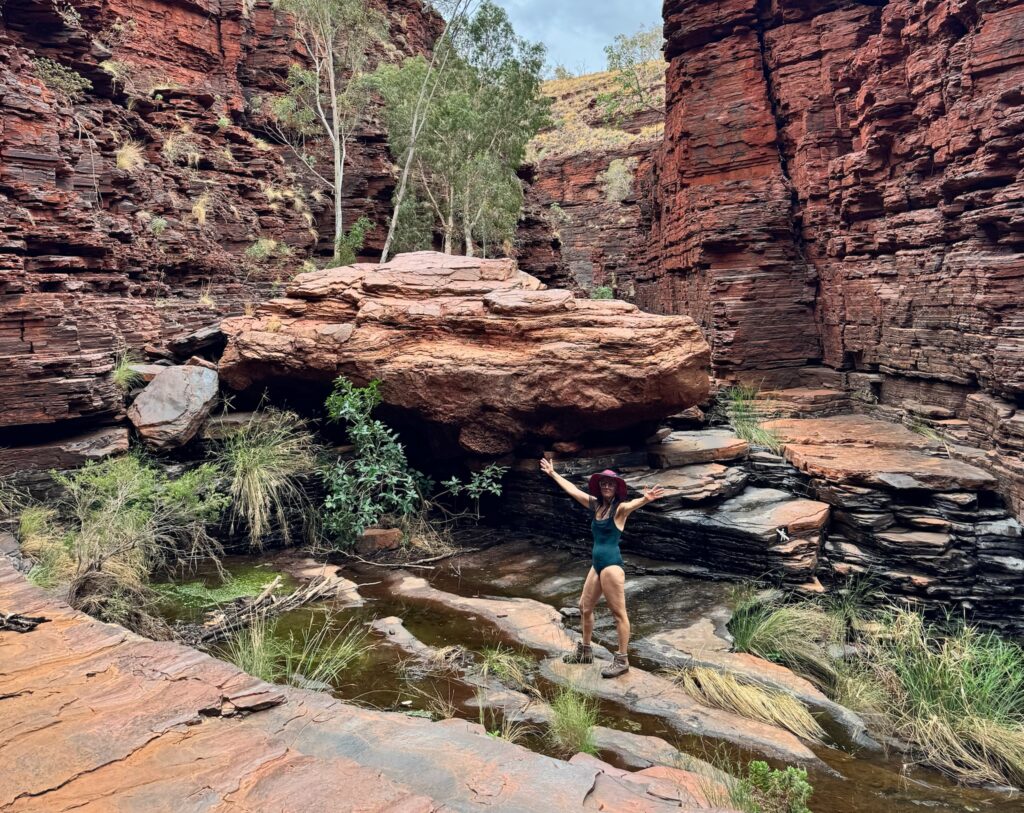
    The next gorge visit to Hancock Gorge involved a different kind of hiking challenge, which was a lot of fun. Roland and Julian rock-climbed the narrow alleys and I swam through to Kermits Pool where we all swam.

    Our last day in Karijini involved less walking and more observation posts. There was a short easy walk to Joffre Gorge with an impressive amphitheatre where I struck a declamatory pose, according to the photographer’s instructions.

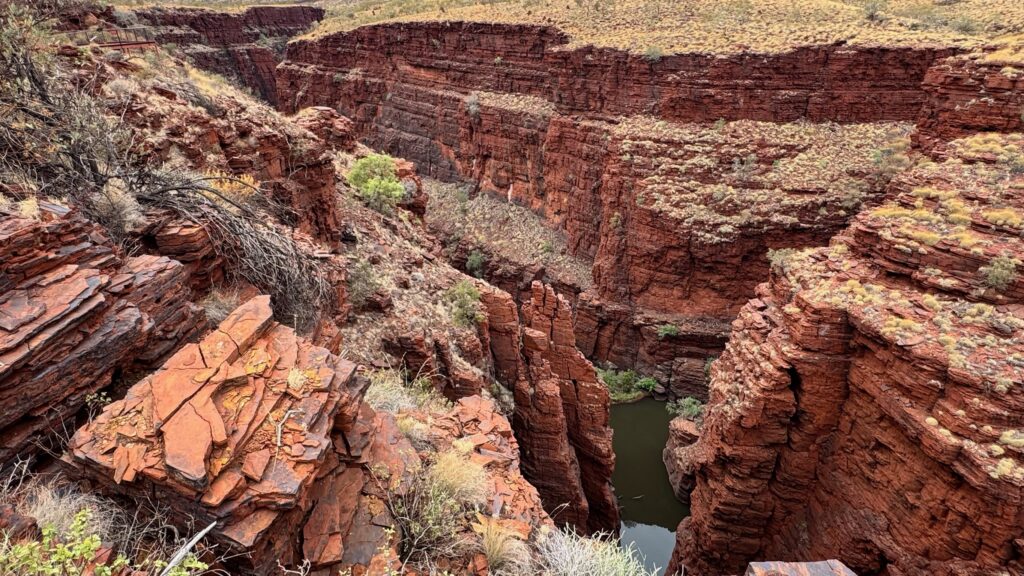
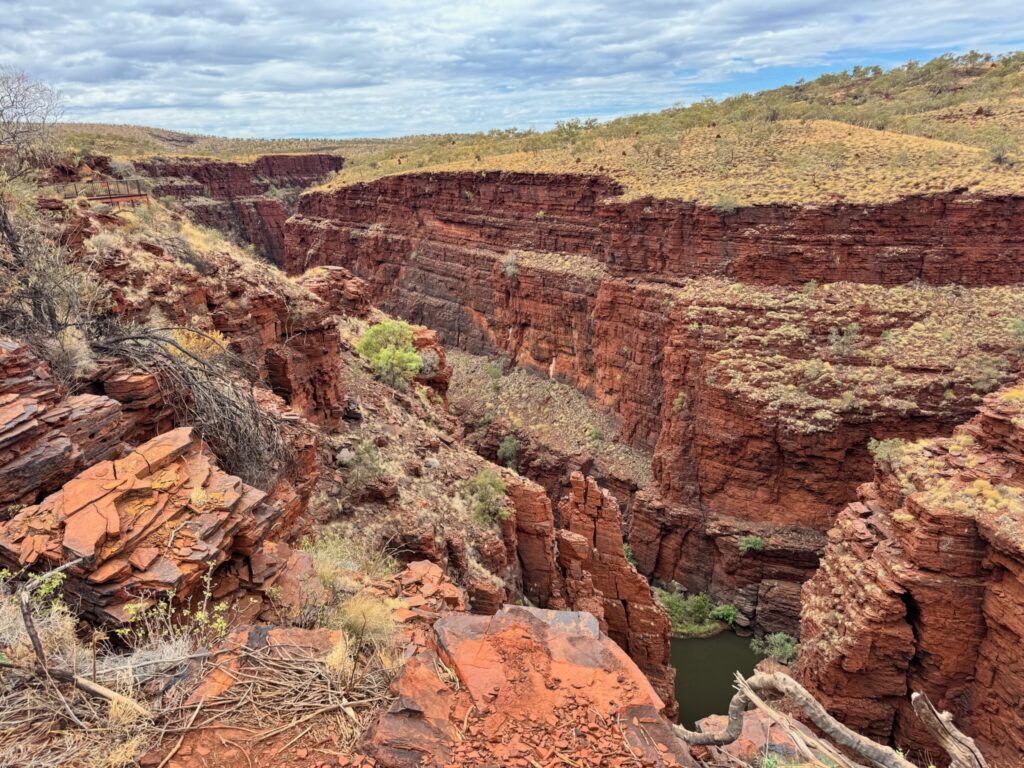
    We were unable to go into Knox Gorge, closed because of a millipede infestation. For some reason, we could only find that out once we had walked down in the heat. A ranger, shutting down the area because of impending rain,  kindly allowed us to proceed to the Oxer lookout, which gave us a good view of the depth of some of the gorges.

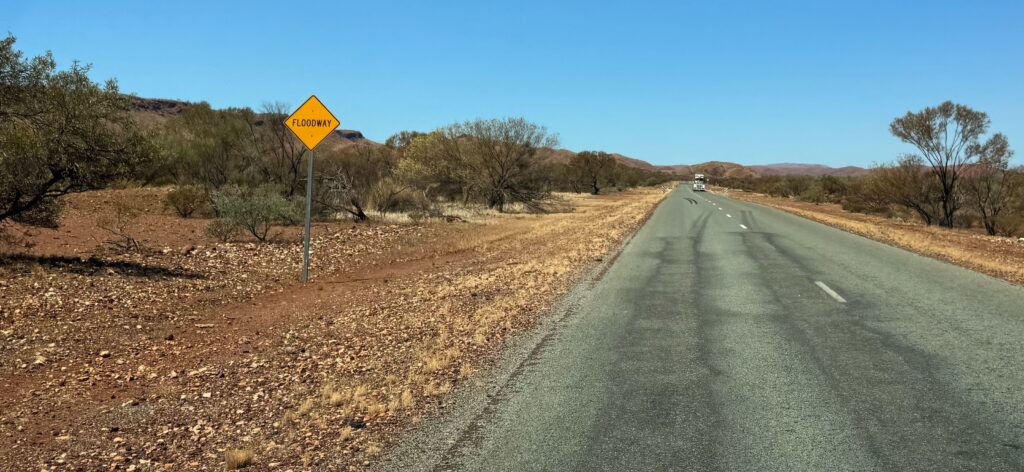
    On Monday morning we had hoped to go to Hammersley Gorge, which involved 40 km on a bumpy corrugated road drive, but it was once again closed for maintenance. We continued towards Karratha, on (another) stunning landscape drive. It is both true and not that driving long distances in the desert in WA is monotonous. If you spend time on a long road trip and pay attention, the landscape changes continually, if somewhat slowly, due to the light, land, flora, the time of day, the sky and, no doubt, our concentration. Sometimes the changes are sudden and unexpected. The bush terrain is not the same all the time. The 40 km corrugated road drive along the Rio Tinto train was another memorable milestone. Once in Millstone and Chichester Park, the vistas changed. We all went for a long swim in the very warm Python pool. Only Roland was brave enough to walk up a hill to get a view: too many flies and too hot for the rest of us. 

    Our approach to  Karratha produced a different amazement. Here was a mining town in all its affluent and yet temporary nature splendor. Karratha appears to be rich, in comparison to Tom Price. Neat comfortable houses with many cars, gardens and boats in the back drive. We found ourselves in a luxurious airbnb apartment. An outside eating place on the terrace, luckily equipped with an outdoor fan. We went to see the sunset on Fortescue Beach nearby, the beach was established for the recreational wellbeing of the mining company employees, with beautifully designed metal shelters with an aboriginal design. The only time we saw shelter on a beach, the whole time we were in WA. No doubt Fortescue wanted to ensure their workers were back at work the next day, after going to the beach.

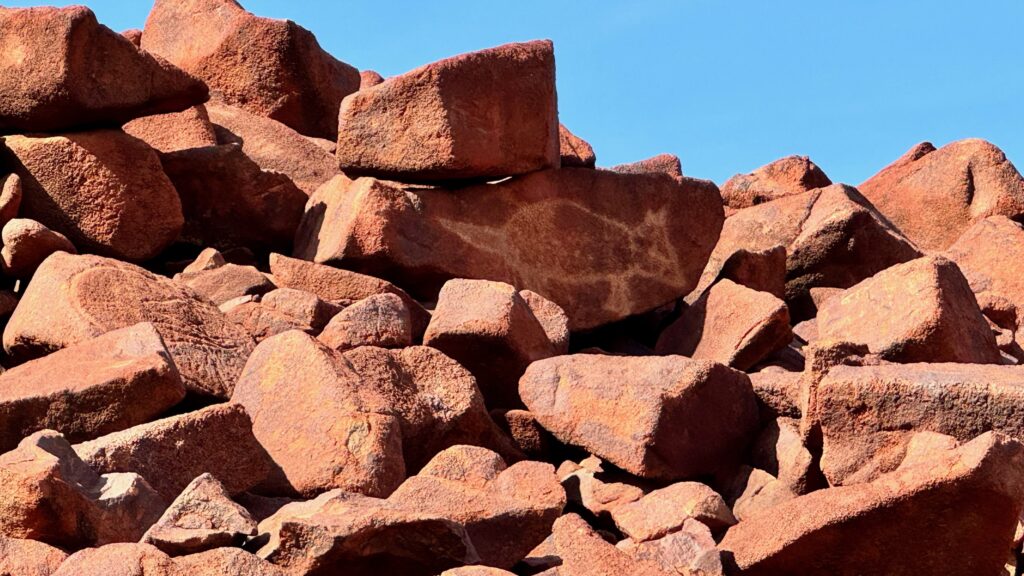
    Our only (as it quickly transpired) visit in and near Karratha was to the  45 000 year-old petroglyphs. It was amazingly burning hot, even by 9h. We joined a group of people who were learning how to guide visitors so after looking at the rocks a second time, we were able to identify many more animals and symbols.

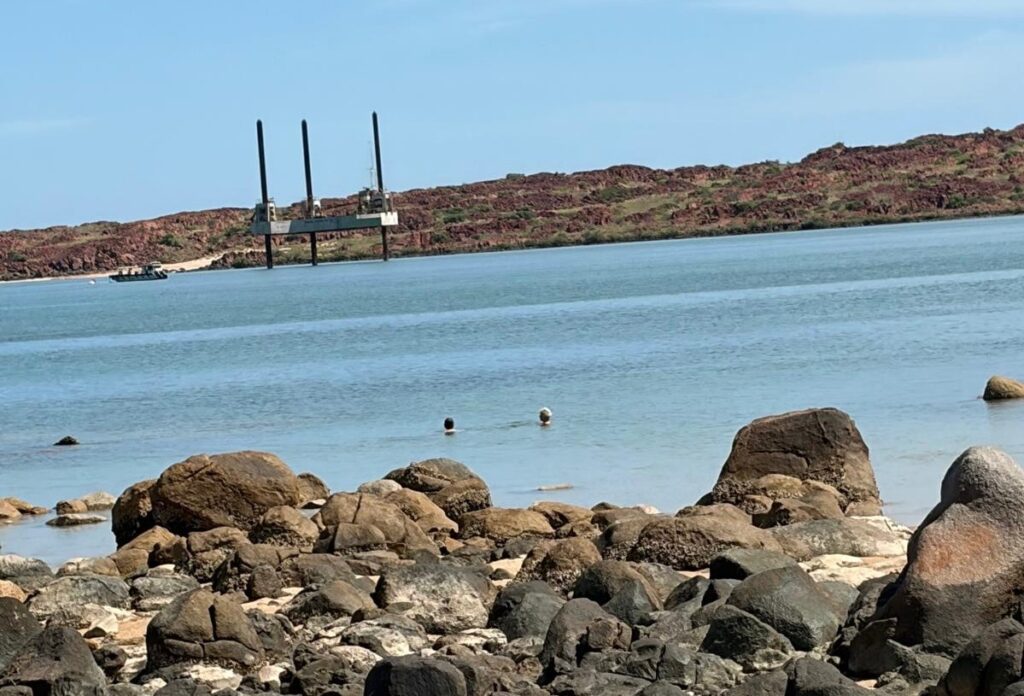
    Roland and I went for a much needed swim near the factory, on a very unscenic beach, though the water was gloriously hot and gentle. The swim there summed up Karratha – the mining industry predominates.

    When leaving the painted rocks (and before our swim) we were alerted by the Karratha tourist information centre to the presence of an imminent cyclone, which Roland had previously identified on his Windy app. We had phoned them to find out if we could come back for a proper rock painting visit. The woman at the centre advised us to leave, informing us that her husband was an air pilot. Our ‘what to do in the event of a cyclone’ discussion started before getting to the beach. After collecting as much information as possible, including checking whether we could return the car in Karratha (no) and taking further advice from Julian’s friend, Leon, who in a nutshell, said ‘get out as fast as possible’, we decided to drive back to Exmouth the next day and change our Saturday flight to one on Wednesday, which we were fortunate to be able to do. Cyclone discussions were ongoing when we went out to lunch in Karratha,  admiring more modern metal architecture and  were brave enough to walk for an ice-cream in a dry burning 40°C, which sizzled on our skin.

    Sadly we packed our things later that afternoon, giving away our opened foodstuff to our next door neighbour (of Italian origin) who admired our taste in olive oil.

    We woke the next morning at 4h and drove back to Exmouth as dawn broke. The road was empty and the drive was very smooth and, especially as it was all on tarmac roads.

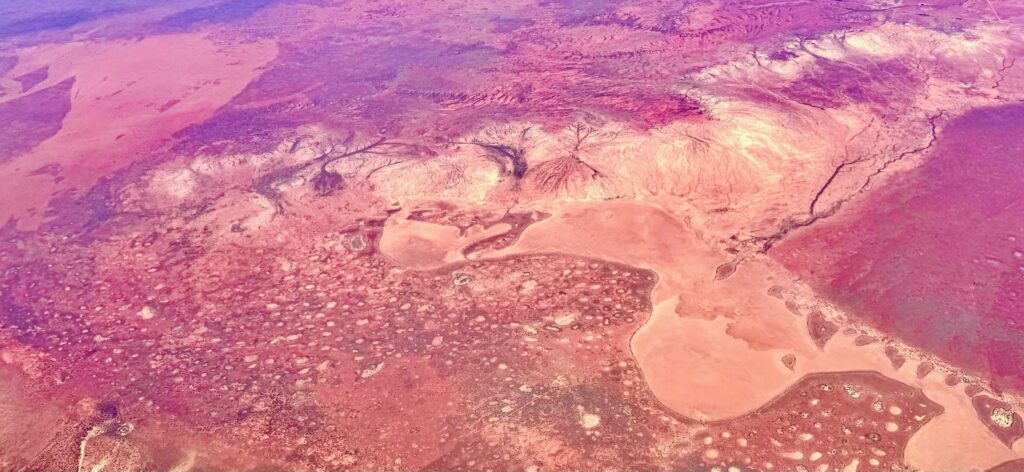
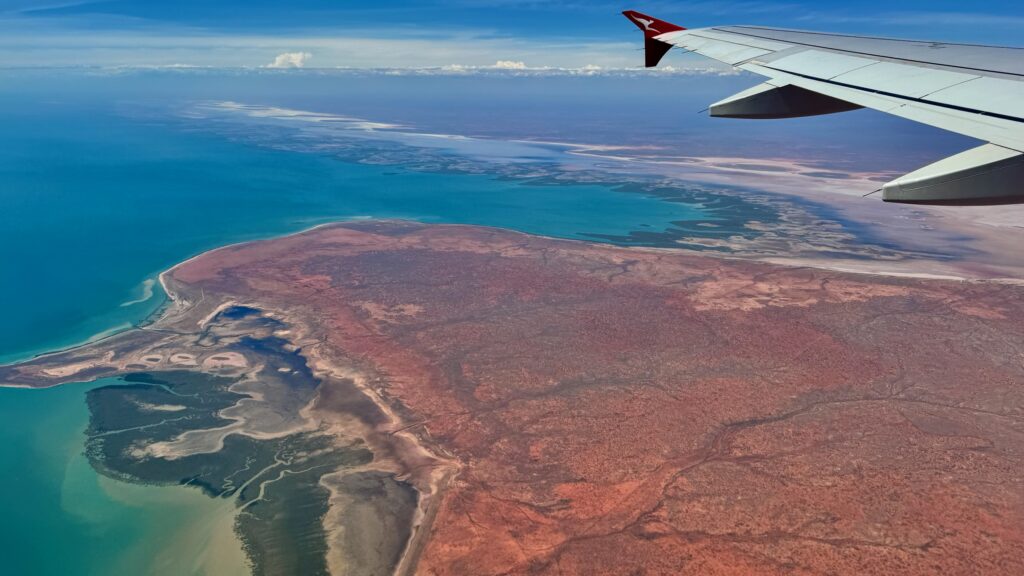
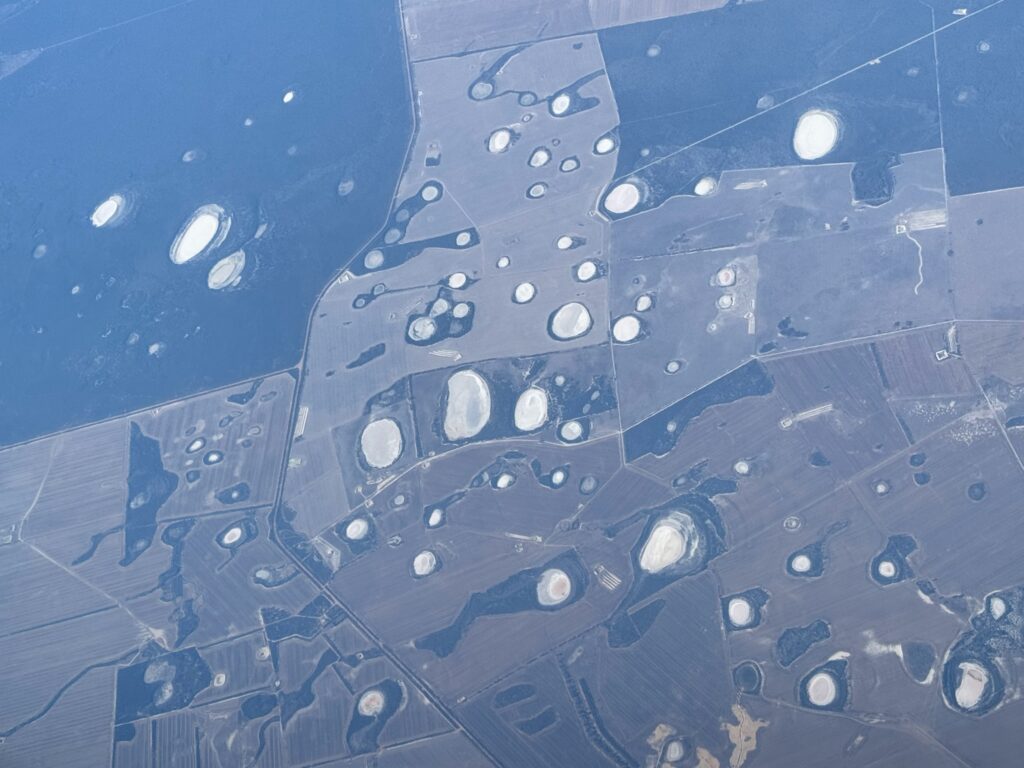
    On our arrival at Exmouth mid morning, panic was palpable in the air, with petrol pumps already running dry. We saw lines of big 4 wheel drives, loaded to the eyeballs, driving away southwards. We left Learmonth in the early afternoon, after returning the car, on the, or on one of the, last  (very full) Qantas flights back to Perth. As Roland snoozed on the plane, I had the luxury of being allowed to sit at the window seat, admiring the red curvaceous and chiseled mountain tops, which looked to me like the famous Bruce Chatwin songlines, as if people had drawn their journeys a long time ago.

    Our return to Perth being somewhat earlier than expected, we were more than glad of Kate’s ability to adapt. We found ourselves back on familiar territory in no time at all and were welcomed back generously. We all drank a glass of red wine to celebrate our near escape. Cyclone Narelle turned out to be scale 4, one of the worst in the last 20 years, and the damage incurred both in Karratha and Exmouth was very severe indeed.

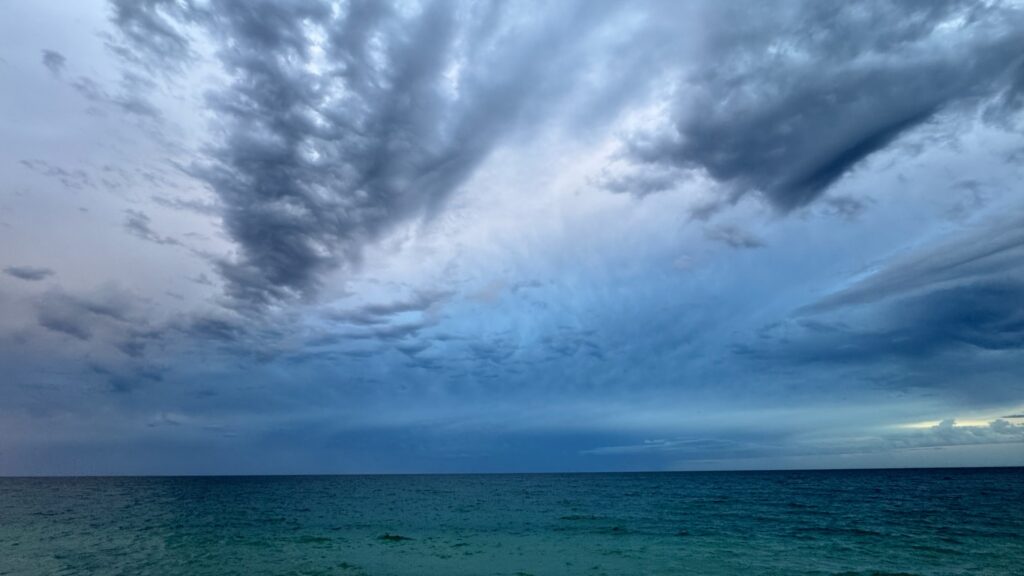
    Our more than generous welcome back included Sandy’s offer to enable us to go and stay in  a resort in Busselton, two hours drive south of Perth, where we drove the next day. After a delicious middle Eastern-style lunch in town, we discovered to our amazement that this involved a very luxurious appartement with 3 bedrooms and 3 televisions. After a walk along the beach at sunset with lightning on the sea horizon, the day ended somewhat bizarrely with Julian being interviewed by BBC Scotland about the banning of social media for under 16s. As he was upstairs answering questions brilliantly from a very Scottish voiced reporter, I was reminded abruptly of the interconnected world we live in. 

    For our penultimate day away  we walked along the sandy beach near Yarringup and Roland spotted a horde of black and red-footed crabs on the rocks. We saw, but didn’t hear a kookaburra. This was followed with visit a winery, the beautiful domaine Naturaliste, for wine tasting, along with a lunch platter. We saw several mobs of kangaroos on the way home. A rainy afternoon allowed us to chill out afterwards.

    The next day we decided to visit Margaret River, with a farmer’s (rather pricey) market, full of aging and colourfully dressed hippies. The place smelt wonderfully of lemon myrtle after the rain. We went on an atypical shopping expedition for slippers. On our way back to Perth we visited Olivia and Neal to see their unique house (designed and lovingly built  by Neal) in Myalup. We were served mouth watering cakes and finally heard the laughing trill of the kookaburra. Our desire to hear its tune made Olivia laugh, which matched the bird’s song. 

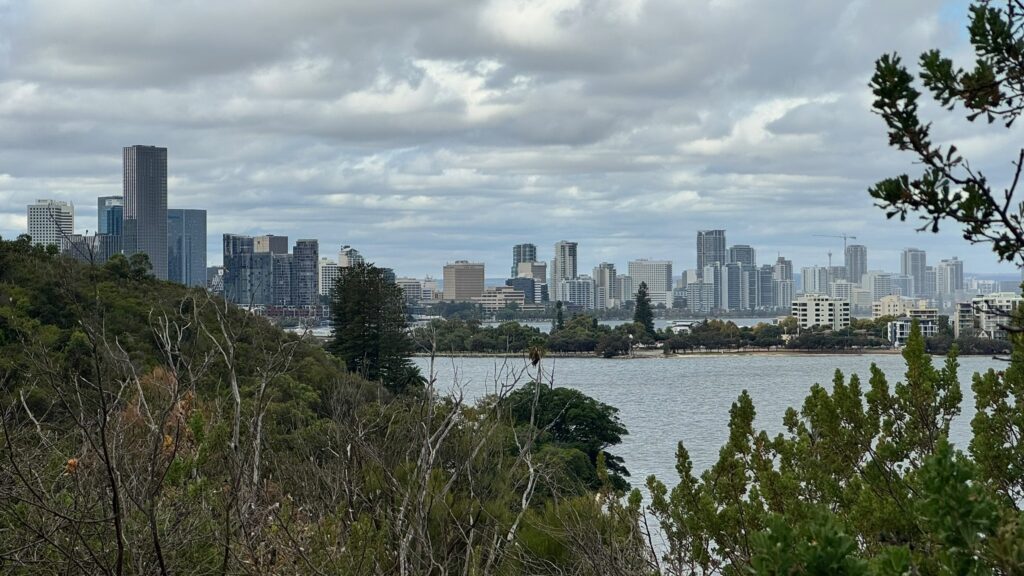
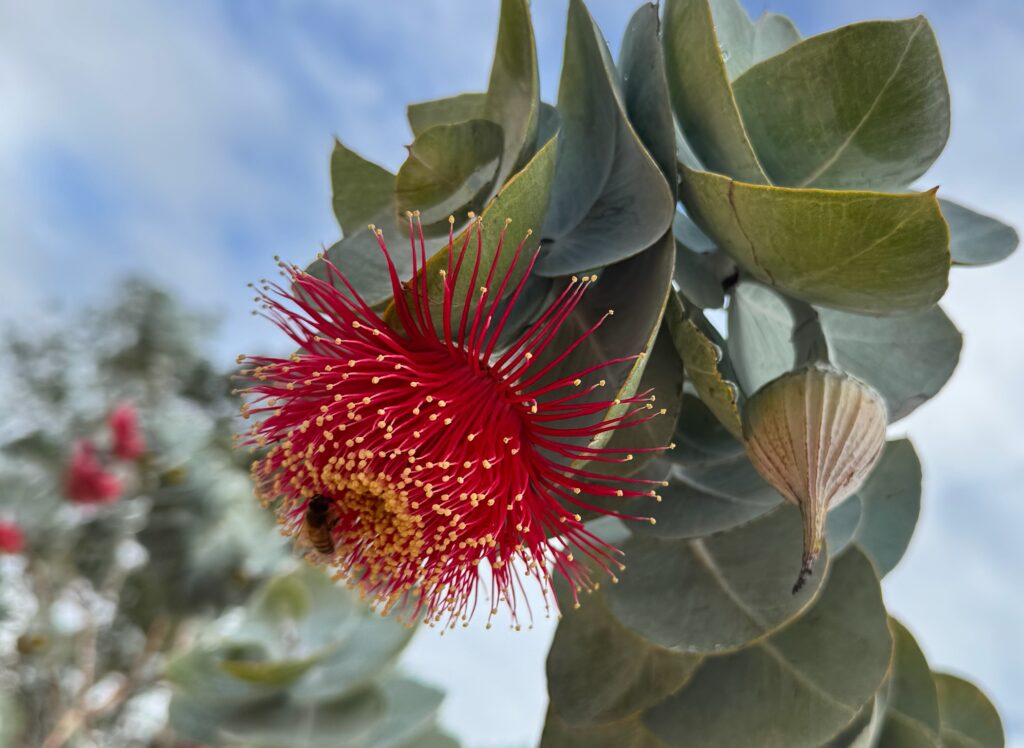
    Our last few days in WA (and indeed in Australia) included an aborted (water too choppy, even for Kate) early morning swim, converted into a long walk on the beach, walking in parks close to Kate’s home and an enjoyable evening out with Sandy and Irena in Subiaco. We saw our first ‘no swimming – shark warning sign’ on the beach – a sharky day. We drank in the last of Perth, enjoying views of the city by the river, from King’s Park. This was a perfect location to end our stay as the botanical gardens showcases some our favourite flowers and trees in WA. 

    The red treasured earth is still on the soles of our walking boots as I write. The redness will stay in our heads, even if physically washed away on our belongings. Our  red road trip to WA is engraved in my memory for many reasons, not least its redness.

  • Gascoyne et Pilbara : le nord de l’ouest

    Notre road trip a débuté á Perth mardi 10 mars s’est terminé par prématurément mercredi 25 où nous avons dû retourner à Perth toute affaire cessante à cause du cyclone Narelle qui menaçait Karratha et surtout Exmouth le jour où nous devions reprendre l’avion pour retourner à Perth.

    Décollage d’Exmouth/Learmonth, à l’horizon les nuages avant-coureurs du cyclone Narelle approchent

    Rembobinage :

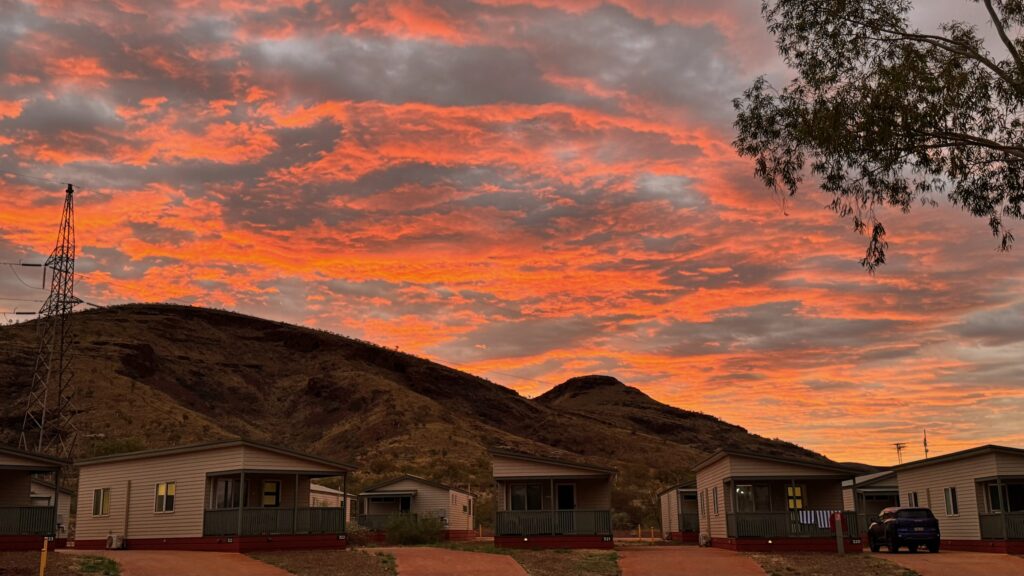
    Nous avons donc quitté Exmouth le 18 mars avec Julian direction plein est à travers la steppe rouge, destination Tom Price, la ville minière la plus proche du parc national de Karijini où nous avions réservé 4 nuitées d’un grand bungalow du camping. Un grand terrain en forme de roue assez étrange où voisinent les touristes et campeurs avec les mineurs et les techniciens logés dans ces habitations provisoires.

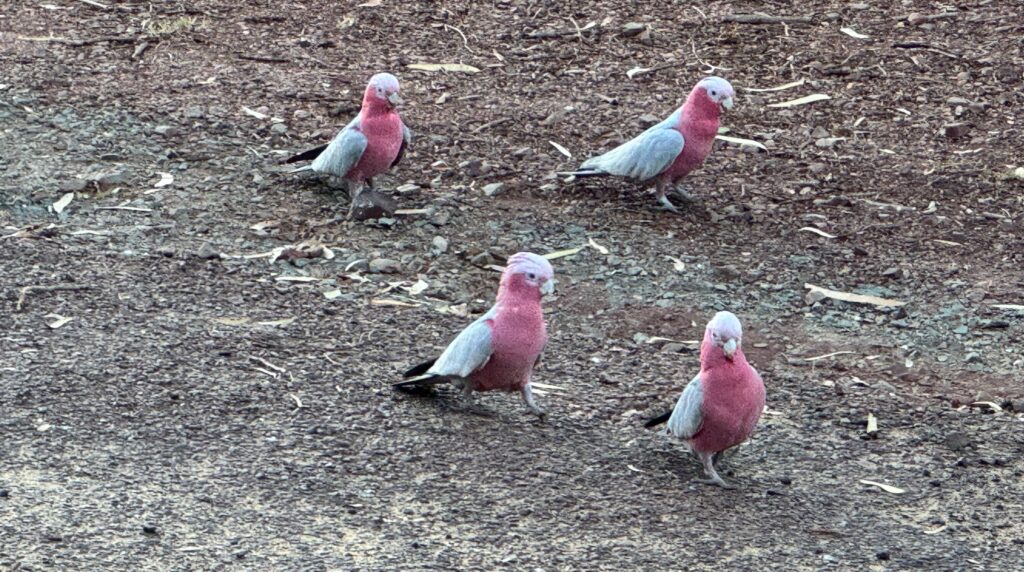
    Beaucoup d’animaux sauvages : ici un Goanna d’environ 80 cm de long se balade entre la lingerie et les jeu d’enfants. Des souris faisant la fête la nuit dans la cuisine, des araignées le raffut de magnifiques bandes de Galahs au coucher et au réveil et une grenouille dans la douche.

    Le centre ville de Tom Price se réduit à un petit centre commercial IGA animé comme une ruche autour de laquelle arrivent et repartent les gros 4X4 techniques blancs et jaunes fluo recouverts de poussière rouge des employés de la mine et des touristes. Les abeilles sont les employés des mines portant les uniformes RIo Tinto : pantalon noir et veste jaune fluo barrée de bandes réfléchissantes horizontales. Pas de restaurant sinon un petit fast food parfumé à l’huile rance. Toutes les “accommodations” fonctionnent ici en “self catering” autrement dit chacun fait sa cuisine, vaisselle et lingerie. 

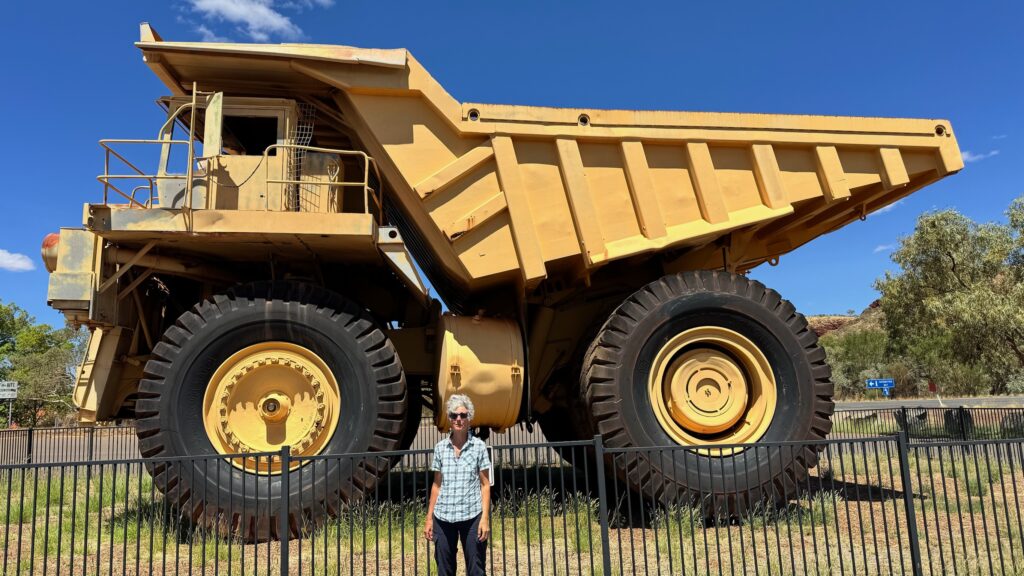
    Parmi les les plus grosses industries West Australiennes, Woodside pour le gaz et Fortescue, Rio Tinto est une des plus grosse compagnie minière du monde, implantée en WA avec 12 M$ de CA/an et possède la plupart des mines du pays. Elle emploie des centaines de milliers de personnes. Elle est également propriétaire de nombreuses routes, chemins de fer, implantations industrielle de traitement et trains de marchandise longs de plusieurs km avec des centaines de wagons, qui circulent à rythme serré au point que la voie semble parfois n’être qu’un seul train liant les mines aux ports.

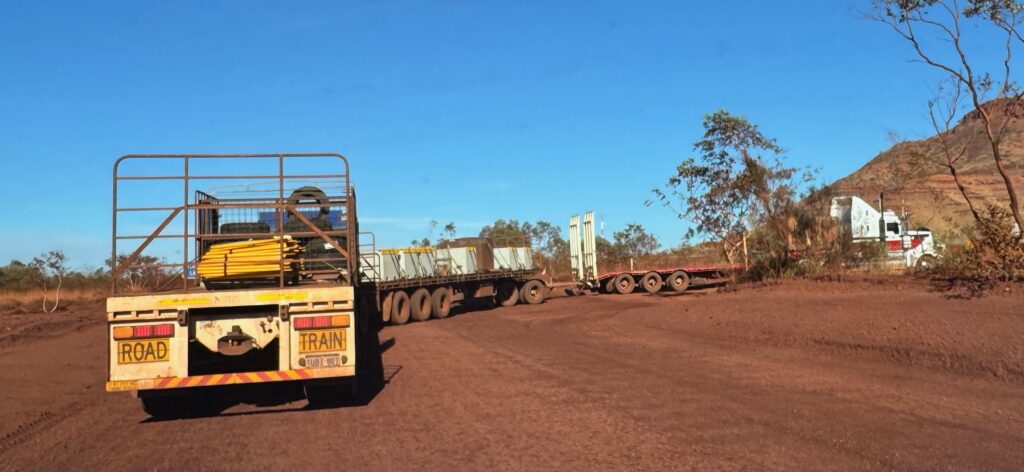
    Le nord ouest est aussi le pays des Road Trains, énormes camions avec 2, 3 ou 4 remorques, soit pas loin de 100m de long et parfois de grande largeur roulant à plus de 80km/h sur les routes en terre rouges corrugated (en tôle ondulée).

    On peut emprunter certaines de ces routes privées, les plus importantes reliant des villes entre elles, à condition d’obtenir une qualification, consistant à un examen en ligne très chiant et très long. Julian y a passé deux heures environ. A part les consignes habituelles et les évidences comme voyager avec de l’essence et de l’eau, s’hydrater régulièrement , ne pas ralentir en traversant les voies ferrées, faire attention aux camions, ne pas rouler au dessus de la limite de vitesse, après avoir visionné les 9 vidéos obligés sans contrôles et répondu aux nombreux QCM, on apprend à ne jamais descendre de voiture à proximité des voies ferrées si l’on porte un vêtement rouge, à bien y réfléchir ça fait sens, mais on n’y aurait pas pensé. Rio Tinto a également un passif de destruction de sites archéologiques aborigènes, comme l’effacement en quelques jours des 46000 ans d’occupation humaine de la Gorge de Juukan par l’extension de la mine Brockman 4 près du site touristique d’Hamesley.

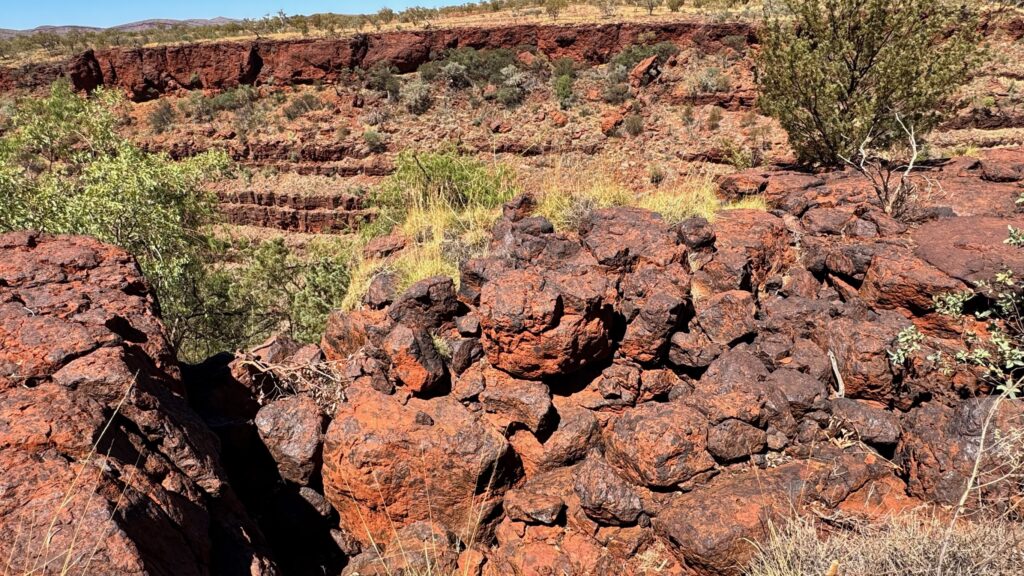
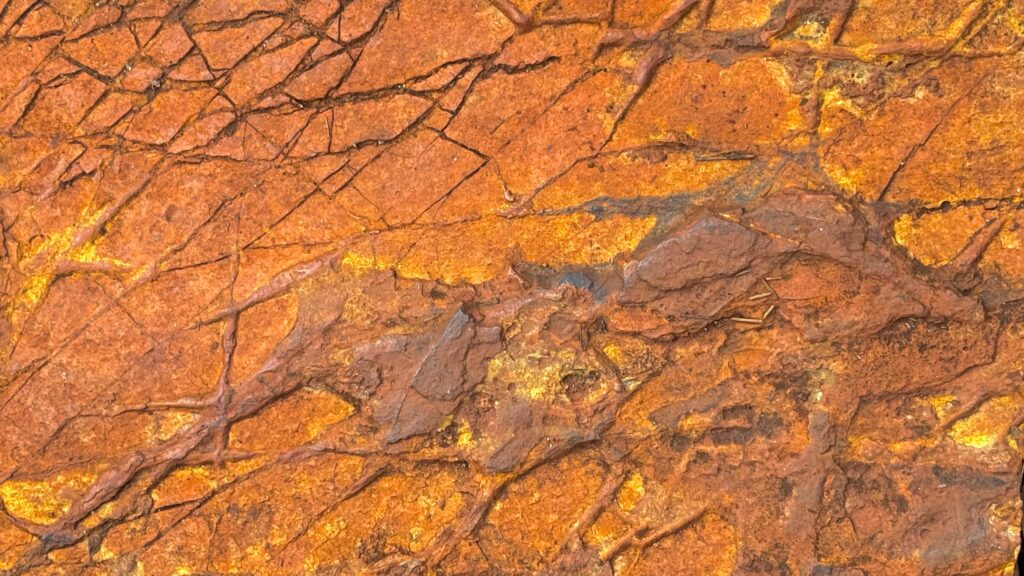
    La région regorge de richesses minières, principalement du fer sous la forme d’Hématite à haute densité. La terre rouge et la roche noire sont tellement riches en fer que n’importe quel gros cailloux ramassé par terre dans toute la région pèse le poids d’un boulet de canon. J’en ai ramassé deux minuscules exemplaires pour ma collection de pierres ramassées lors de nos voyage, qui énerve assez Ruth. On y trouve aussi de la bauxite, du sel et du lithium, germant sur les marais salants “brine ponds” de Karratha, des lacs de terre rouge à la surface givrée éblouissante sous le soleil zénithal.

    Ici on vit au rythme du soleil : coucher à 9h, lever à 6, départ à 7, 100 à 150 km pour aller sur les sites du parc, marche de 8h à 11h au plus tard, après il fait trop chaud. Les sites de promenade aménagés, sans aucun doute parmi les plus spectaculaires du parc, sont principalement des gorges avec des marres ou des étangs dans lesquels on peut souvent se baigner. Petits oasis paradisiaques de schiste rouge creusés en marches naturelles, remblais d’une végétation luxuriante sous un ciel d’azur. Mais à la fin de l’été beaucoup d’entre elles n’étaient pas très encourageantes. La population la plus importante est sans aucun doute celle des mouches, particulièrement tenaces, d’où l’importance du filet à mouches.

    Ces gorges dont seulement de minuscules parties sont visitables, sont comme des coups d’épée dans le plateau. A la moindre pluie, tropicale et violente, ils risquent de se remplir en quelques minutes de torrents de boue.

    C’est pourquoi les rangers ferment souvent les routes et en font remonter les visiteurs à la moindre annonce d’orage. Il pleut plus souvent et surtout plus qu’on ne pense : chaque creux sur les routes désertes peut devenir une marre de boue rouge parfois très profonde alors que le plateau lui-même peut se transformer en étendue liquide.

    Karijini park est un plateau aride, autour 600 à 700m d’altitude, où derrière chaque colline rocheuse apparaît un nouvel horizon à l’infini. Les perspectives sont uniques, à cause du relief permettant des vues époustouflantes, chose rare dans ces paysages ouest Australiens où la plupart du temps le relief se réduit à des rochers ou des dunes de quelques mètres.

    Il est plutôt bien géré, notamment car une partie du personnel et de l’administration est confiée aux communautés locales des premières nations. On peut se demander pourquoi cette pratique n’est pas généralisée. La montagne au dessus de Tom Price s’appelle sur les cartes “Nameless Mountain” alors que son nom ancestral aborigène est sans doute depuis des dizaines de milliers d’années Jarndunmunha. 

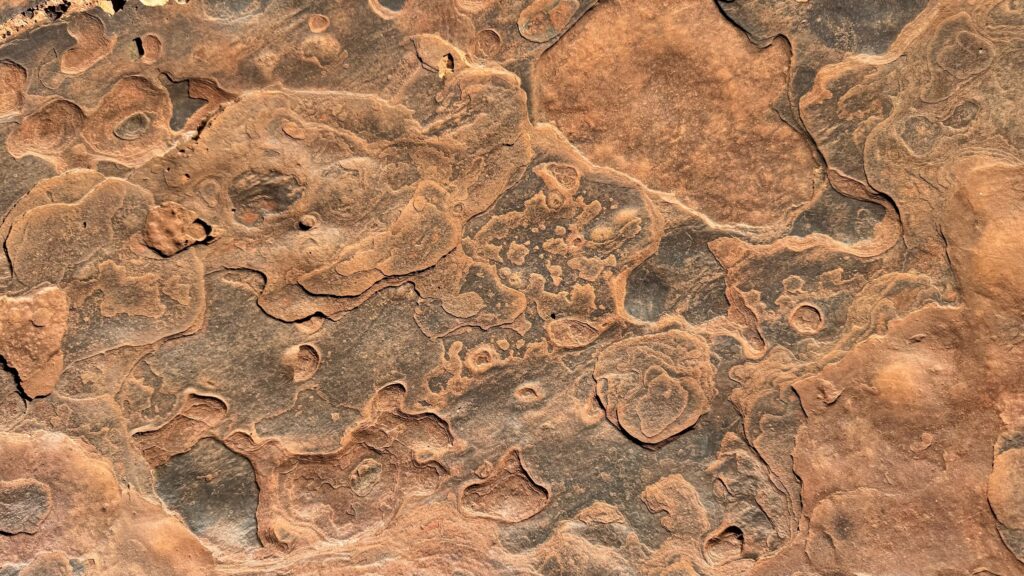
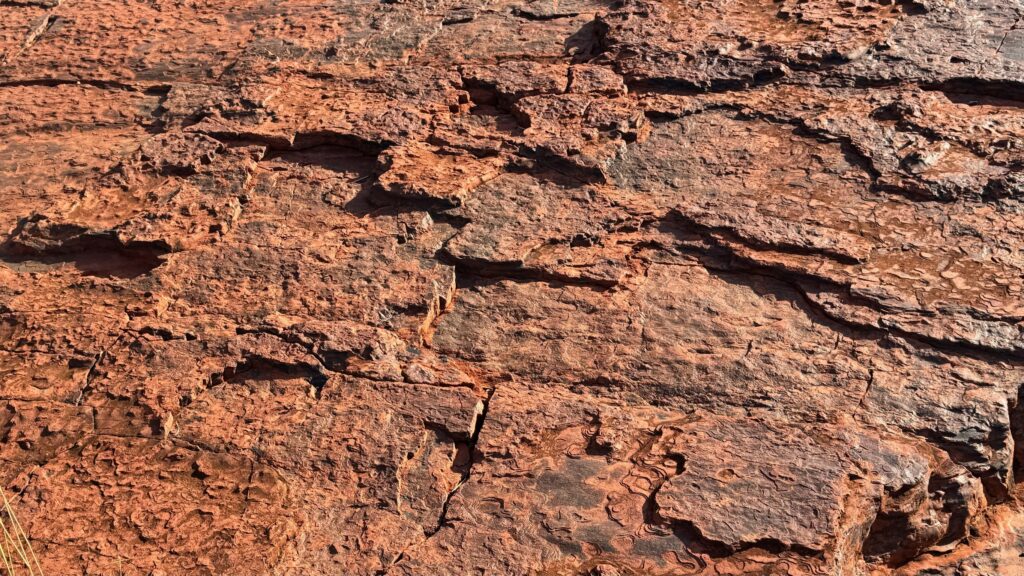
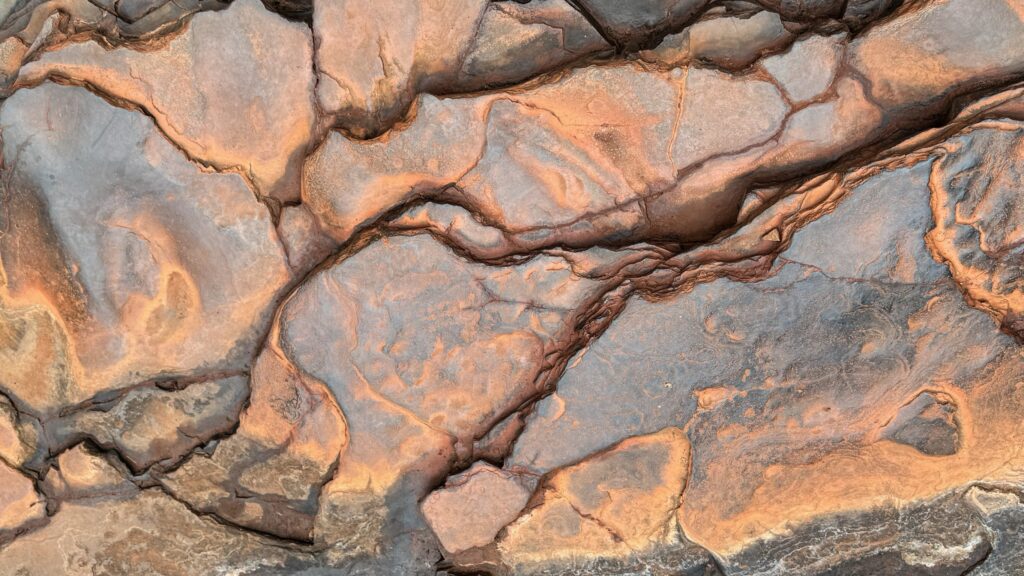
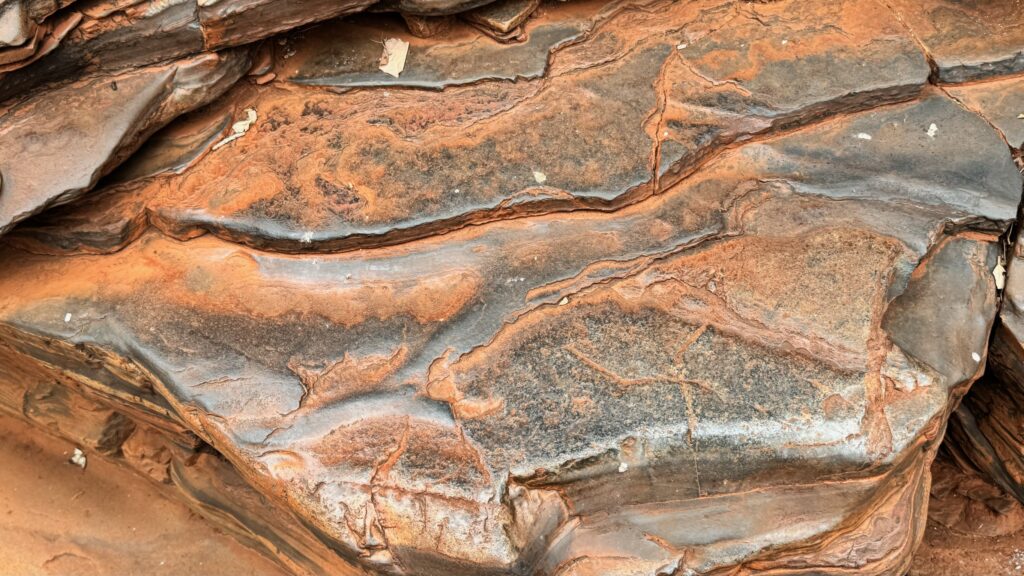
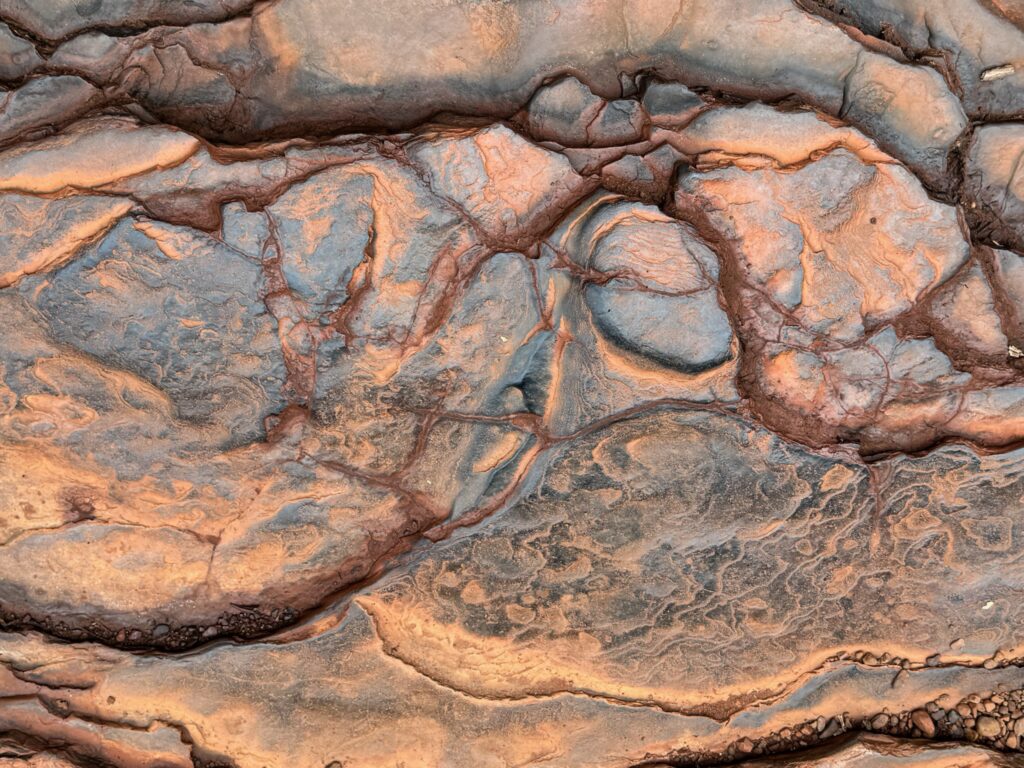
    Les pierres rouges sont des œuvres picturales en elles-même qui par leur formes et leurs couleurs font penser aux peintures aborigènes et à un rouge de rouge à la Soulage par leur matière. On peut voir dans ces micros reliefs comme des homothéties de montagnes et de vallées imaginaires.

    Polies par les passages de centaines et probablement milliers d’années comme des veilles reliques en marbres, les jaunes, rouges et noirs reluisent comme de la vielle patine.

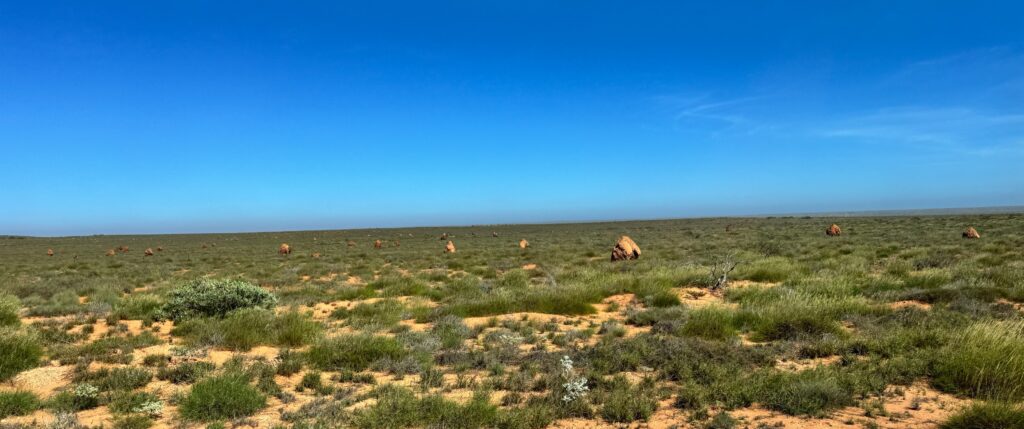
    Dans toute la région on trouve aussi de magnifiques termitières parfois de plus de 3m de hauteur et dont les teintes varient entre le jaune et le rouge foncé. Cimentées par des milliers de goutes d’eau et dures comme de la pierre, la chaleur à l’intérieur peut atteindre les 100°, elles sont comme des forteresses déployés à équidistance les unes des autres.

  • Sensations from Western Australia

    One of the reasons we chose to come to Australia was because we have family here. The family link is on Roland’s side, Sandy (is Valerie’s second cousin) and Kate (his daughter, is Roland’s third cousin) met us at Perth airport, just as Lydia (Kate’s daughter) did in Melbourne. The sensation of being a VIP thus continues.

    Sensations refer to physical feelings and also to feelings of excitement. WA has produced a series of sensational experiences so far – a riot of striking colours, powerful unforgettable landscapes, generous and friendly people, as well as the most amazing diverse wildlife. A unique, raw, intense, wilderness.

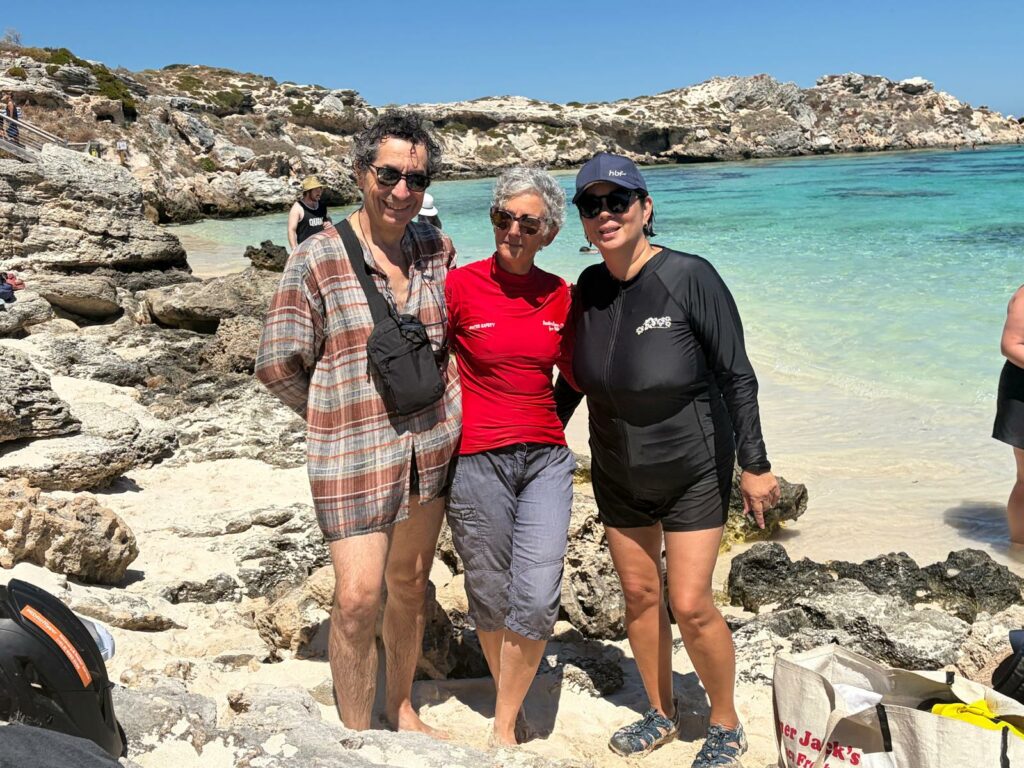
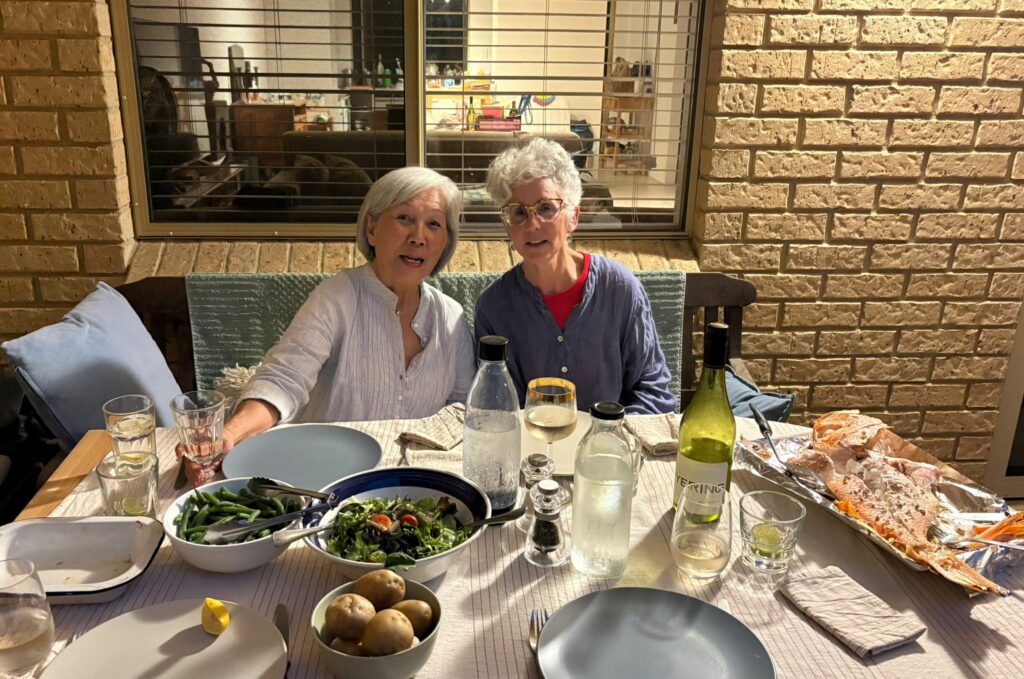
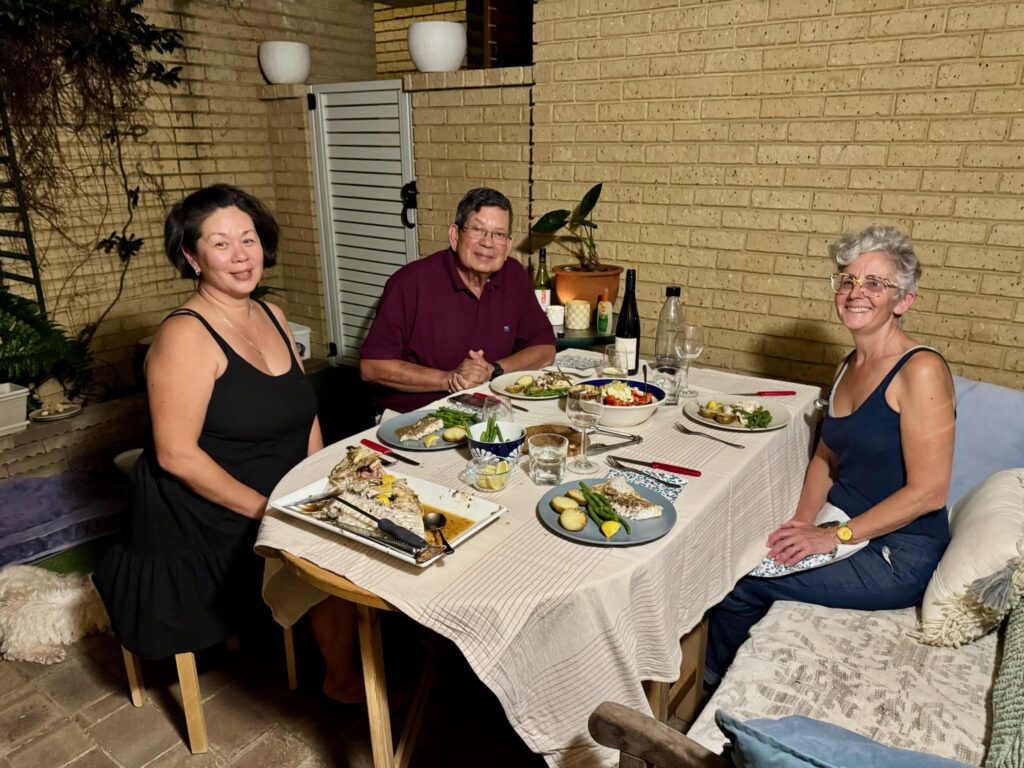
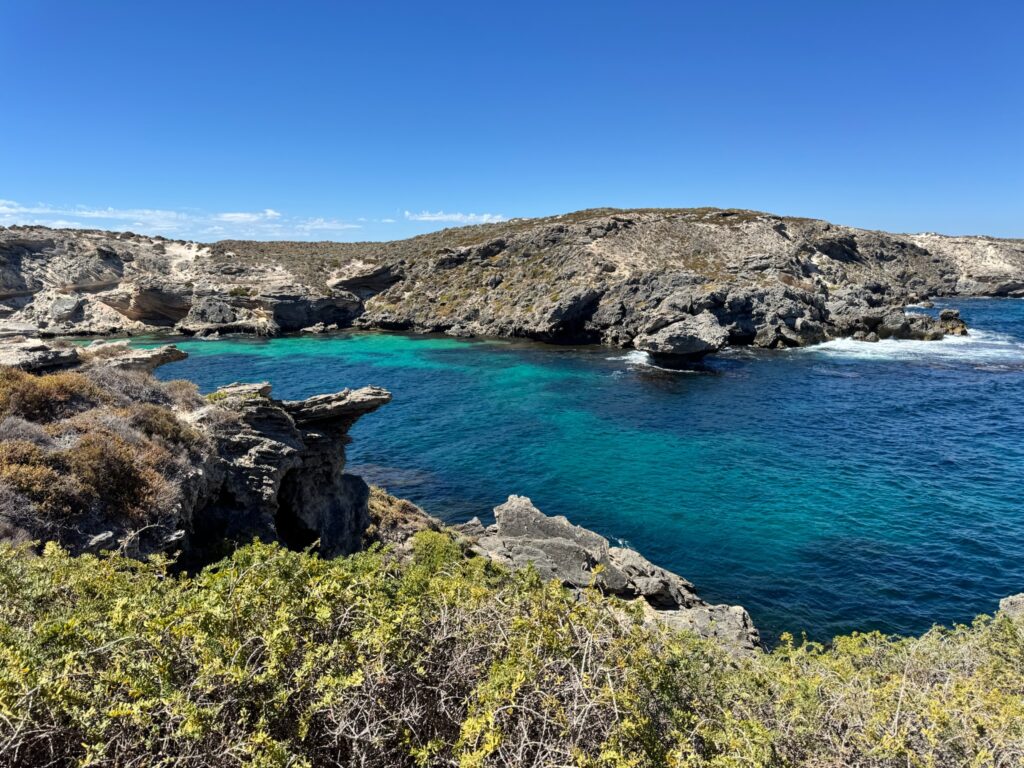
    After settling in at Kate’s flat we caught up and cooked the biggest snapper I have ever seen. Our first Perth experience was a day out to Rottnest Island, which Kate had planned for us, with Joanna, a friend of hers, whom we have already met in Paris. After the ferry, Roland and Joanna biked up and down the island and Kate and I walked and took the bus. We met up at various bays, coves and beaches and learnt the art of a quick swim to cool off.  Deep turquoise beaches with wind, purple coral and multi coloured fishes that even I could see, thanks to Kate’s gift of goggles. I saw one quokka and Roland saw a lot more, being on a bike.

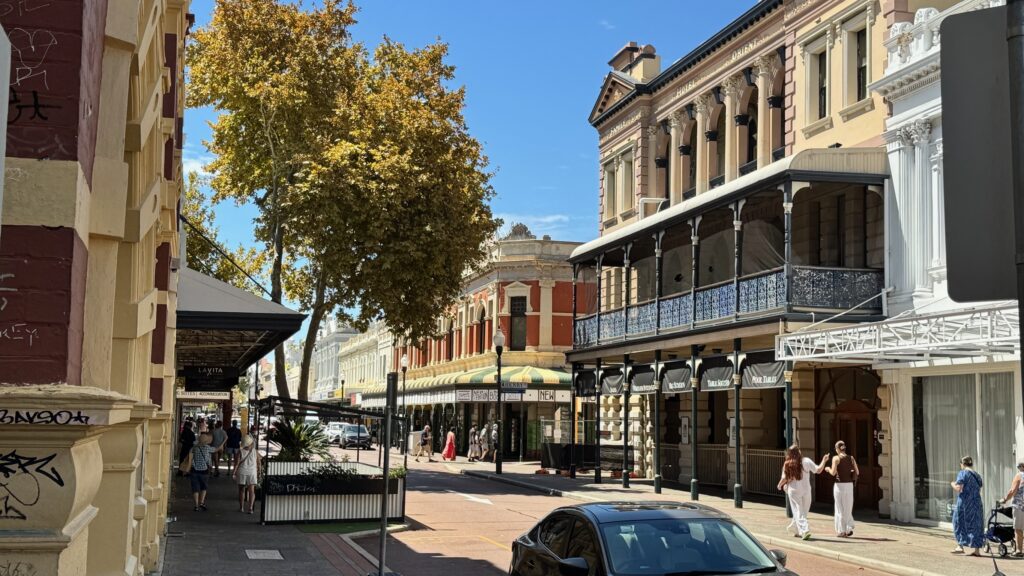
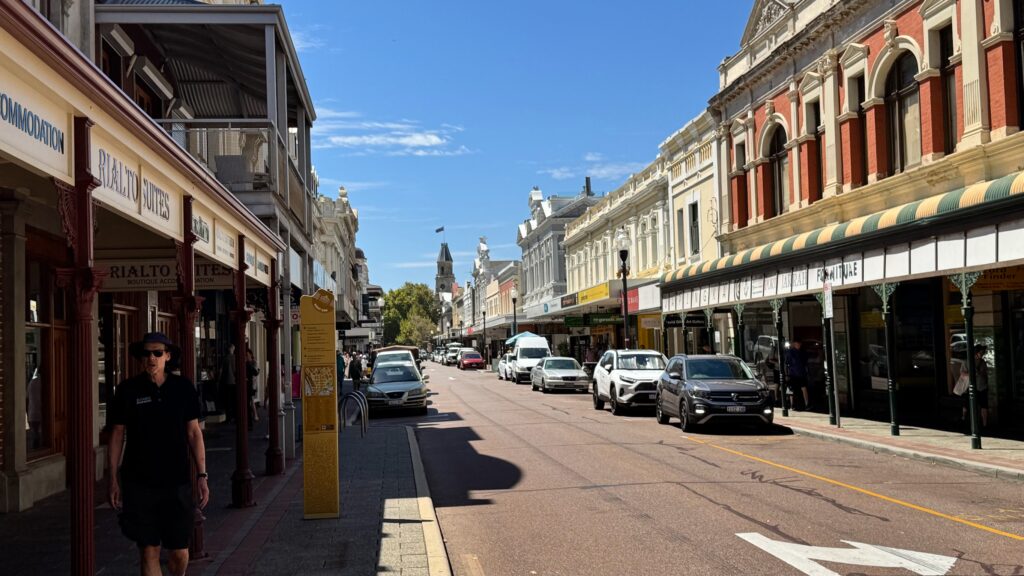
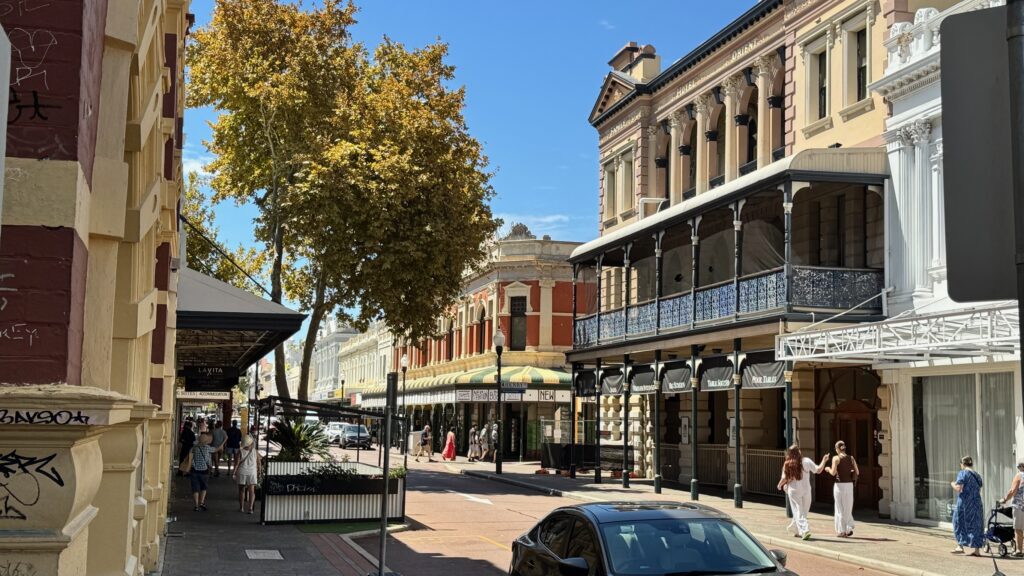
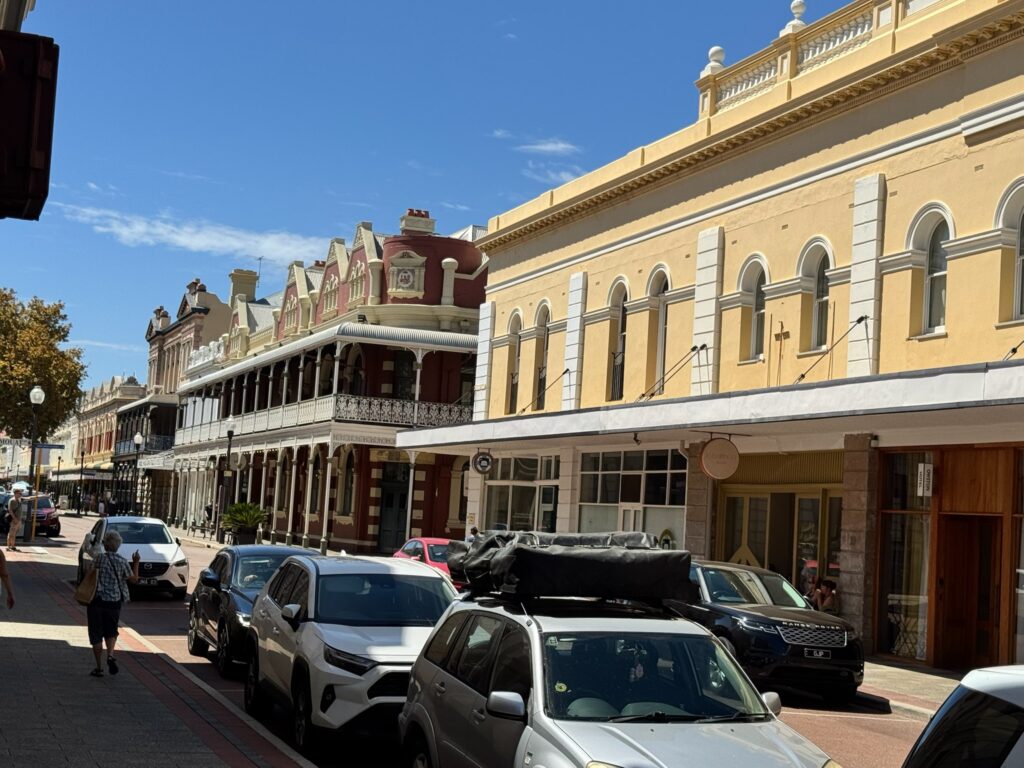
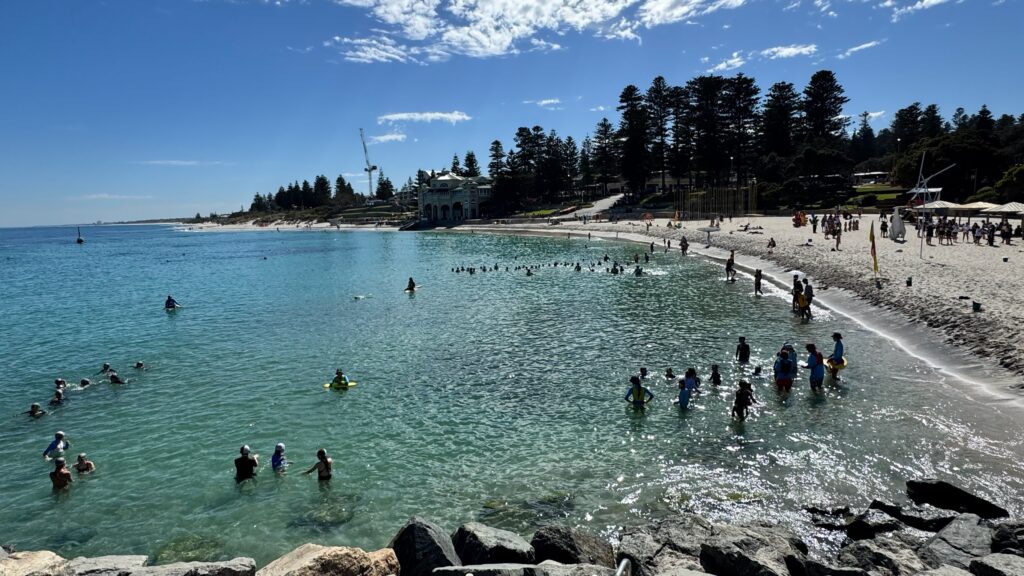
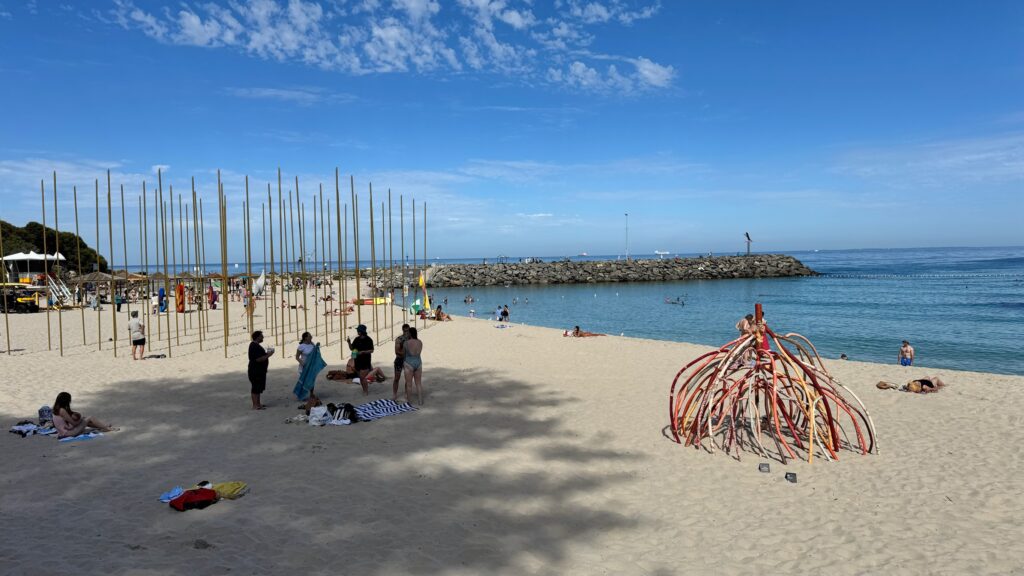
    Kate showed us some of the highlights of Perth, including Freemantle, where we walked up to the top of a pub and sat down to admire the rooftops and old buildings. Swimming inside a shark net on Cotesloe, alongside the sculptures on the beach, was another memorable first. Sandy prepared a delicious meal for us with members of the family and we spent a very convivial evening in his grand house.

    Preparations for our trip up North included the acquisition of 30l of water and other provisions in case of emergencies,  delighted that Kate decided to join us for the first few days. We finally had the pleasure of meeting Olivia (Kate’s mother) properly, over another fish dinner. She has generously supplied us with home-grown mangoes, home-made honey and other delicious goodies and I thoroughly enjoyed spending the evening with her.

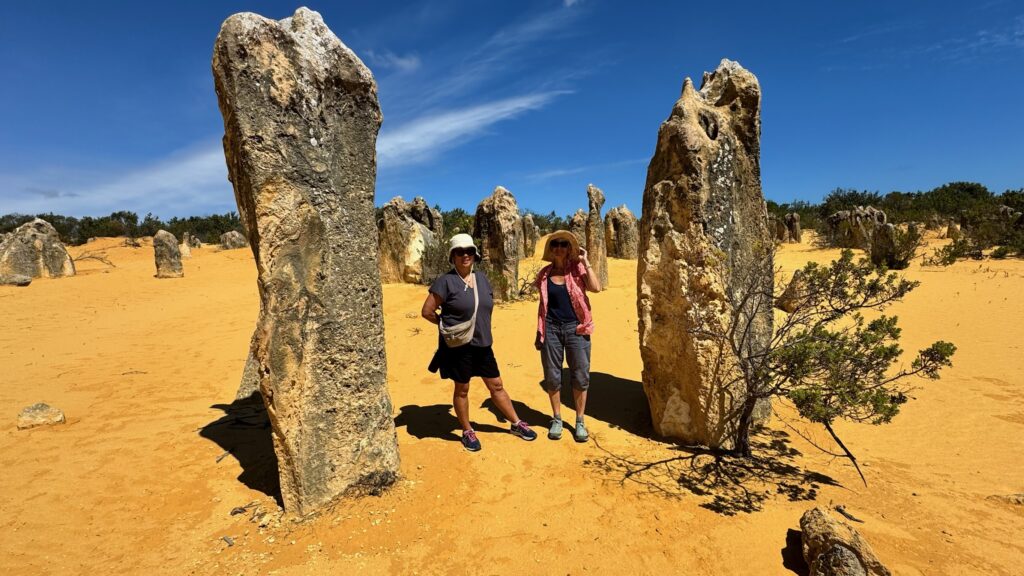
    The first sensation of the WA road trip up north  was the yellow Pinnacles. The strikingly yellow sand and eerie strange rock formations are like nothing seen before. The rocks look like little figures from another planet. No one quite understands how they are formed.  There is a First Nations’ story of people sinking in the sand and reaching out with their hands, before the sand engulfed them.

    The bright yellow stands out amongst the whiteness of the neighbouring sand dunes. The long long drive to Kalbarri where we arrived late that evening was rewarded by our first sighting of kangaroos, albeit on the lawn of the town centre, as if they were strays. 

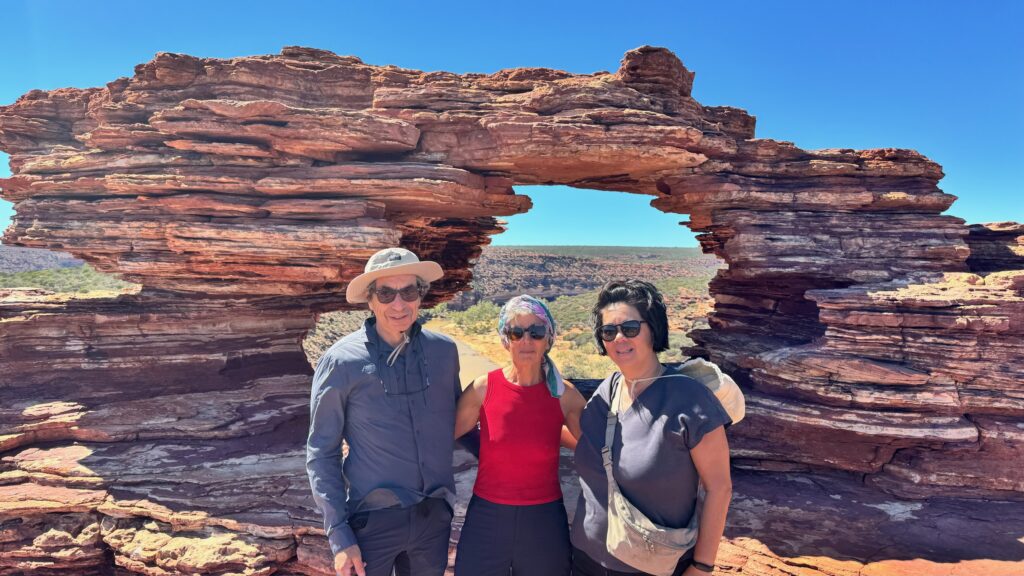
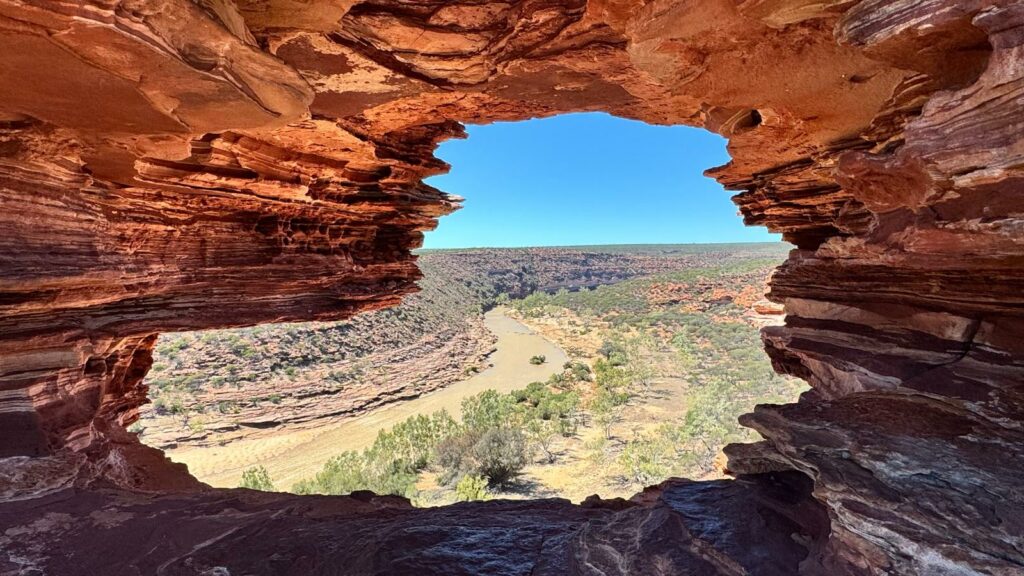
    The next sensation was the red earth canyons of Kalbarri. Denied the pleasure of the loop walk, both by the park prohibitory rules about the heat  after 7am and the very annoying  flies, we contented ourselves with a visit to the skywalk and Nature’s Window. We paid hommage to Tobias, who came here in 2012, recognizing we are following in his pioneering footsteps.

    Sadly Kate left for a long bus journey back early the next morning. We drove on North, stopping to look at the environmentally important stromatolithes on Hamelin Beach which were less impressive to look at. We were stunned by the very white

    Shell beach, where the approach to the sea is an uncomfortable (if you don’t have the right shoes) walk across a crunchy beach made of the tiniest white sea shells. The water is excessively salty. This odd landscape, with a turquoise shallow sea, proved almost impossible to capture on the camera.

    On our way towards our next stop at Monkey Mia Beach, we saw several  emus crossing the road majestically, as well as big thin lizards, called goannas. We had now arrived in the red, red earth of the desolate North, contrasted at Monkey Mia by a beach where one side is white (limestone) and the other red (sandstone). Although this particular place to stop was not our cup of tea at all, we were rewarded by a beautiful sunset and sunrise in  and from the sea , along with 4 our 5 dolphins swimming 3 m from the sea shore. In addition to this particular sensational sighting (I have already lost count), there were huge prehistoric-looking pelicans with pink beaks, sea turtles and massive fish, seen from the jetty. 

    The next day we retraced some hard-earned kms and passed the fork to the Useless loop road, accessible only to drivers of 4 wheel cars. Our next stop was at Wooramel, a rustic  and well organised, pleasant campsite, boasting of hot river springs from a subterranean river 240 m deep. Needless to say, all the rivers we crossed in the Northern bush were dry and empty.

    A starry starry night: a sight to behold. We  realised we needed a new constellation map to get our bearings, the luminous Milky Way being our best marker for now. We have since acquired some markers and now recognise the Southern Cross and Orion’s Belt, thanks to Kate’s help and Julian’s stellar app.

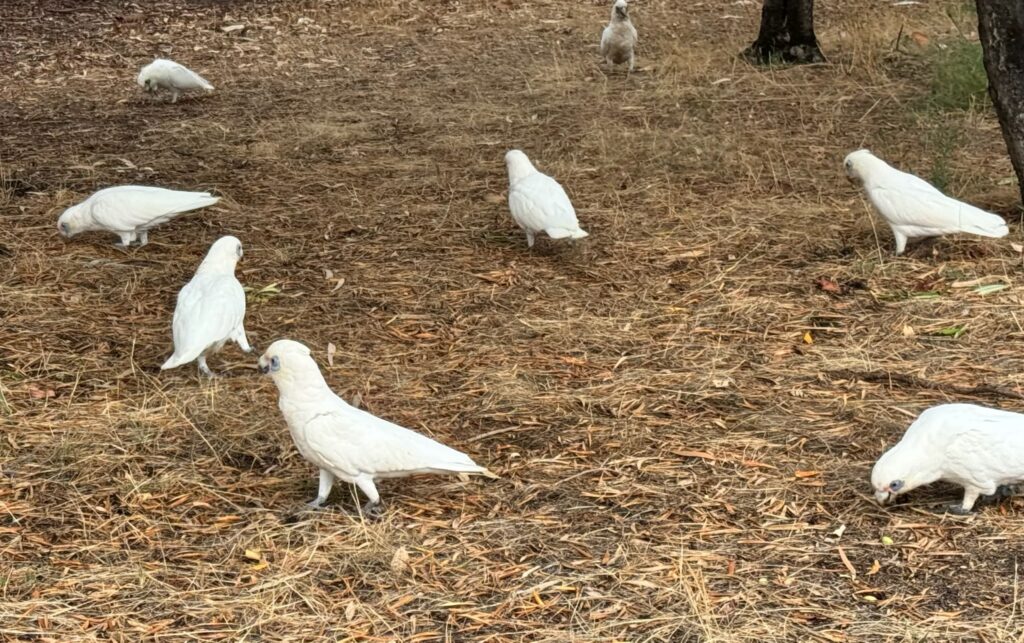
    Leaving Wooramel before breakfast and coffee ( a not to be repeated decisoon) we saw and heard white parrots in flight and more kms of red, red earth.

    After handing in the smallest car on the road in WA, we met Julian ( my brother) off the plane at Learmonth airport. We would have taken a photo but it’s strictly forbidden, as it’s in a military area. After a short drive to Exmouth in a now whopping 4 by 4 and settling into Ningaloo Lodge, we decided to visit

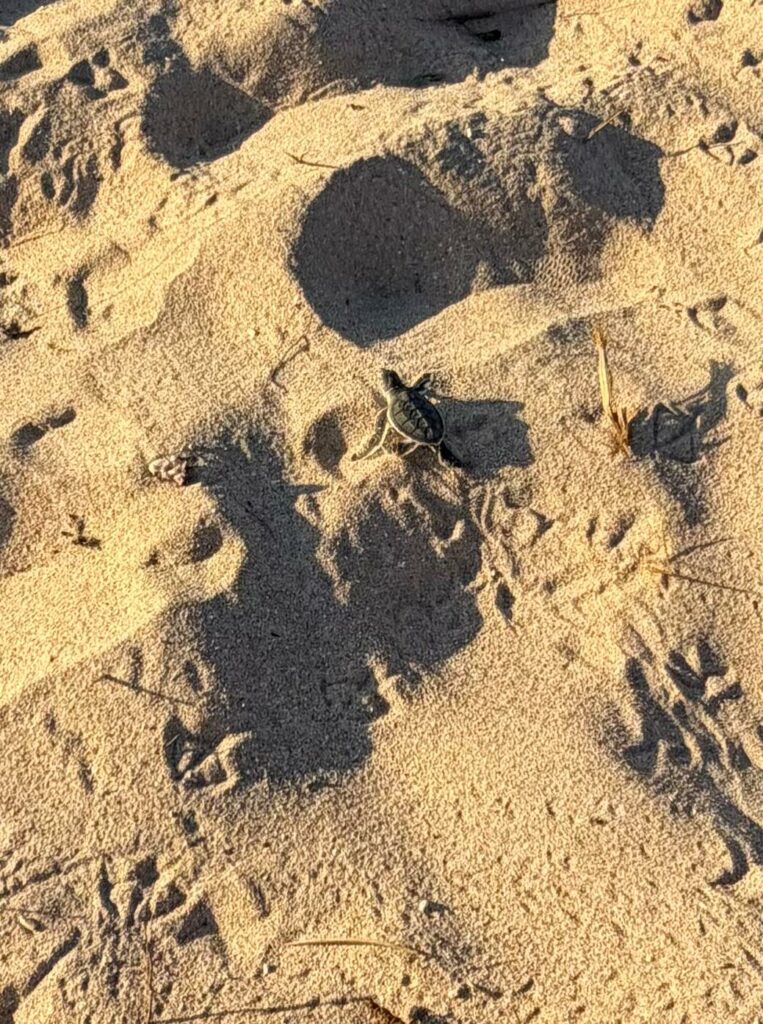
    Turtle beach, on the Ningaloo Reef, in the late afternoon. We struck gold and and stared into awe at dozens of green turtle hatchlings making a run for their lives and the sea, at the end of the day. If the gulls or fish don’t catch them, they can live for up to 60 years. An epiphemenon of Darwin’s theory of the survival of the fittest.


    Next day we went on our own snokelling outing at Turquoise Beach, which more than lived up to its name, where we saw a vast amount of amazing multi coloured fish, the likes of which I have never seen. I swam with a turtle. Julian was delighted by our ability to find the perfect picnic place at the beach. 

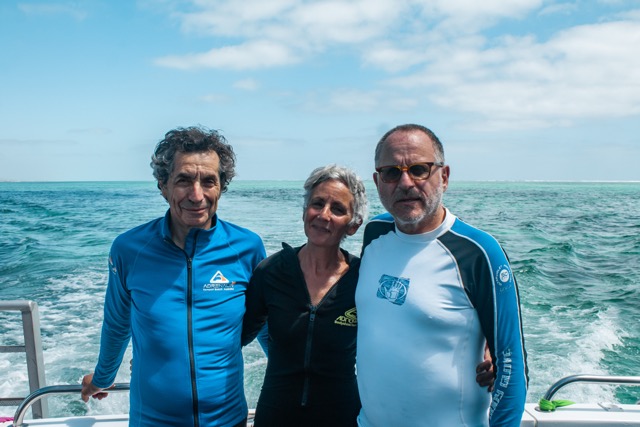
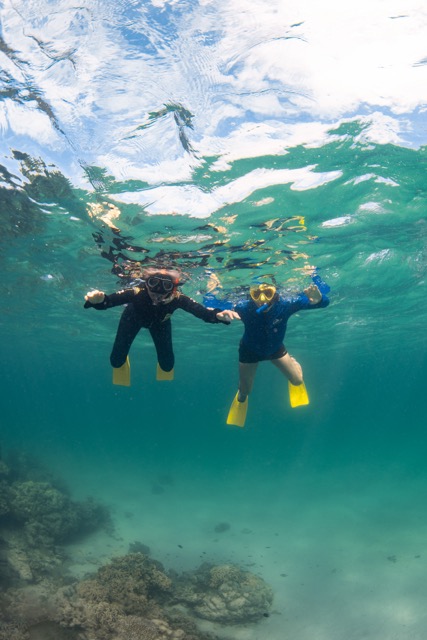
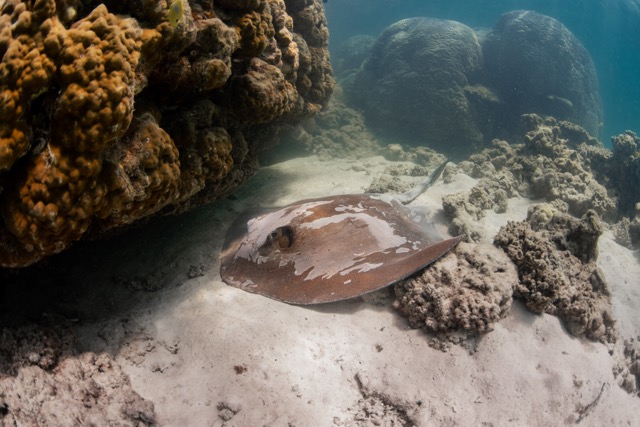
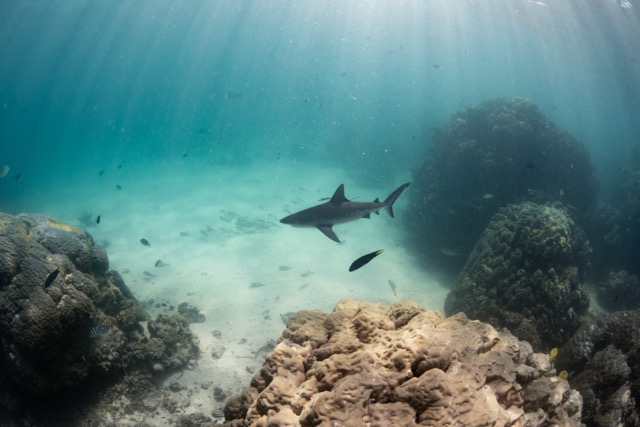
    Our next sensational experience involved a personal epiphany. We had booked to go on a shark whale outing, though Roland and I didn’t sign up for that part. The excursion involved 2 long snorkeling expeditions and I used prescription goggles for the first time in my life. It was like being given back the sight I do not remember having, my first pair of glasses having been acquired with many tears, at the age of 8. Suddenly I could see in the water and gazed at multi-coloured parrot fish, butterfly fish, neons, chromies, a shoal of juvenile barracudas, many crocodile fish, 2 stingrays (one enormous with a wedge) and a reef shark. We also 2 octopi, a huge clam and star fish, along with a myriad of other aquatic wonders, including purple coral.  Julian swam with a grouper. 

    Here are a few photos made by Albert, a young Spanish man and excellent  (professional) photographer, who was on the excursion tour.

  • Perth capitale de l’Australie de l’ouest (WA)

    Perth n’est pas seulement la capitale de l’Australie de l’Ouest mais aussi sa seule véritable ville, l’état de West Australia (WA) étant également le plus grand parmi les six, avec un bon tiers du continent à lui tout seul et une population humaine de 3M d’habitant soit 1.15 habitant par Km2 dont les 2/3 à Perth.  Construite sur du sable, malgré quelques grattes ciels, au centre près du port de plaisance de la river, histoire de montrer sa hauteur au reste de la fédération, la ville s’étend surtout à l’horizontal, sur une bande sud-nord d’une centaine de km, sur une vingtaine, entre la mer et les collines boisées du Helena National Parc. Les autres agglomérations ressemblent davantage à des chefs lieux de canton, parsemées de quelques dizaines ou centaines de petites maisons, généralement préfabriquées, alignées sur une grille autour d’un mini centre avec quelques commerces et leurs parkings. Sauf qu’ici chaque circonscription s’étend sur des centaines de km.

    Entre ces nœuds, comme dans les peintures aborigènes, s’étend le bush, mot générique pour des paysages tous différents outre trois composantes communes : une surface de terre sableuse ou rocailleuse, dont la couleur varie entre le jaune-gris et l’ocre-rouge foncé, une végétation d’arbres, arbustes ou buissons, plus ou moins dense et un tapis plus ou moins serré et d’herbes drues. C’est là que se cache la population la plus importante d’Australiens, les animaux sauvages ou semi sauvages : kangourous, wallabies et marsupiaux de toutes tailles, émeus, dingos, chèvres et même chameaux ( apportés d’Afghanistan  par des migrants afghans au 19e siècle pour transporter les marchandises à travers le désert), reptiles lézards et serpents et oiseaux comme les cockatoos (cacatoès blancs) ou galah (cacatoès à la tête rose) rassemblés parfois en grandes colonies très bruyantes au lever et au coucher du soleil. 

    On rencontre quelquefois les animaux terrestres, surtout la nuit et comme en Tasmanie malheureusement écrasés morts sur le bord des routes, ce que les australien appellent roadkill. La faune maritime est la plus extraordinaire que nous n’ayons jamais vue, poissons, des mammifères marins, tortues …etc (à suivre)

    À Perth nous avons retrouvé ma cousine Kate (Katerina Bril) qui nous avait rendu visite à Paris avec sa fille Lydia. Nous avons aussi diné chez Sandy, le protagoniste de l’histoire et cousin de ma mère.

    L’histoire de ma famille avec l’Australie de l’ouest est une véritable épopée comme tant de familles émigrées en connaissent. Joseph, le frère de mon arrière grand mère maternelle, Amalia Bril, s’est échappé de Roumanie dans les années 30, où l’antisémitisme était problématique, pour l’Italie où il a épousé Josephina, dont la famille corse, qui détestait Mussolini, est parti s’installer en Australie de l’Ouest. Joseph n’aimait pas le climat et s’engage alors dans l’armée américaine pour aller se battre contre les Japonais aux Philippines, où il rencontre la jeune Maria Isabel avec qui il a deux enfants dont Alexandre (Sandy).

    Sandy épouse la charmante Olivia aux Philippines et ils s’installent à Perth où ils ont 4 enfants dont Kate. En dehors de son activité professionnelle Sandy se passionne alors pour la généalogie. Un jour au début des années 2000 Sandy envoie un email à mes parents : je suis votre cousin australien, je viens bientôt à Paris et aimerais bien vous rencontrer. Ensuite mes parents sont allés à Perth en 2004 et Tobias, lors de son grand tour d’Australie en 2012, a été quelques temps accueilli chez Kate et sa fille Lydia. Plus récemment Lydia est venue à Paris au printemps dernier, c’est elle que nous avons retrouvée à Melbourne en février. 

    Grace à Kate, nous avons découvert l’île de Rottnest,  une île parc à une heure de bateau du port de Fremantle où j’ai fait en vélo le tour de l’île de plage en plage avec Joanna, pendant que Ruth et Kate prenaient le bus. Le centre historique Fremantle avec ses façades balconnées et ouvragées s’avançant par dessus les trottoirs pour que les clients s’arrêtent au frais regarder les vitrines. 

    Les plages où Kate nage tous les jours, pour préparer ses compétitions de natation en mer.

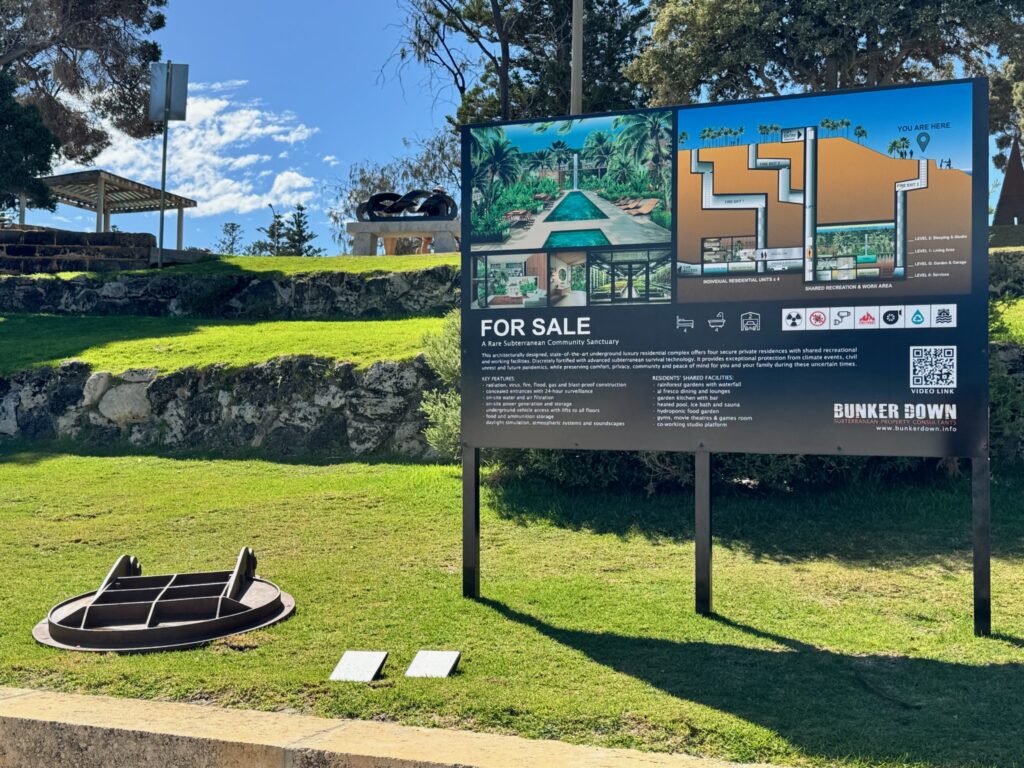
    Nous avons visité la superbe exposition, Sculpture by the sea,  sur la plage de Cotesloe, en plein air, superbement montée, exposée et médiée, comme les australiens savent le faire, avec des œuvres éclectiques mais toutes remarquables et magnifiques dans leur cadre de verdure et au bord d’une mer d’azur.

    Les plages de l’Australie de l’Ouest, il faut bien le dire dépassent l’imagination, par leur dimensions puisqu’elles couvrent quasiment toute la côte ouest, la couleur de l’eau d’un bleu turquoise éblouissant, par le fait qu’elles sont la plupart du temps inaccessibles, sauf à emprunter des « unsealed roads » 

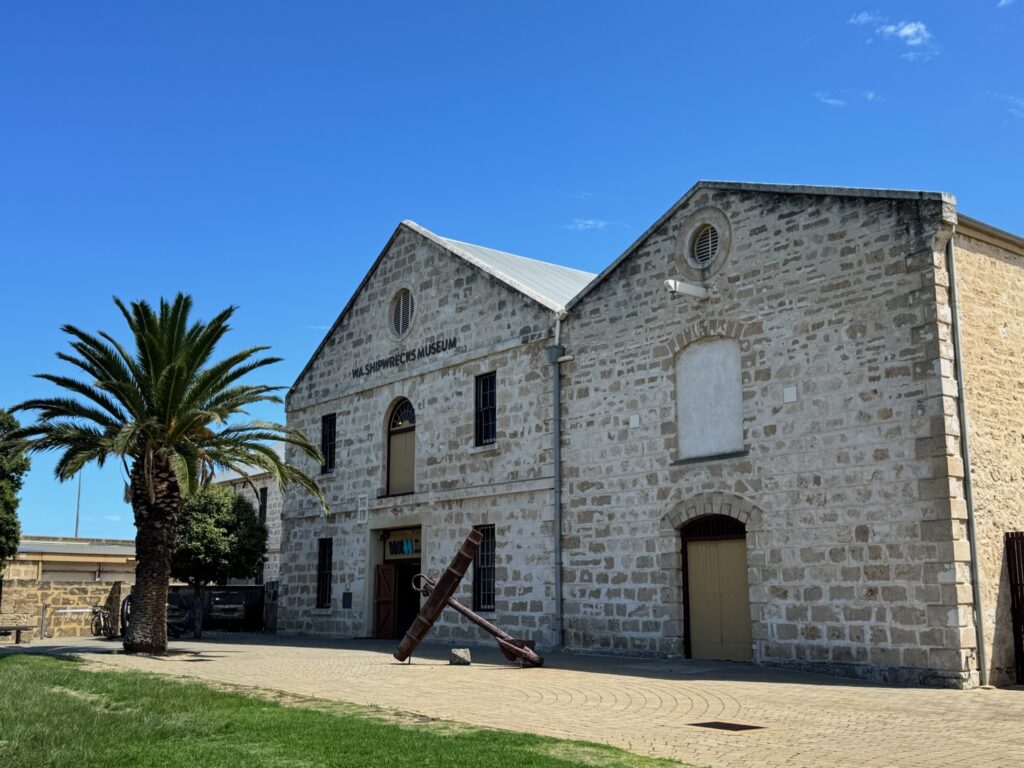
    Perth possède probablement un des seuls musées des naufrages maritimes au monde. L’histoire et la côte en regorge. Beaucoup d’autres anciens bâtiments devenus musées sont des prisons du à l’histoire de l’Australie. Julian nous disait que beaucoup de ses camarades et collègues aux racines australiennes se réfèrent à leurs ancêtres qu’ils soient prisonniers, indigènes ou les deux.

    Après ces quelques jours de retrouvailles et de rencontres très agréables à Perth, nous somme partis à l’aventure avec Kate vers le nord, avons loué une petite voiture, to hit the road again et remonter jusqu’à Kalbarri.

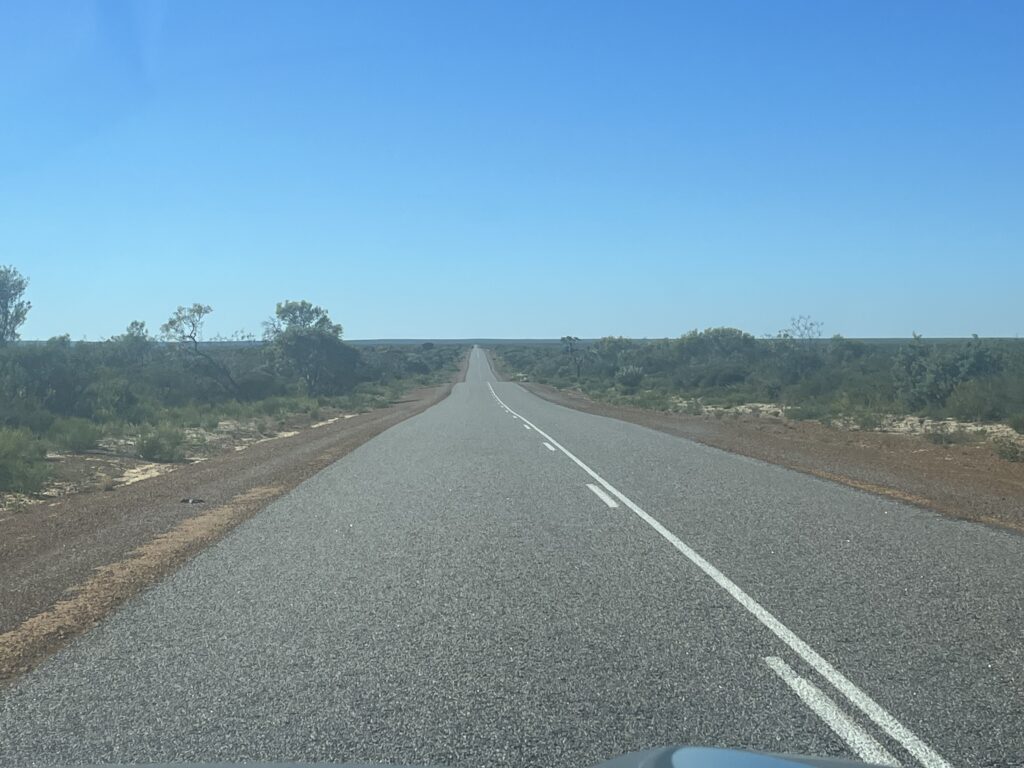
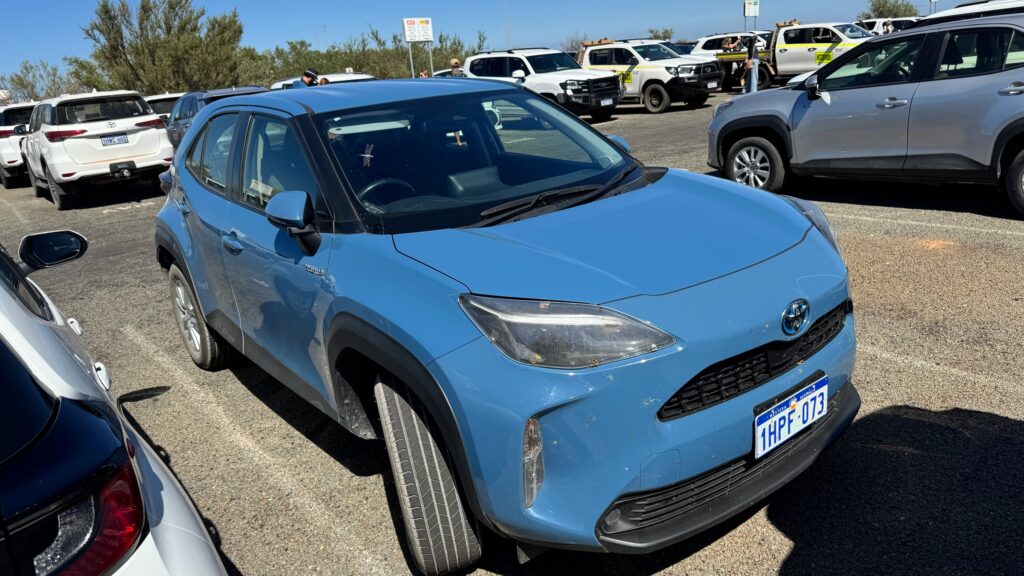
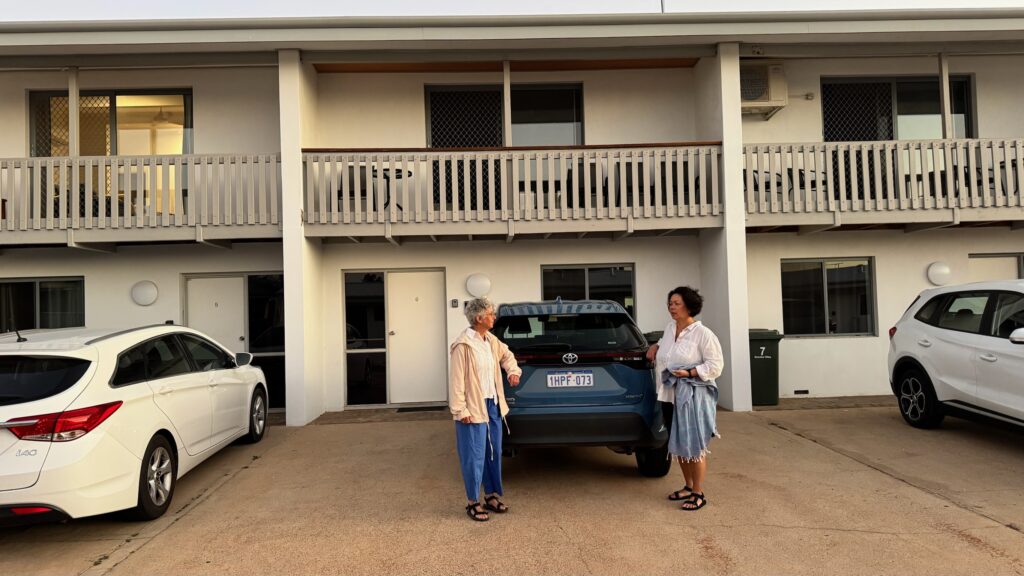
    La Toyota Yaris Cross qui nous avait tout d’abord semblé un peu sous dimensionnée pour le voyage, car plus petite que celle que nous avions initialement réservée, généralement la plus petite voiture sur la route, s’est avérée parfaite, facile à conduire, excellente tenue de route et un cruise control avec auto-correction de trajectoire, tout à fait adaptée aux très longues routes droites et aux plateaux infinis ouest australien. Pas besoin de crisper le pied jusqu’à la crampe sur l’accélérateur à mi course, seulement accompagner en douceur les virages de l’auto-pilote sur le volant.

    Kalbarri est une de ces nombreuses bourgades de la côte ouest avec ses pelouses arborées au bord de la plage et de la rampe de bateaux, ses quelques magasins, la station d’essence Ampol, quelques service, l’IGA (épicerie supermarché), un ou deux cafés, le magasin d’alcool et ses nombreuses accommodations, autrement dit des logements à louer où l’on fait la cuisine soi-même.

    Les 570 km de route nous on pris plus de temps que prévu. Nous  avons fait un arrêt aux Pinnacles. Petit morceau de désert jaune parsemé de monolithe aux formes extraordinaires, comme une armé d‘ombres figées dans la pierre, probablement des reliques de racines de mangroves ou de réseaux racinaires ayant fossilisé avec la terre qu’ils avaient emprisonnée, les ombres stoppées dans leur lente marche d’arbres paléozoïques. 

    A Kalbarri, notre appartement pour trois personnes et deux nuits était plutôt luxueux : duplex super propre, dénudé et fonctionnel de 75m2, énorme cuisine salle à manger avec un frigo gargantuesque trois portes, que nous avons bien utilisé, un salon genre home cinéma avec un écran de télé encore plus géant, que nous n’avons pas utilisé, deux chambres, une salle de bain avec laundry, une terrasse, un petit jardin et un parking pour deux voitures.

    J’aime beaucoup ces petites villes travailleuses et isolées, où on trouve de tout, des savoir-faire incroyables, où tout semble visible alors que l’essentiel est caché à la vue et ce n’est qu’avec le temps qu’on peut vraiment appréhender le génie du lieu. Bien sûr je n’aimerai pas y vivre, conscient que ces petites communautés sont des compressions de sociétés où voisinent et se télescopent les extremes. 

    Canarvon, Denham et Exmouth empruntent un modèle comparable malgré des différences fondamentales, notamment sociales et en terme d’activité. Alors que Canarvon et ses quartiers pauvres vivent d’immenses cultures de fruits et légumes, Exmouth est principalement occupé par le tourisme et sa station de communications navales Harold E. Hol, un énorme réseau d’antennes radars et radio tournées vers le ciel américano-australien.

    Pendant ce voyage nous avons souvent marché dans les traces de Tobias qui est passé ici dans le sens inverse il y a presque 15 ans et nous a aimablement conseillé de choisir plutôt l’ouest que l’est de l’Australie pour ce voyage.

  • Tasmanie Impressions

    La lumière y est de diamant et les nuages de plomb. Une île en forme de cœur. Un bijou qui s’abîme néanmoins.

    Deux semaines en Tasmanie, trop court pour comprendre, trop long pour ne pas voir.

    Changement complet d’ambiance

    Ici on se sent un peu au far-ouest ou dans le middle-east des USA, autrement dit la Tasmanie est très américanisée. D’ailleurs on tournait des westerns dans les petites villes comme Zeehan.

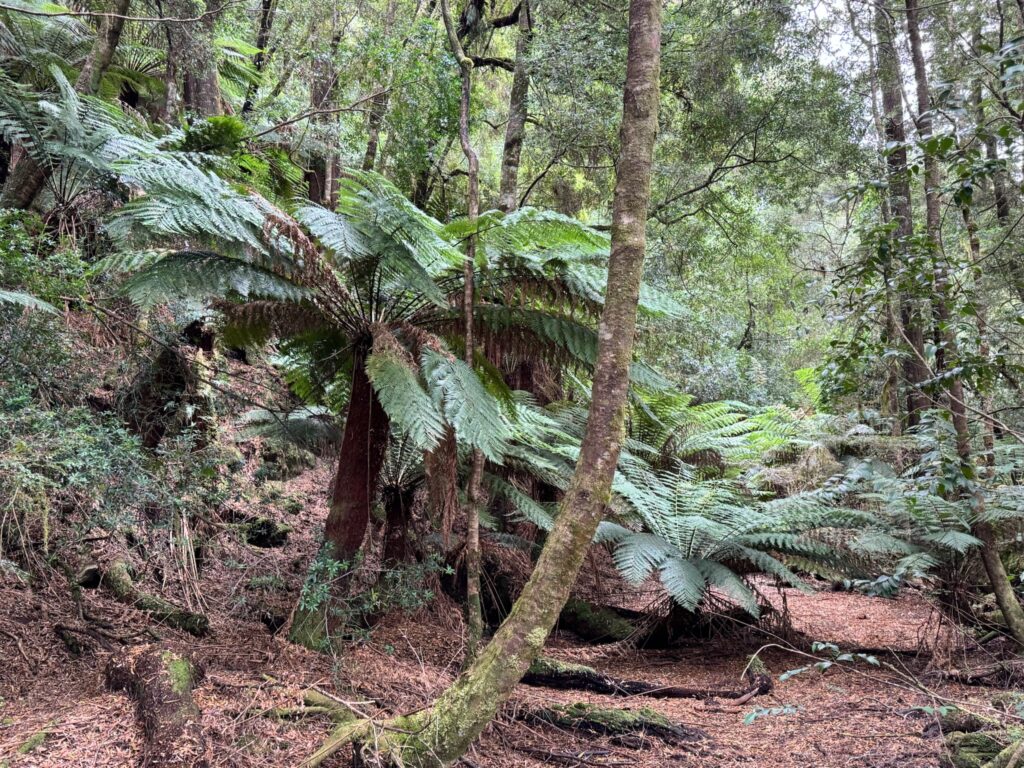
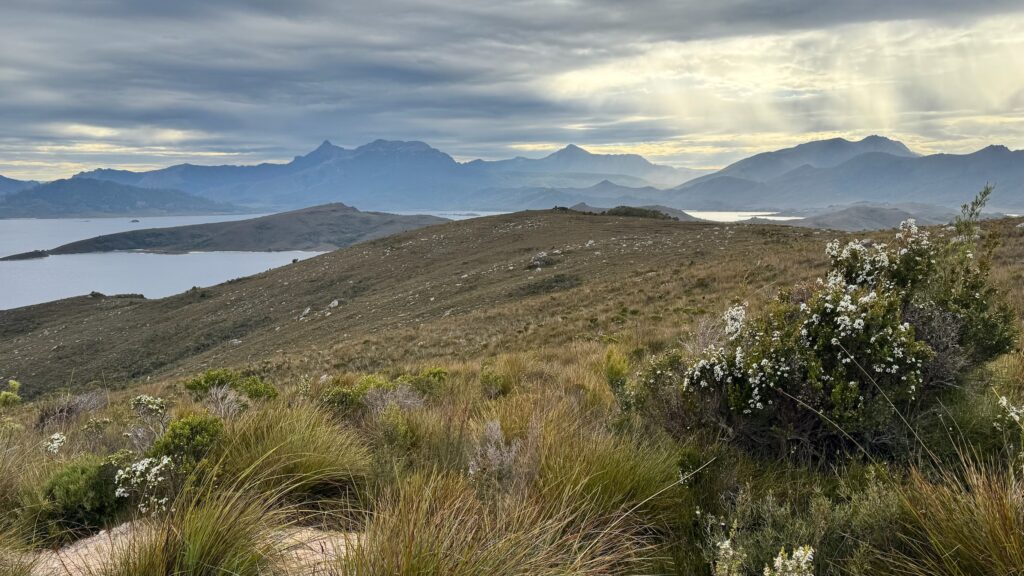
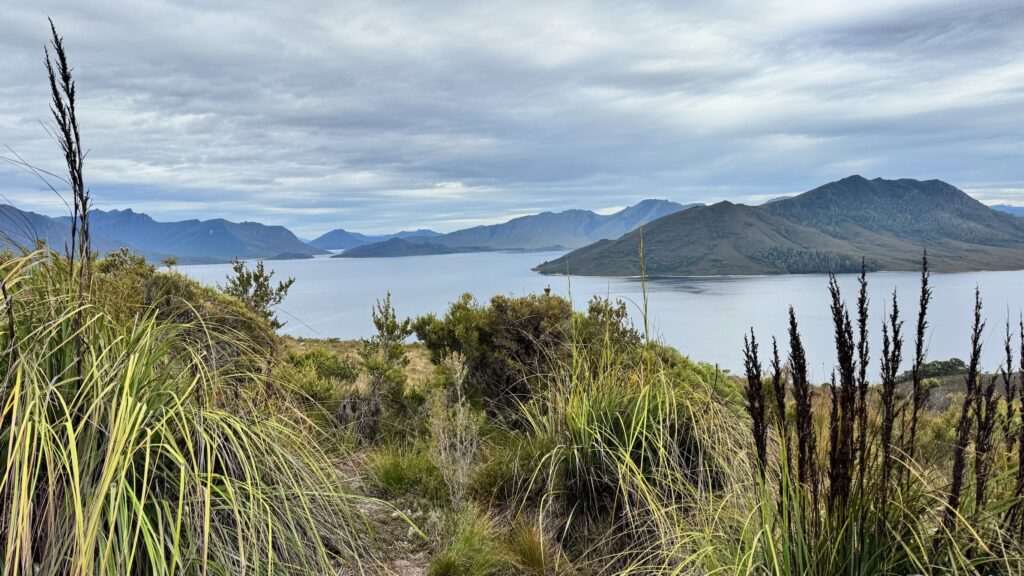
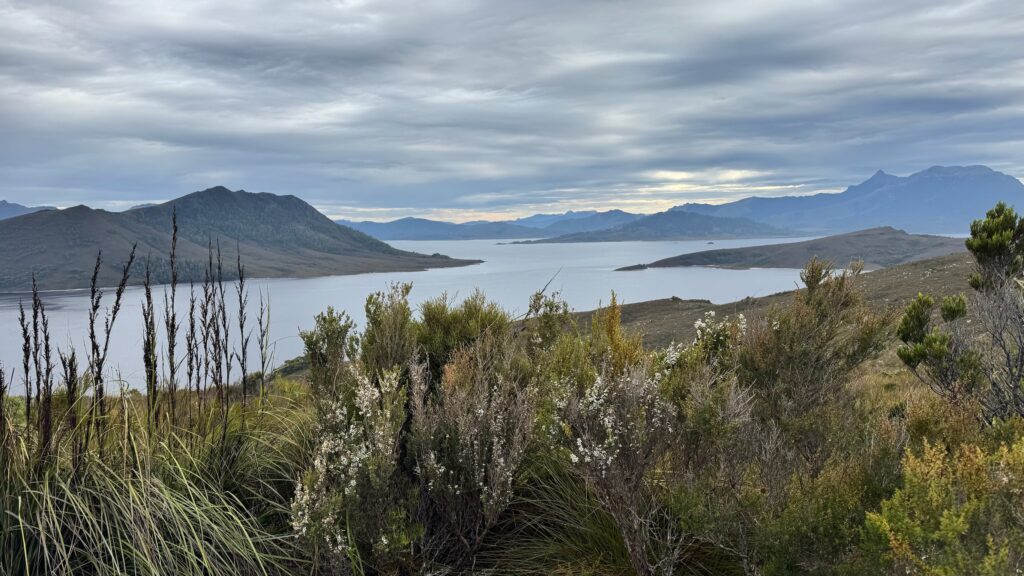
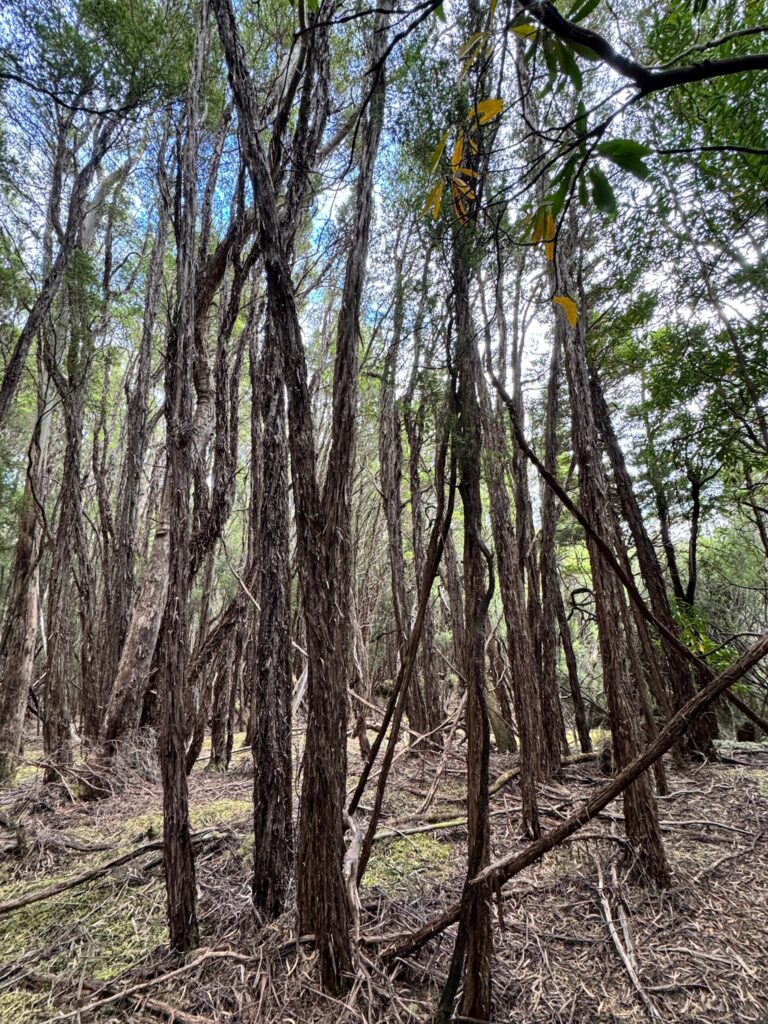
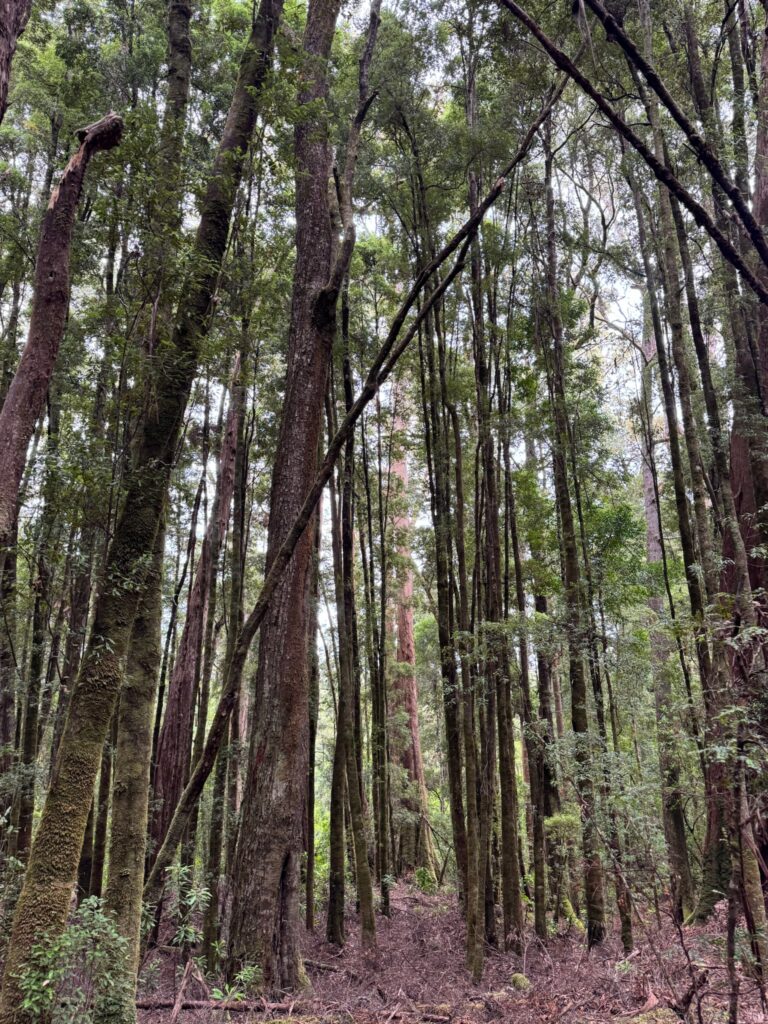
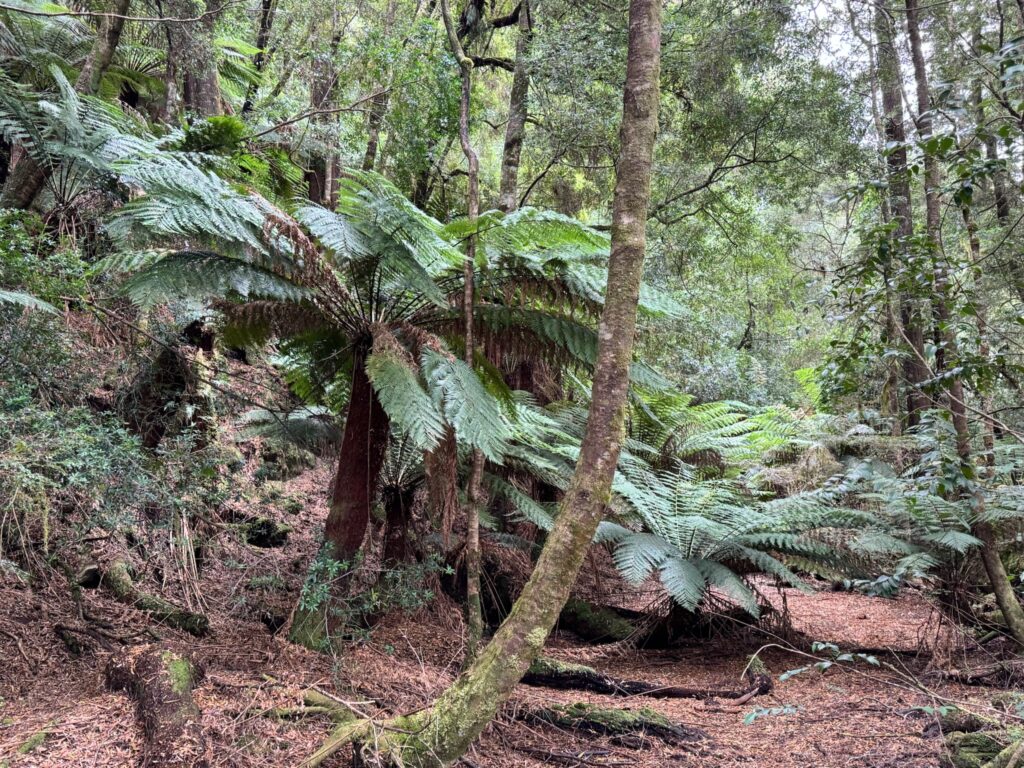
    Les paysages sont extraordinaires, surtout dans les régions sauvages avec leurs forêts primaires. La Tarkine est une forêt vierge primaire froide dans le nord-ouest, unique dans le monde avec des arbres millénaires.

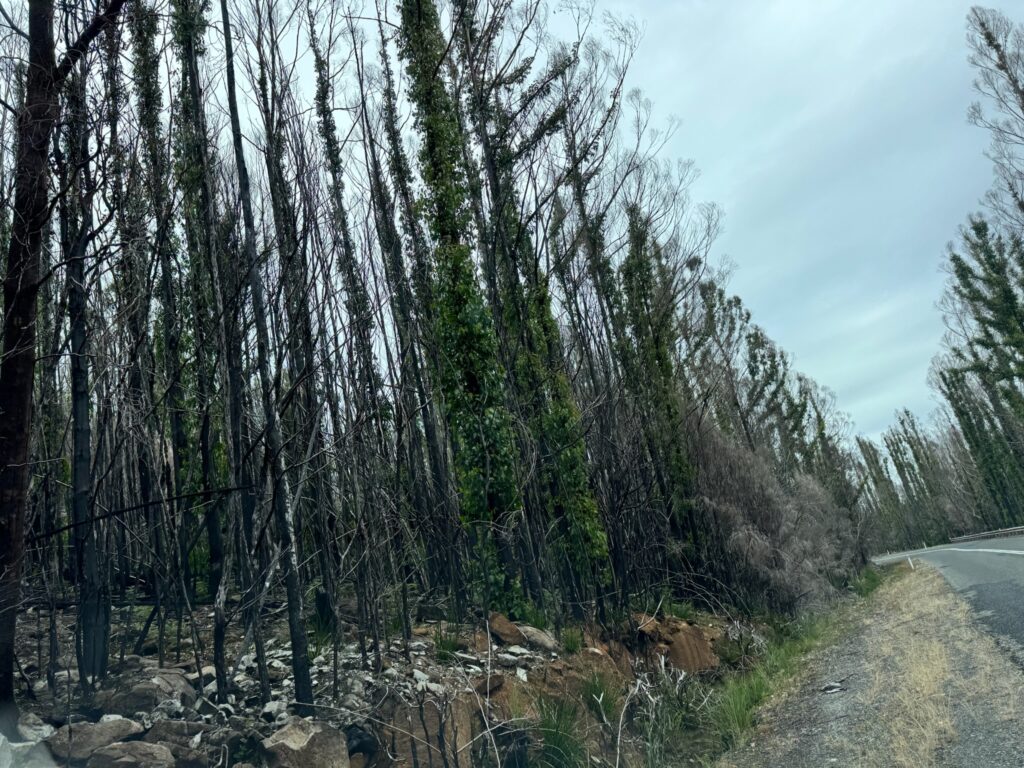
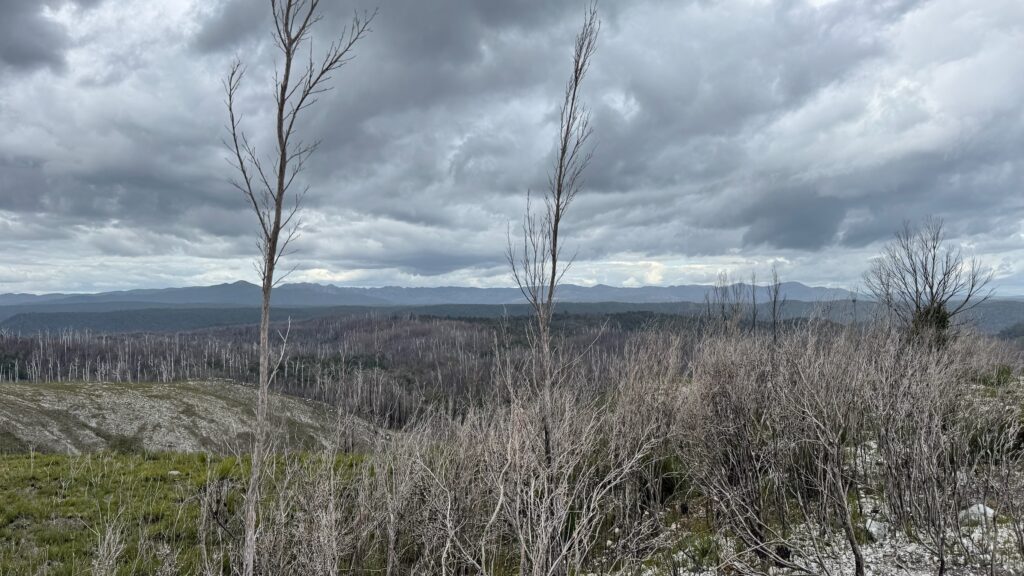
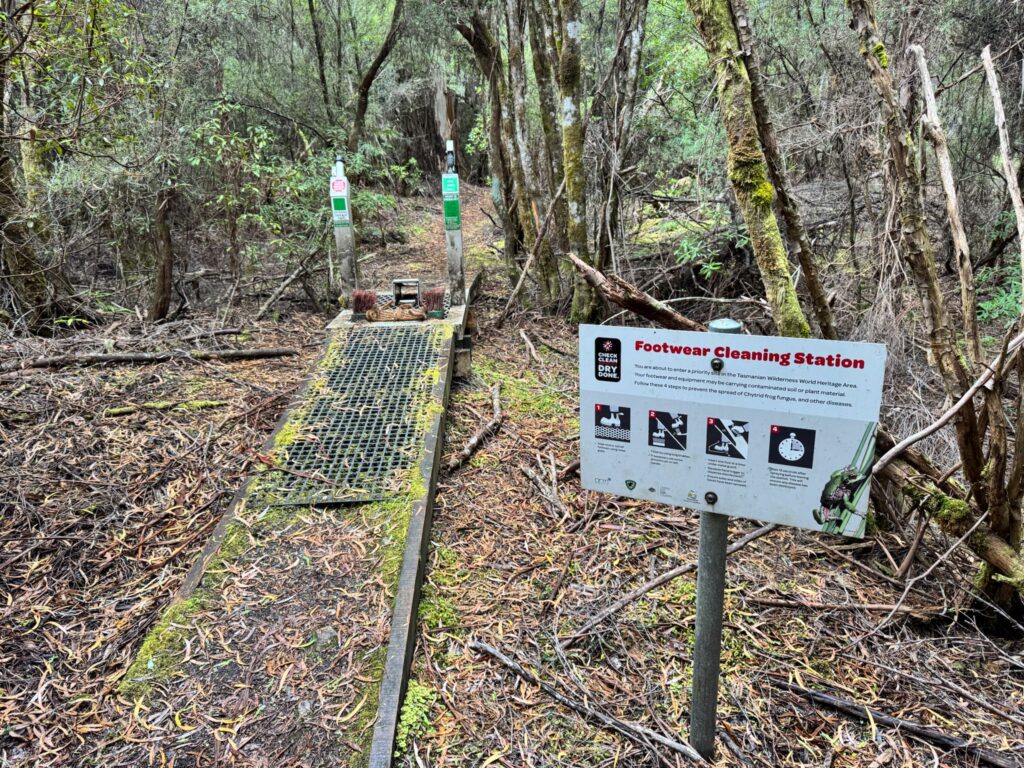
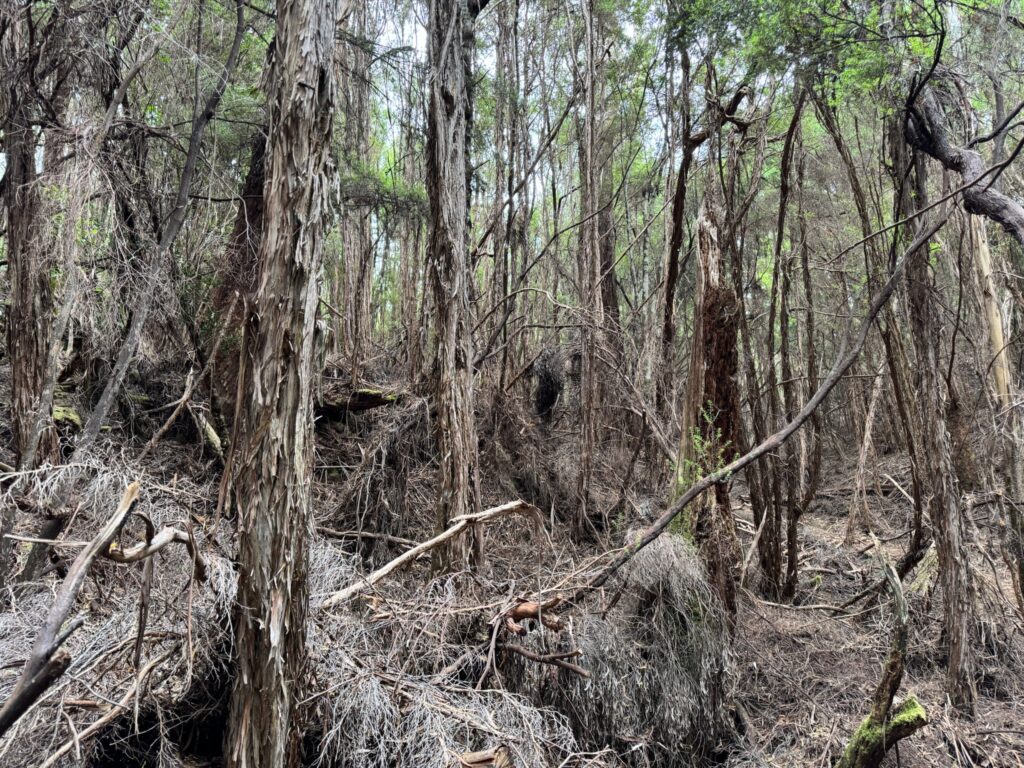
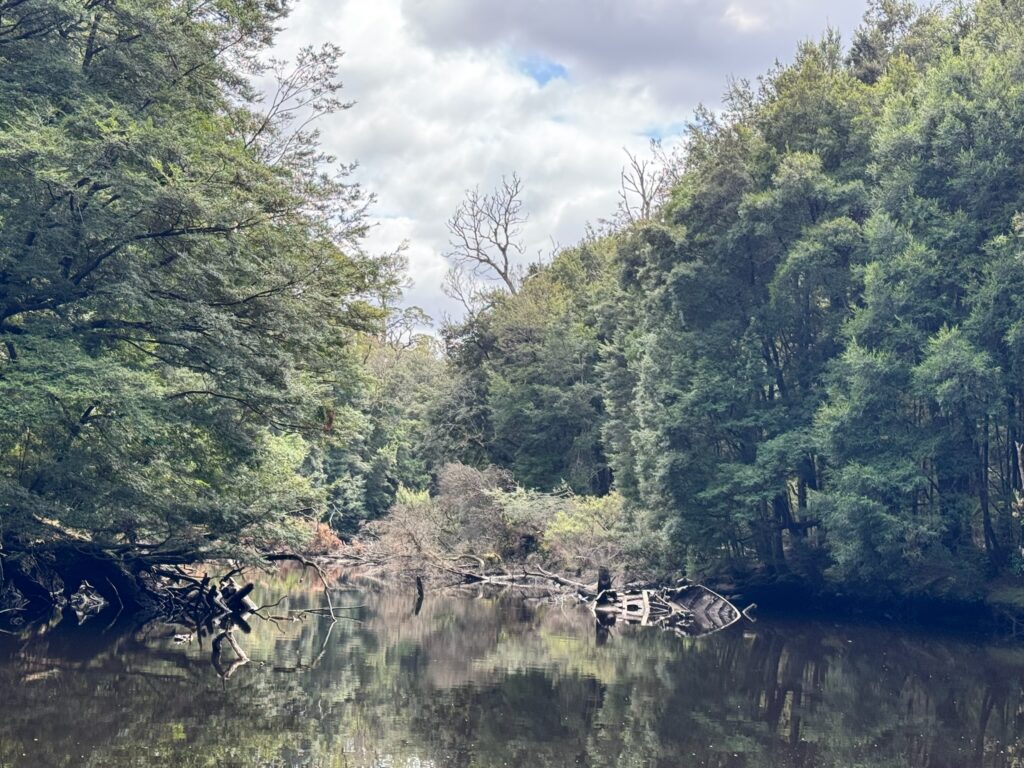
    Malheureusement, les incendies de 2016 et 2025 en ont détruit une bonne partie, en fait une région entière, la partie sud entre les rivière Pieman et Frankland créant un paysage sublime mais désolé parsemé de troncs morts à perte de vue.

    Contrairement à l’Australie, dont les paysages dit-on changent peu, (on verra bien lors de la prochaine étape de notre voyage) les paysage Tasmans changent beaucoup d’une région à l’autre, d’une vallée à l’autre, selon la géologie, l’exposition aux vents, le relief, l’altitude, les réseaux hydriques et et les activités humaines. La côte nord est très construite et parcourue quasi de bout en bout par une autoroute des viles et des routes qui s’enfoncent vers le sud et ne communiquent pas, pour ainsi dire, les unes avec les autres.

    L’Ouest est complètement sauvage, à part un ou deux bleds sur la côte ventée par les quarantièmes rugissants comme Strahan ( prononcer Strawn) et que nous avons vite fui étant donné la surcharge des campings et « accommodations ». C’est à dire très peu de routes, généralement en terre et cailloux quelquefois sur des dizaines ou des centaines de kilomètres, sans rencontrer une maison et croisant seulement quelques 4×4 dans un nuage de poussières ou cyclistes gravels égarés, épuisés et haggards d’avoir mal mesuré la distance infinie à parcourir sur ces routes difficiles.

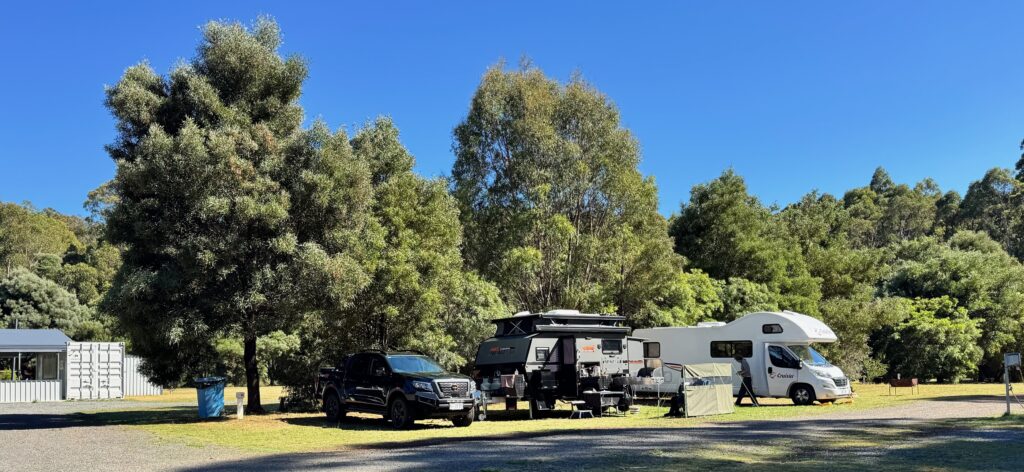
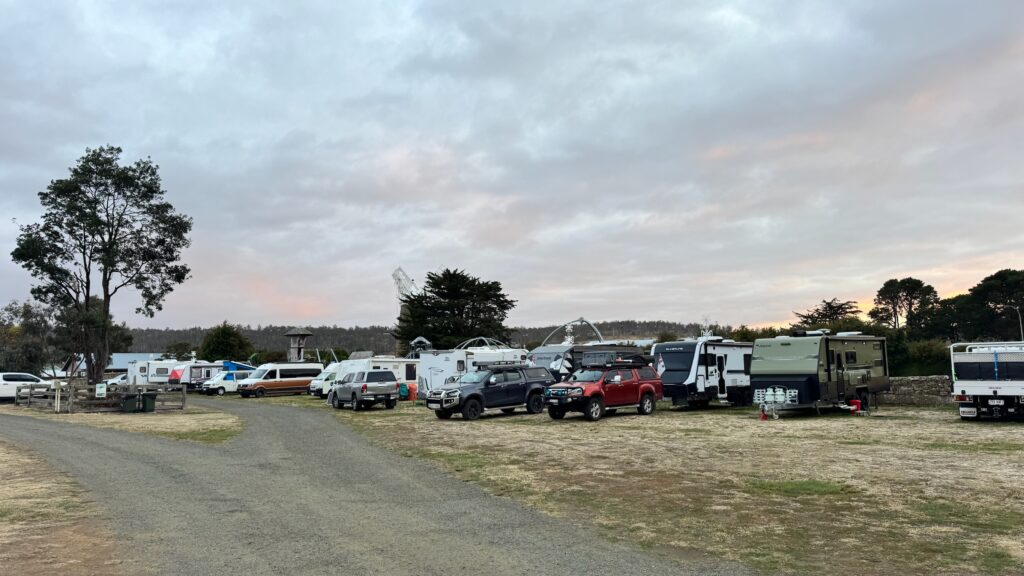
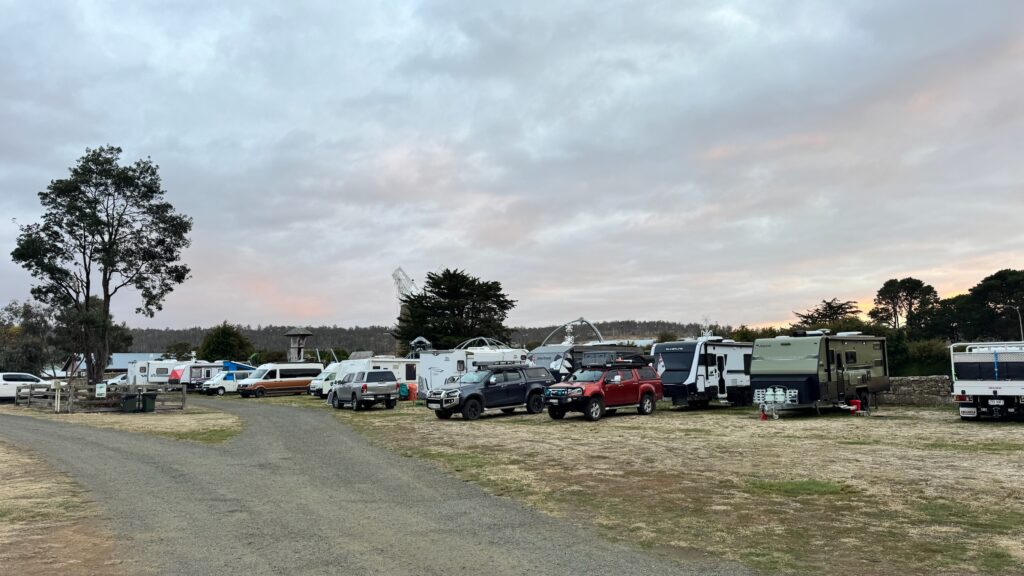
    Les personnes que nous avons croisées et avec qui nous avons échangé étaient soit des touristes australiens, soit des Tasmaniens. Les premiers étant souvent assez typiques : les plus riches dans d’énormes caravanes tous terrains, tirées par des 4×4 rutilants portant les noms de defender, raptor, trooper ou revenger, tout ça pour faire des balades qu’on aurait fait sans problème à 4 dans une 2CV. Tout ça pour se retrouver sur un parking avec d’autres engins du même gabarit comme au salon de l’auto-camping.

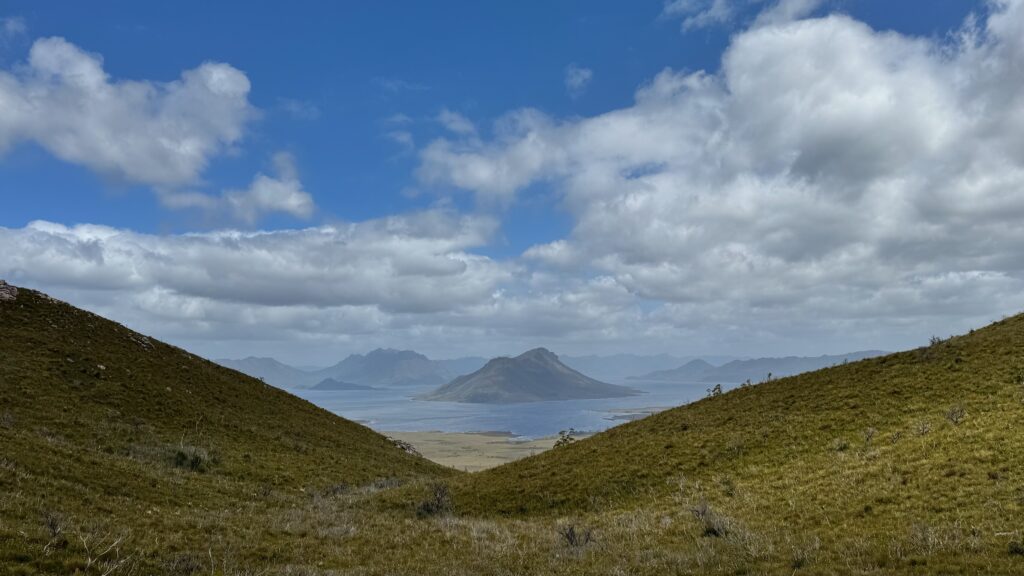
    On ne peut pas ne pas remarquer également que la plupart des voitures font des bruits de camions, et certaines rugissent comme des tracteurs, coutume étrange qu’adoptent généralement plutôt les motards, Pour augmenter leur sensation de puissance et pressés semble t’ils de ne plus entendre. On mesure à quel point l’absence de prise de conscience voire l’opposition à la réduction des nuisances sonores est forte. Mais il y a heureusement aussi quelques piétons, des cyclistes et pas mal de randonneurs carrément sportifs, de tous âges, portant des sacs impressionnants, sur des trails de 5 à 10 jours, intrépides face à une météo qui peut devenir carrément hostile et imprévisible, et bien sûr des marcheurs plus dilettantes mais tout aussi passionnés, familles avec enfants, couples de jeunes retraités, comme nous. Quelques touristes professionnels plus rares donnent dans le style aventurier et nomades, on les rencontre surtout dans les sites naturels les plus difficiles d’accès, comme au lac Pedder/Huon, amateurs d’oiseaux, de vie sauvage, écologistes, scientifiques ou amateurs, avec de grosses land-rovers bien usées, dread locks et bonnets de laine et appareils photos paraissant minuscules au bout d’énormes téléobjectifs peinture camouflage, comme Pete qui nous a fourni en eau en échange de deux verres de vin, alors que nous arrivions bêtement avec seulement 4 litres d’eau et 2 bouteilles de vin. Il rigolait en disant que seuls des français peuvent arriver dans un coin perdu avec du vin et sans eau. 

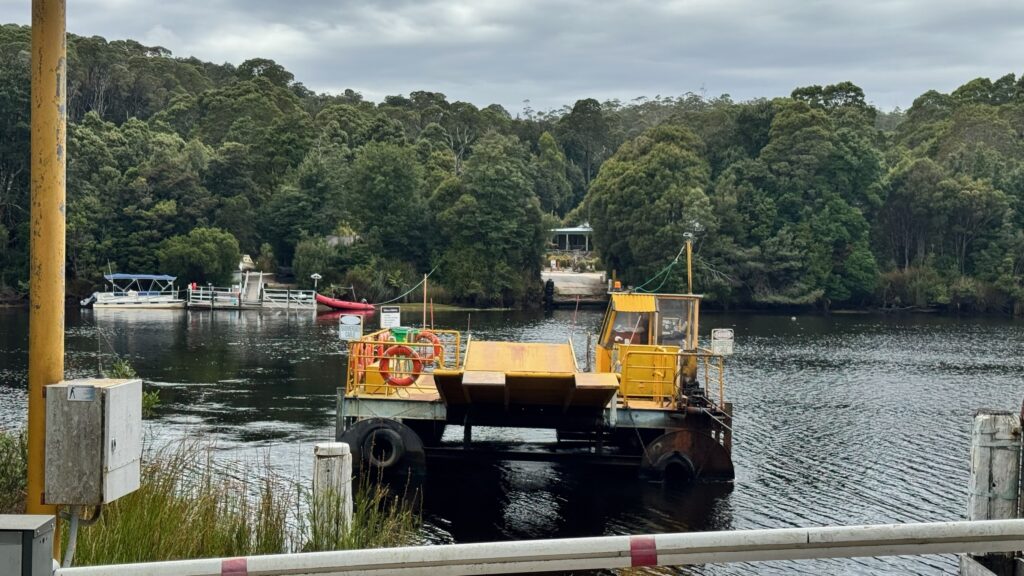
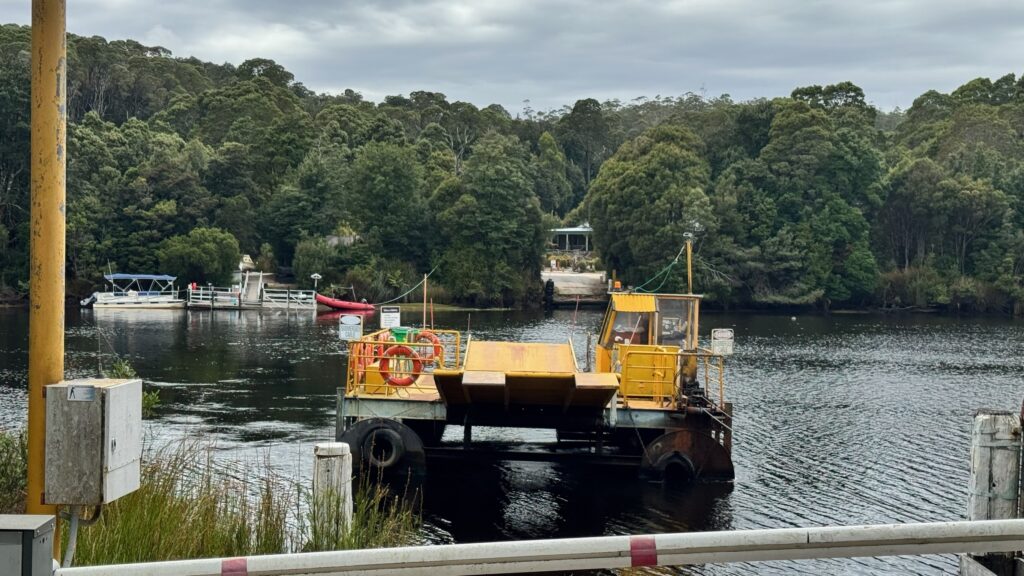
    Mais on rencontre aussi des touristes plus pauvres avec un vieux van ou une tente, souvent seuls et âgés, veu·fves, célibataires et jeunes étrangers en balade. Certains d’entre eux essaient de se fixer sur place et doivent pour cela exercer un emploi d’utilité publiques dans une ferme ou une communauté locale, comme le pilote du fameux « fatman barge » qui relie les deux rives de la Pieman river à Corinna, qui était un jeune et français de Rouen plutôt maigre. 

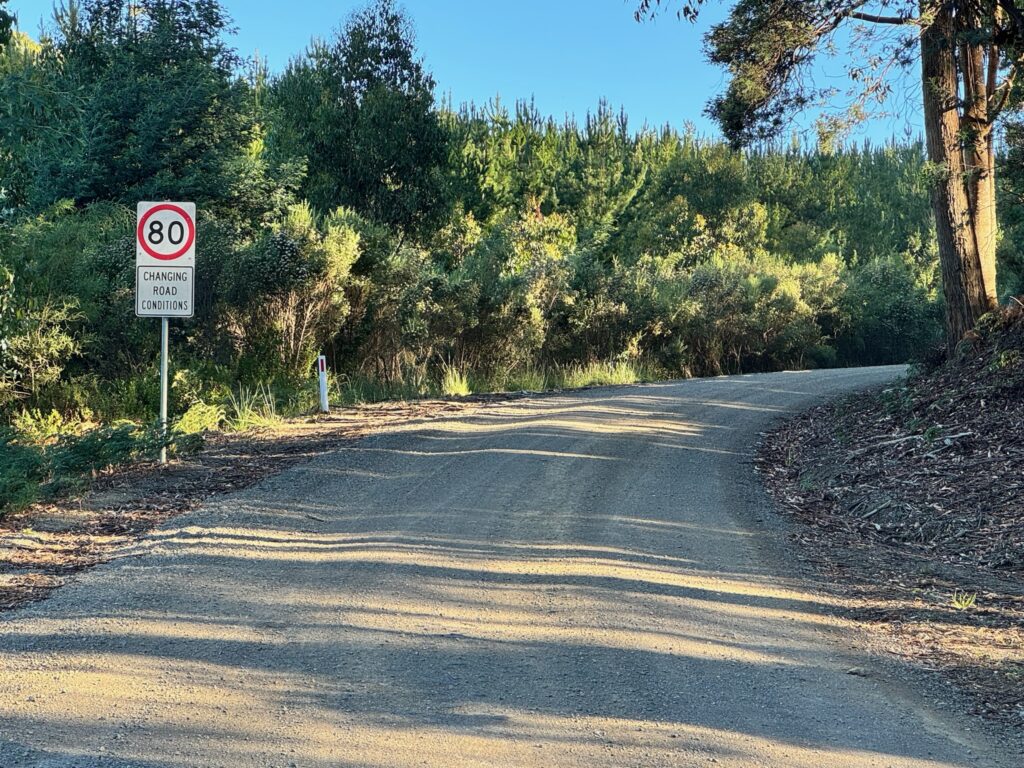
    Comme souvent on rencontre deux sortes d’habitants : ceux qui s’occupent du tourisme, professionnels ou occasionnels et ceux qui ont d’autres diables à fouetter les évitent voire les méprisent. Les premiers sont le plus souvent vraiment sympas, comme cette employée de bar qui nous a fait un cours sur les Gins Tasmaniens. Dans l’ensemble il existe en Tasmanie une véritable éthique de qualité de service. Parmi les second nous avons rencontré quelques énergumènes au doigt d’honneur facile, sans doute une mode locale, surtout sur la route, par exemple si on se range pour les laisser doubler ou qu’on veut tourner à droite au milieu d’une route rapide. On conduit ici à gauche comme dans toutes les anciennes colonies ou comptoirs britanniques où l’on vote plutôt à droite ou au centre droit. Ici le clivage n°1 est l’écologie, quoi d’étonnant. Les conservateurs représentent en quelque sorte l’Amérique profonde tasmanienne, celle qui vote Trump et ses clones locaux, inconditionnel du style de la campagne américaine, qui chasse, qui emmerde les écolos, les touristes, les intellos, les urbains, les juifs et tout ce qui ne lui ressemble pas. Ce qui ne l’empêche pas d’être composé essentiellement de propriétaires terriens, possédant plusieurs véhicules coûteux, conduisant vite et souvent pompette au sortir des pubs ou avant l’aube pour aller bosser, sans trop d’égard pour la faune sauvage. En Tasmanie la vitesse et les limites sur les routes sont très au dessus de la normale, 110 sur les routes à deux voies, 100 sur les routes secondaires qui tournent beaucoup et 80 sur les dirt tracks.

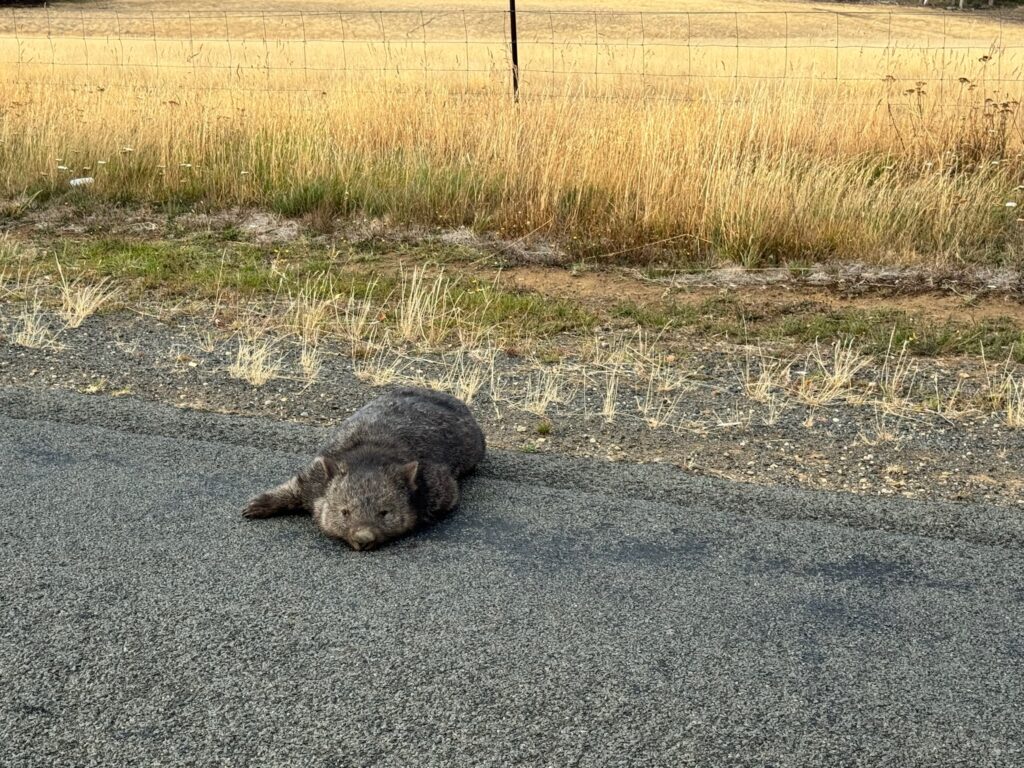
    La nuit, from dawn to dusk, elle est théoriquement limitée à 40 ou 45 selon les endroits. Mais même à cette vitesse, comme les animaux sautent sur la route de tous les côtés et à tout moment, il est très difficile de les éviter. Les routes sont de véritables hécatombes. Il y en a moins sur les routes principales grillagées, mais une fois passés par un trou ils se retrouvent coincés sur la route et forcément finissent par être renversés par un véhicule. Par conséquent les route sont toutes ou presque jonchées d’animaux à fourrures écrasés les tripes à l’air au milieu de la route ou entiers et sans vie sur le bord et dans les fossés, en moyenne tout les 100m, autrement dit en une semaine de voyage on aurait pu en compter des milliers. Plusieurs espèces sont en voie de disparition, comme le fameux Diable de Tasmanie. (Ici un wombat)

    Heureusement nous avons rencontré aussi de nombreux animaux sauvages vivants : opossums venant chercher à manger autour de la tente la nuit, de nombreux pademelon ( une espèce de petit kangourou très sympa et endémique qui vient brouter l’herbe des jardins), l’echidna (sorte de porc-épic fourmilier) ou de magnifiques raies venant fourrager le soir dans les basses eaux de Nubeena.

    Beaucoup d’oiseaux également avec des chants incroyables. Chaque variété a sa propre signature, tellement originale et sans canon esthétique ou limite de bienséance. Des sonorité poignantes, séduisantes, alarmantes, musicale ou non, en solo, en duo ou en groupe. À Gunns Plain, où nous avons séjourné, l’app écologiste en science participative eBird signalait 71 espèces d’oiseaux différente constatées au cours de l’année 2025.

    Géologie et les arbres

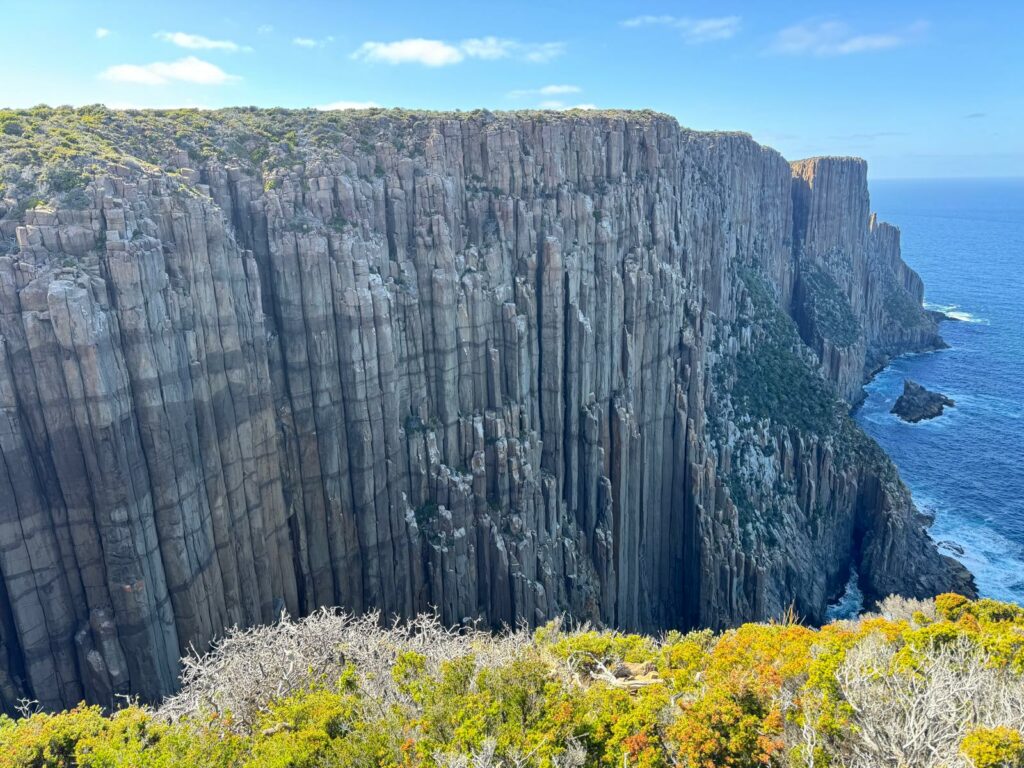
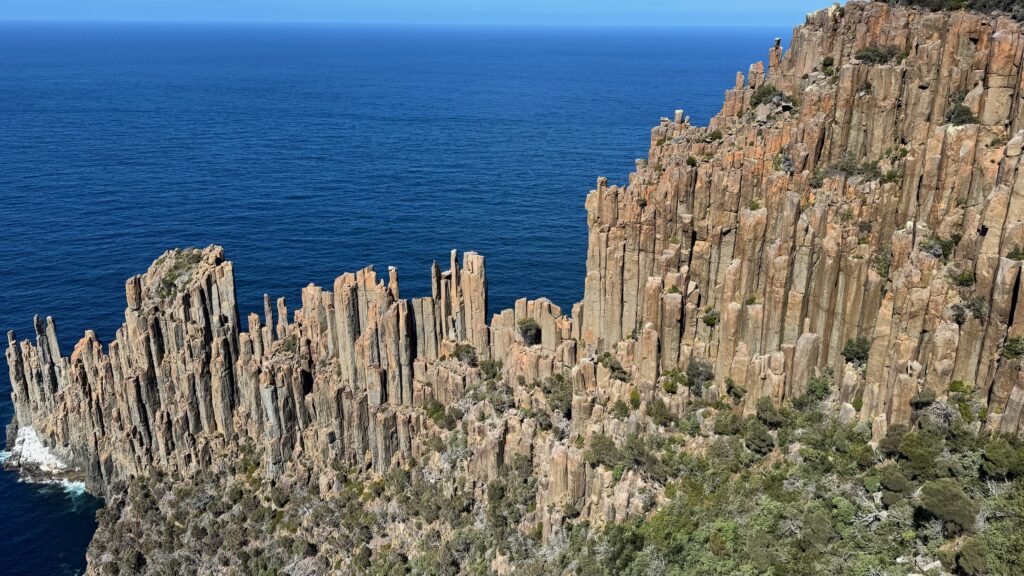
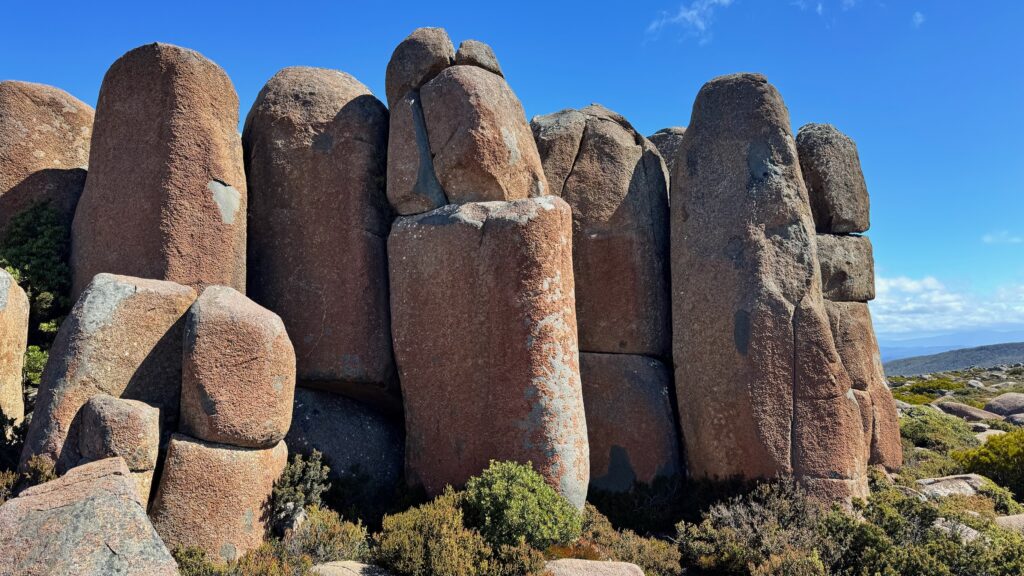
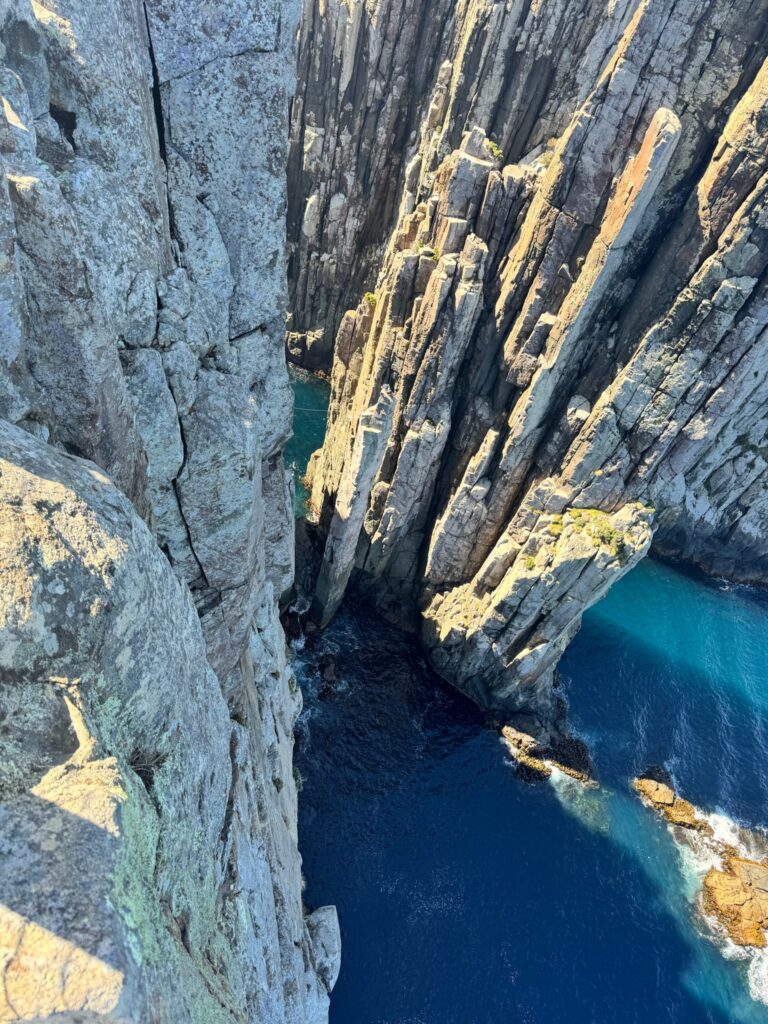
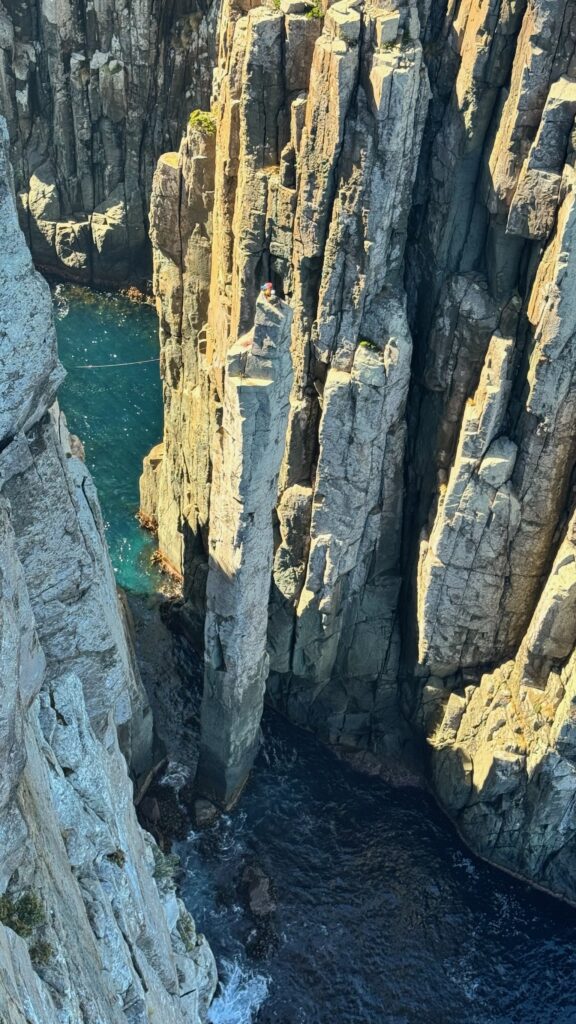
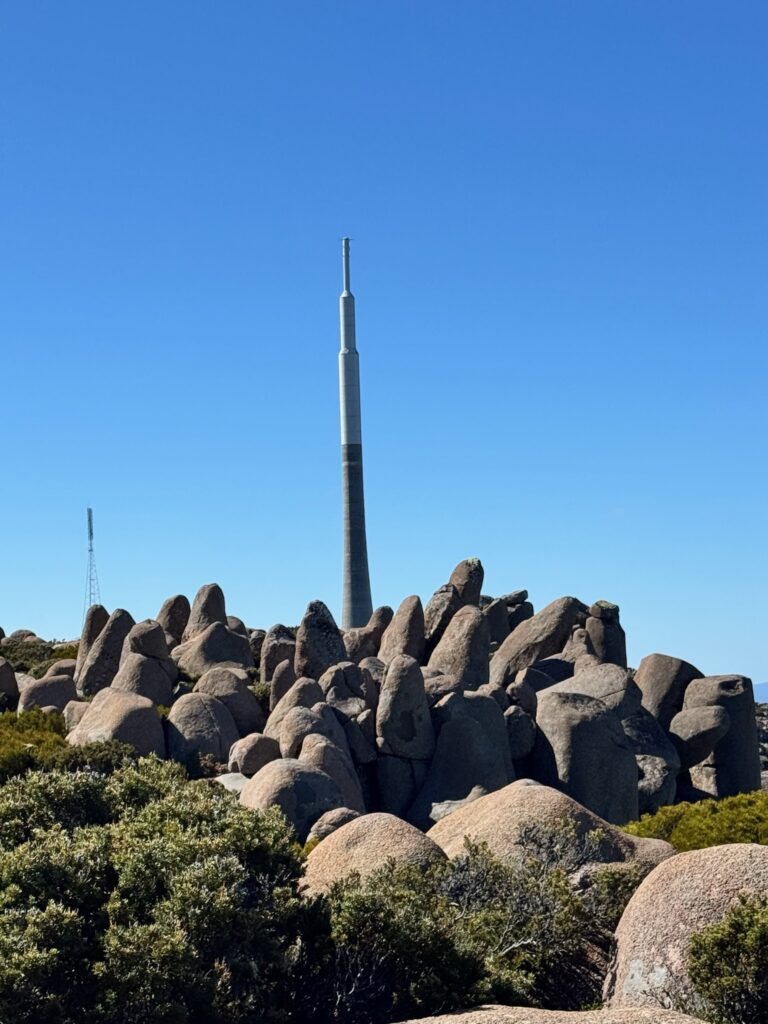
    Les Dolorites, équivalent de nos orgues de basalte affleurent au somment des montagnes comme sur les côtes rocheuses et constituent l’ossature du relief Tasmanien. Attaqués par le vent ou les vagues elles forment de sculptures naturelles sublimes comme le Totem pole du cap Huay près de Port Arthur ou les Lingams géants (nom inventé) sur le Mont Wellington.

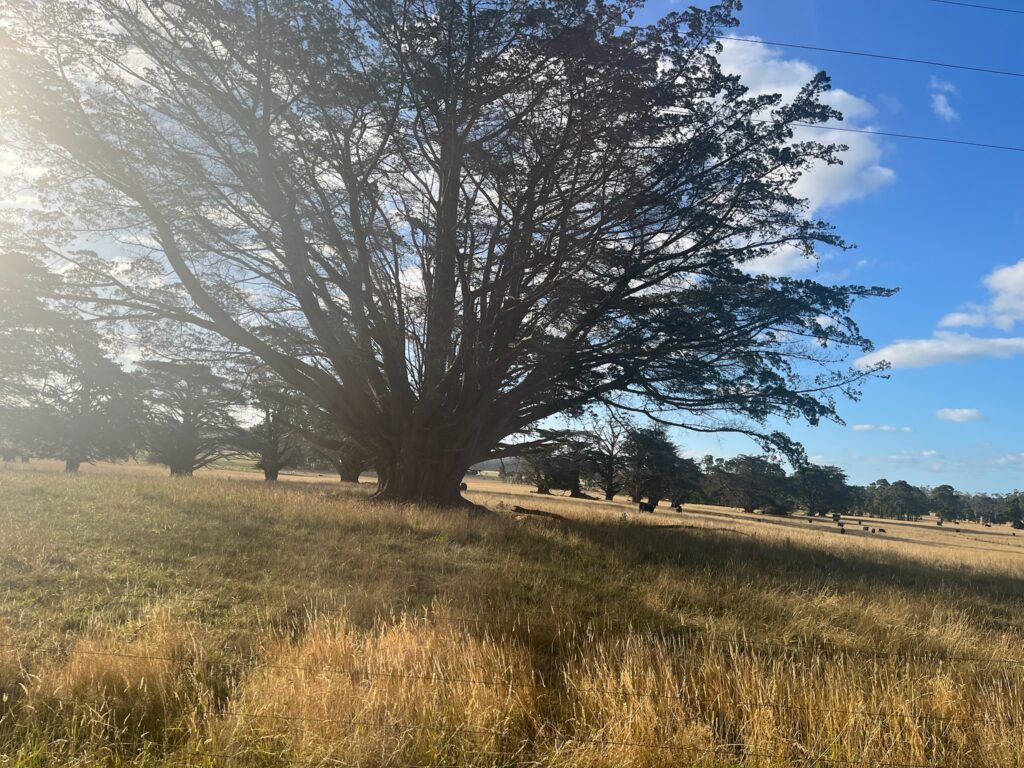
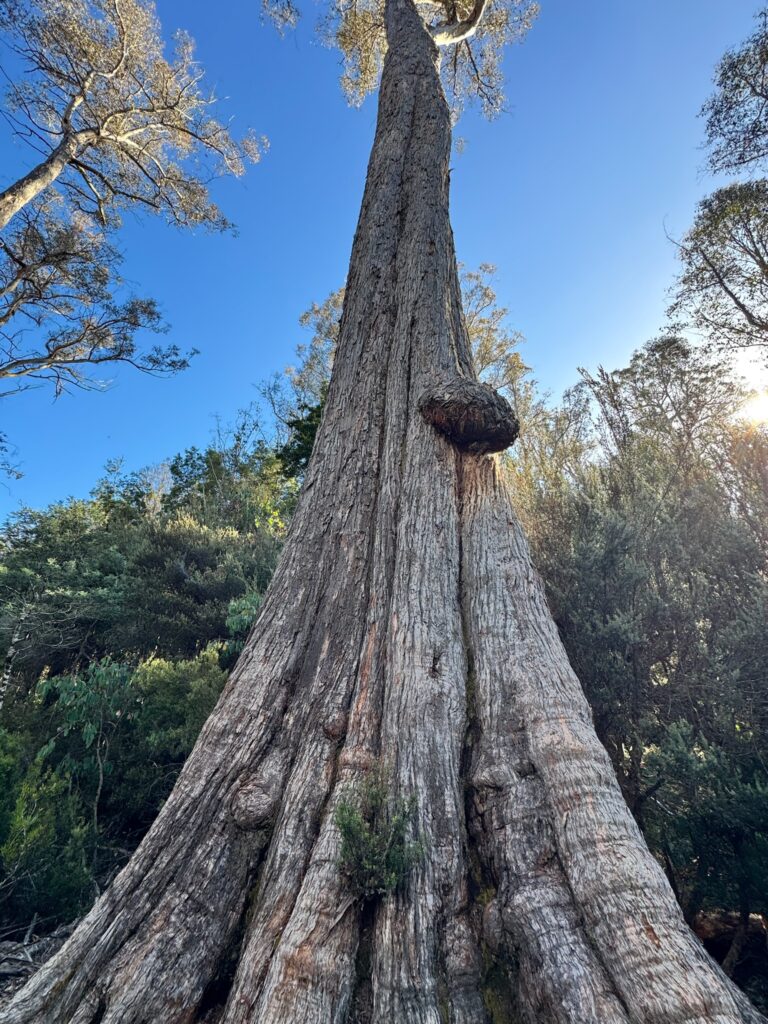
    La végétation est magnifique dans les forêts humides comme dans les plaines qui ressemblent à des savanes, surtout après l’été 2025/2026 qui a été un des plus secs depuis longtemps. En temps normal des prairies sont verdoyantes, parsemées de grands arbres. Ce sont des eucalyptus et il y en a une grande variété, feuilles allongées ou feuilles rondes, écorce blanche qui sèmes ses lanières recroquevillées et craquantes, ou écorce filandreuse à la manière des séquoias. Les australiens les appellent gumtrees.

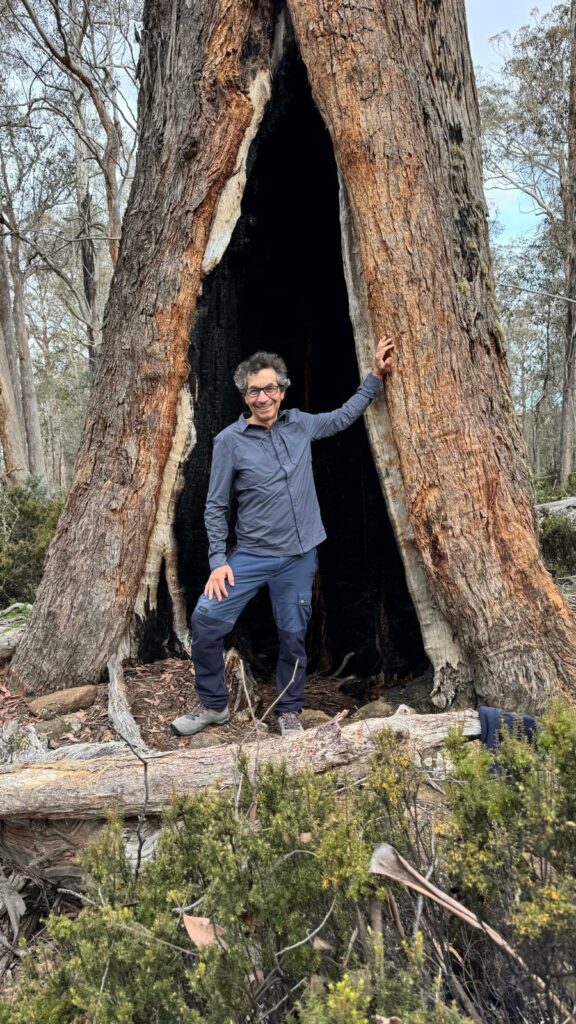
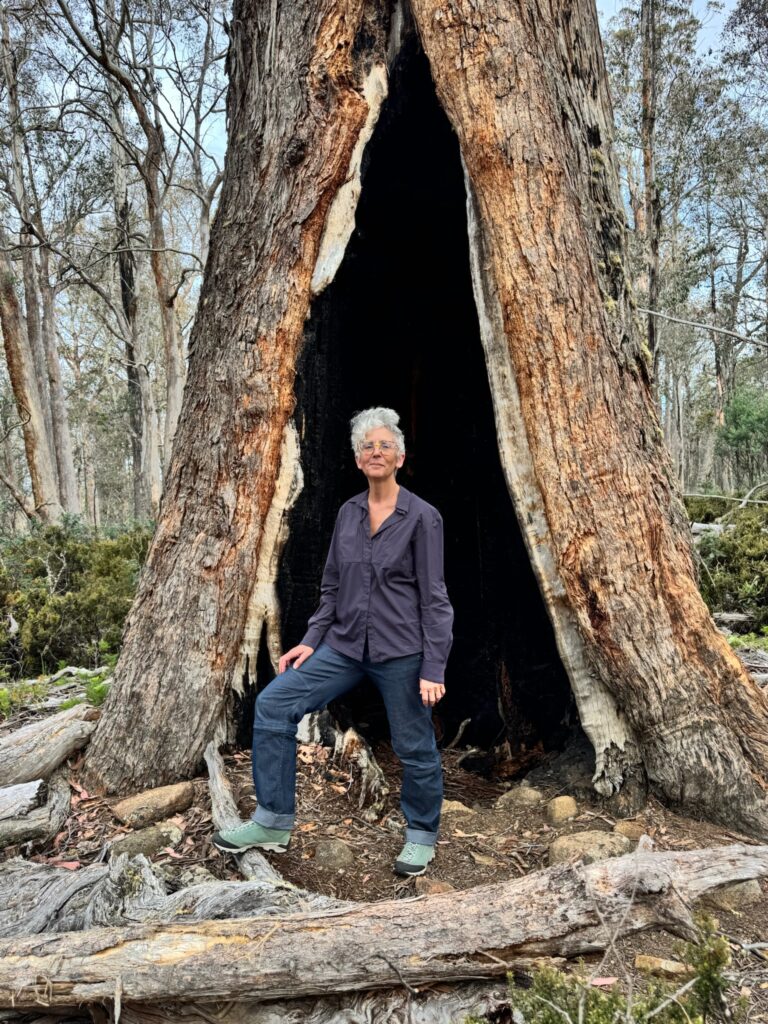
    Grand veut dire vraiment grand et vieux, plus de 60 mètres pour les eucalyptus et plus de milans pour certains spécimens de pins Tasmaniens. Longtemps exploités par les anglais qui coupaient les plus gros et les plus anciens pour bâtir et construire des bateaux, pour aller conquérir d’autre terres, pour couper d’autres forêts,…, vielle antienne britannique.

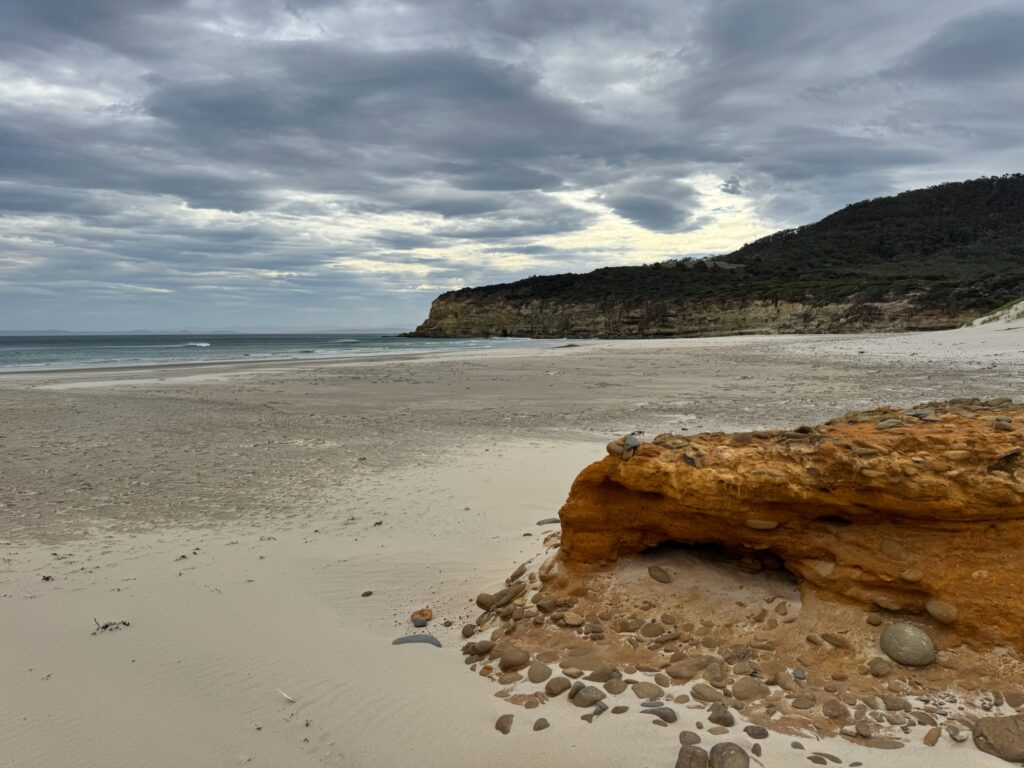
    Nous avons passé les derniers jours a proximité de Port Arthur à visiter l’archipel de péninsules, les caps les plages et le site du premier comptoir anglais. Port Arthur était entre 1815 et 1875 avant tout une prison où l’on envoyait les convicts anglais, souvent de pauvres bougres et de nombreux enfants/adolescents pour qui la seule éducation possible se réduisait à peu près à tenter de les redresser et à les faire marcher doit et à leur montrer, le fallait-il, comme la vie peut être dure pour les malheureux, emprisonnés pour des cacahuètes et les aborigènes, un système répressif arbitraire et cruel. L’implantation comportait tout ce qu’il faut pour exercer un pouvoir par la force sur un territoire les plus démunis une garnison, une police, des ateliers de travail pour les prisonniers réduits en esclavage comme dans les prisons américaines aujourd’hui.

    On peut aussi visiter les restes deux églises, leur presbitaires, les belles maisons du préfet et du commandant avec leurs magnifiques jardins.

    Les caps sont accessible par des chemins souvent assez long et en mode tunnel, c’est à dire qu’il est impossible d’en sortir car la forêt est très dense et on ne voit rien au delà, on y croise de nombreux groupes de touristes quand il fait beau. Le soleil cogne. Le chemin est construit souvent avec des escaliers en pierre comme celui du cap Huay Heureusement les points de vue sont sublimes, même si peu nombreux. On a pu voir des escaladeurs incroyables dans les dolorites. Ces ascensions étant parmi les plus complexe au monde.

    Nous avons passé la dernière journée sur le mont Wellington à Hobart avec des vues extraordinaires sur Hobart et les contours maritimes qui l’entourent.

    Enfin nous avons visité le MONA (Muséum of Old and New Art) une vraie dinguerie creusée dans la pierre sur le modèle des pyramides égyptiennes avec de vraies momies et de œuvres contemporaines remarquables.

    Et puis, en route pour Perth (WA).

  • Segue into Tasmanian wilderness

    After a night out with Julian and Lydia, last and hot day in Melbourne with Lydia. Lunch on her terrace.

    Beautiful wild trail with urban setting just beyond. Distinctive gummy smell of eucalyptus trees.
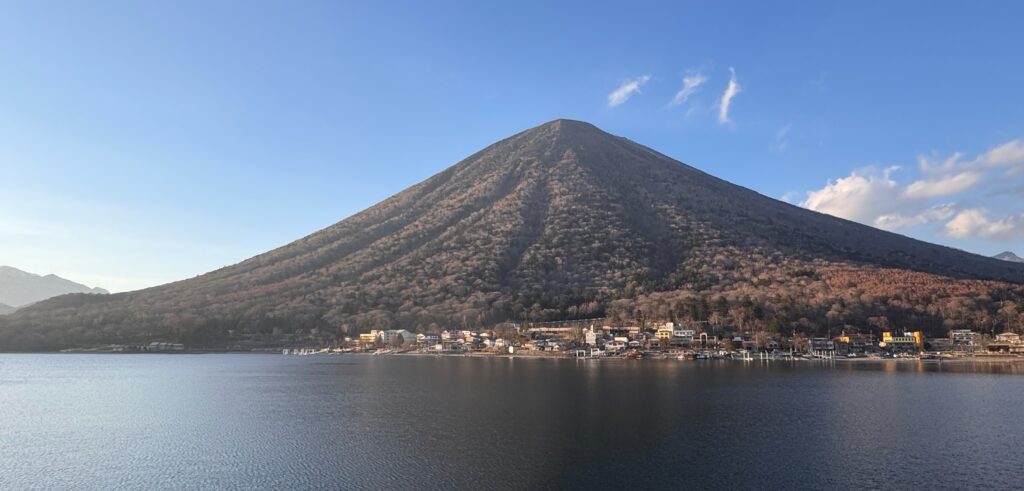
    Late flight to Hobart. Arrived in a strange sort of motel, unsure how to get in to room as no indications about rooms being round the back. Two local drinkers (who’d just been thrown out of the casino bar) helped us out.

    Startling clarity of light over Hobart Bay. Numerous Tasmanian red flowering gum trees, of fluorescent orange, red and pink. Got ourselves kitted out for the duration (car upgraded for free which turned out to be very lucky indeed and allowed us to sleep at the back). Went to Explora, an outfit operating from Sebastian’s garage and super efficient.

    A trip to the supermarket and we were away. Ate picnic lunch with sheep nearby in a recreation area in the middle of nowhere.

    Drove on Westwards to Lake Peddra/ Huon campsite in a blazing luminosity. This summer has been particularly dry, especially on the east side and everyone longs for rain. Stopped for cherries and an icecream at last outpost of civilization, though we didn’t realise at the time.

    Sighted our first ( live) wallaby at 16h45. We slowed down and got a good viewing. Unfortunately we have seen far too many dead animals on the way ( roadkill). Carrion crows clawing at the carcasses, walking away in a dignified manner as we approach.

    Drove on and on, for hours on a dirt track and reached Huon lake and campsite, realising as we approached we’d gone off the grid. The campsite is in the woods and Roland set up the tent in a jiffy. We invited our neighbour, Pete, for a glass of wine. He brought his mug. He wondered wittily if we were able to turn wine into water (note the alliteration), since we’d forgotten to bring water with us. Not doing that again. We can of course drink the rain collected water, boil it and use purifying tablets. There is lots of water.
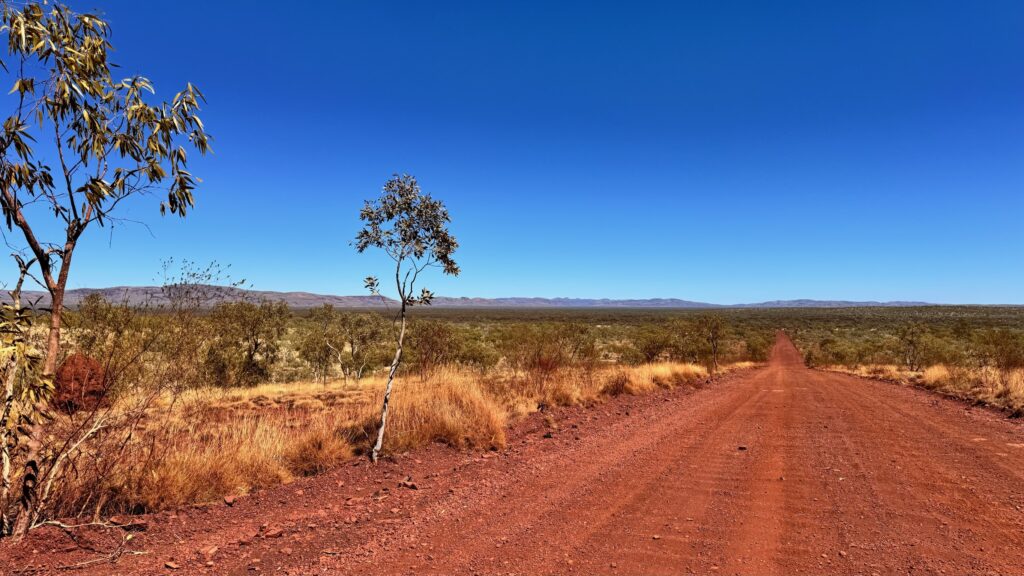
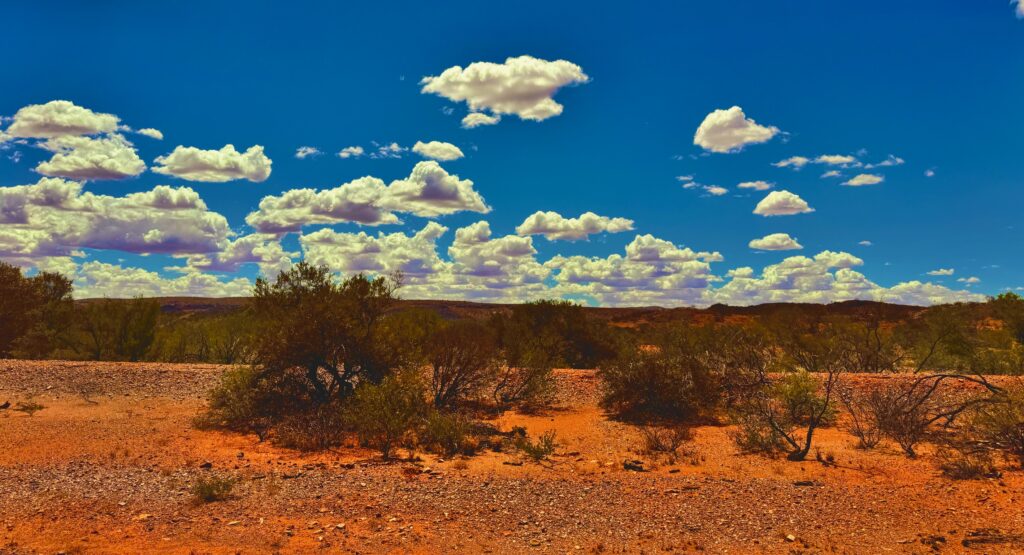
    In the evening, after dark, we saw a curious spotted tailed quoll (a wild Tasmanian carnivorous cat) who was probably interested by the smell of our sausages. Pete caught it on his camera and said we were really lucky to have seen it and so close. We could have stroked it, which we didn’t attempt to do. Just as well as apparently it has a very large range of teeth.

    Next day, we drove up to Red Knoll for the glorious view. 

    As the terrain is even more wet than in Scotland, most trails are wooden, at least when crossing marshes.

    Walked or a maybe skied a tiny part of the Port Davey trail, until it began to rain pretty badly. We wanted to go further and start climbing but the weather was not in our favour. 

    My hunch that we should buy gaiters, nay-sayed by the men, proved premonitory. A lot of peaty mud. We got back to the car in the nick of time before the heavens really opened. Now understand better why people hire camping cars and don’t tent camp (apart from on hikes) as we have been stuck in the car ever since. It’s tipping it down! We talked to 2 serious hikers coming back from the Port Davey trail, who said the wet tent stuck to their face in the night time. 
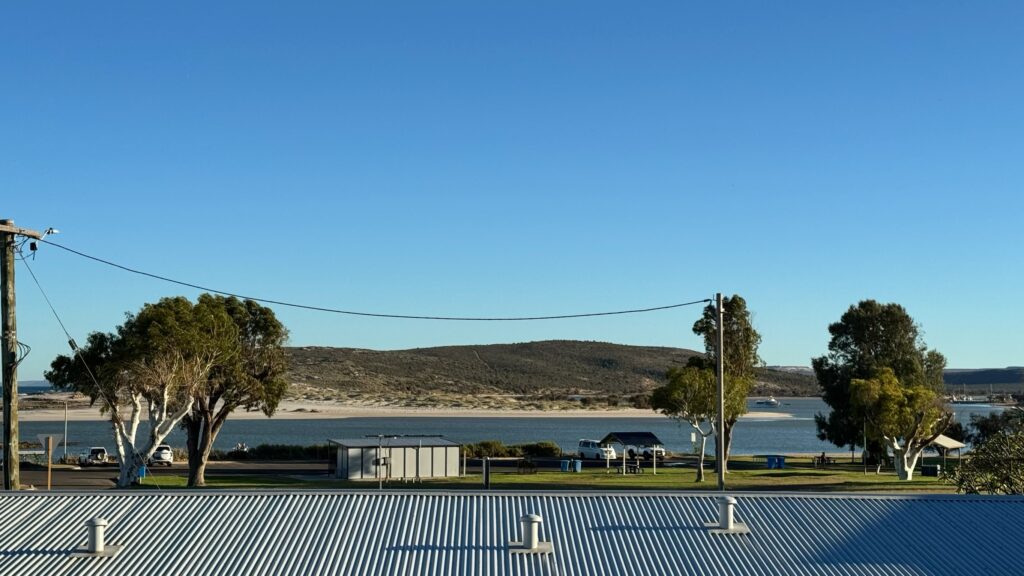
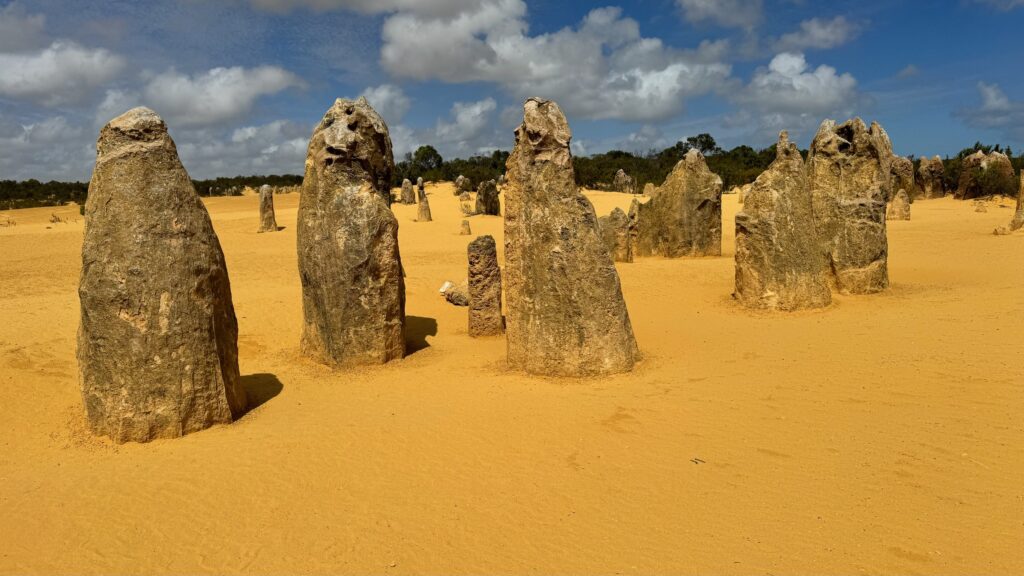
    The walk was incredible, most beautiful wild forest we have ever seen. You have to disinfect your shoes before you enter. A strange mixture of landscapes.

    Gargantuan trees of all sorts. Primeval forests. Huge ferns. Unending swathes of nothingness, one of the wildest places we have ever been to. I am bowled over by the breath- taking wild beauty.

    Sensational views on ascent at Mount Anne (1250m). Confession – we didn’t get to summit, too tough after a night in the car. Gorgeous day. The trail neatly constructed as a wooden stairway gave Roland aches and pains in his calf muscles for several days.

    We then drove back into civilisation and had another ice-cream to celebrate. Drove on to a well organised and friendly campsite at Wayatinah by a lake. The beginning of our late arrivals at campsites where we were mostly welcomed, despite our late, perhaps inconsiderate, European hours. Tasmanians have dinner around 6pm, most places close at five and lights out around 8-9pm.

    Drive next morning took us to Lake St Clair, via Tarraleah. The campsite was basic, with a good camp kitchen and plenty of big super annoying but inoffensive flies, when we had a quick lunch after setting up. We went for a short walk in mid afternoon. Walked though a dense forest to Platypus Bay. We later discovered you needed binoculars, a lot of patience or a telescopic lens to see the platypuses. Another couple showed us their photos, taken at 50m later that evening. However, on our way back, along the beach, we did have our first encounter with a beautiful black tiger snake 80 cm long. I saw it first and gasped. Note I did not shriek or scream. We watched as it slithered off and stayed off the path nearby. No photos allowed.

    After supper at the restaurant and a local rum (to calm our nerves or send us to sleep), we retired early, as befits campers. We were amused by a lodge-user holding, or even leading, what was clearly an impressive board meeting (in Dutch) on zoom in the hotel lounge. A black- tailed possum greeted us near our tent at bedtime.

    Next, we drove to Zeehan via Horsetail Falls (with some jolly travellers who took a photo of us), via Queenstown, a mining town, where we should have probably stopped but I vetoed the idea.

    We were headed for Strahan (West coast) where both of us had a sort of idyllic image of a picnic on the beach. Strahan did not live up to out expectations, for a number of reasons. The beach (Ocean road) involved a dirt track road and a beach where the roaring 40s were rather hostile and impressive. No question of a picnic there. We eventually found a very late quiet picnic stop, on the way to Maquarie Heads.

    photos

    We didn’t like Strahan at all. The (so-called) wild Western coast was teaming with people (all the campsites were full up), the golf-course over-flow chock-a block, so on we went away. Being obstinate was worth it this time round as our next evening stop was glamping at Zeehan, the most memorable camping stop because of the relative luxury and the obliging and several very tame pademelons grazing on our lawn.

    My new definition of bliss: a hot shower.

    But Zeehan is such a typical street village that it is also a famous film set for Australian westerns and modern Tasmanian cinema.

    We drove on to Corinna the next morning, which involves taking a short ferry across the river. The actual boatman of the ‘fatman boat’  operating the ferry was a Frenchman from Rouen who gave us several Tasmanian tips. We walked along the Savage River Trail, which proved quite exerting, lots of ups and downs, in the most beautiful wild Tarkine forest. Had a picnic at the pontoon where you can see the remains of the sunken Croyden (1919 shipwreck with 10-12 000 ft of cut wood – terrible loss). Such a contemplative peaceful place.

    When we asked, naively, in Corinna, if there was accommodation, we were told, bluntly that the next available slot was in one month’s time. Julian could say ‘I told you so’, but is too generous. We then embarked on one of the most challenging gravel dirt tracks roads we have ever driven on (Lyell Highway). I wasn’t driving off course. It lasted 75 kms and resembled a roller coaster. It took a jolly long time and even though I wouldn’t necessarily do it again, I am glad, retrospectively, that we did it, as the scenery was utterly spectacular.

    We arrived end of the afternoon at Smithton. A noisy campsite but fine, though I didn’t see the hot water instructions, so being myopic definitely has disadvantages, even if I can read without my glasses.

    From Smithton we drove to Stanley the next morning and climbed the (volcanic) nut. This turned out to be fun, especially when we caught the roaring 40s again.

    We didn’t stay to see the penguins, which only come out at dusk, though we did sight several pademelons and a penguin hiding in the undergrowth on the penguin trail.

    From there we drove and drove again. Along the North coast (ugly) and veering South/East though not having a precise idea of where  we were going. Fortunately we found a basic, but very peaceful, campsite at Gunns Plains, called Wild Wings. The other advantage of the place, aside the much recorded by Roland bird song was that I got talking to two serious hikers (Tasmanian women) who gave us lots of tips and ideas. We both slept like logs, despite,  or because of, the simple conditions of camping in a field.

    We then drove on across from the motorway on the Highlands lake Highway ( a sealed road)! Following the tips of our Tasmanian hikers, we stopped for a short and challenging ascent at Projection Bluff, where we picnicked at the top.

    On a drive onwards, we stopped near Shannon Tiers at the Steppes to see the 14 statues of Stephen Walker, open to all in the most beautiful forest.  Many black swans in the lagoon of the lake, just like in the statues.

    There followed a long drive to Bothwell, which was a dump and the camper ground was vastly unsuitable for tents and undesirable into the bargain. We ended up in another field in Oaklands, beating our own record of a late arrival at nearly 8pm. A gorgeous red sunset was perhaps the most memorable part of that stay, unrecorded as by that time it was eat now or never and everyone else had already gone to bed.

    From there, we drove all across to Nubeena, near Port Arthur. An early start as Roland was bothered by the irrigation of the neighbouring field in the night. The hike and earplugs meant I was out for the count.

    We are now settled in Nubeena, not far from Port Arthur (SE Tasmanian peninsula). We decided we needed to stay put and have rented a  functional, if somewhat ugly, bungalow on a campsite, in a well situated spot. Beautiful walk along a beach (Roaring Beach) we had to ourselves this afternoon. Rejuvenating briny smell of the sea, we walked along the sand and wet our feet after an encounter with a friendly echidna on the way.

  • Melbourne: a paradox

    Moving across the Equator towards the other side of the world, also involved finding a familar-looking place, which looks rather like parts of the UK, hence the paradox.

    Met by Lydia at Melbourne airport, which made us feel like VIPs. After finding our feet in the neat little flat which has bern lent to us in Fitzroy North and doing something mundane ( going food shopping) we caught up on some lost sleep.

    Took the tram into the city centre to meet Julian at the telephone-provider Telstra shop to get an e-sim. We have since visited this shop several times, which is why it deserves a mention. Wandered round the area, visiting camping/ sports equipment shops and tasting one of Melbourne’s best ice cream shops, Kori (Japanese icecream).

    Melbourne felt clean, modern and stream-lined in comparison to Asia,  sometimes similar to England, apart from the sky.

    The heat matches Thailand and Cambodia, but burns into you a different way. Hats and sunscreen are definitely compulsory.

    Walked back through Melbourne Museum and Carlton gardens, appreciating the city skyscrape.

    The next day we achieved our rather ambitious plan, starting at the luscious and beautifully planned out vast botanical gardens.

    We then walked slowly in the heat to the Melbourne Gallery of Art to see Legacy of Light, a marvellous exhibition about women pioneer photographers 1900-1975. Here are some examples. 

    This portraits definitely looks like my mother Dorothy, when she was young.

    This exhibition illustrated neatly, not surprisingly, the noticeable and vidible gender shift  after Asia where women’s occupations were limited to traditional norms. Just as we saw women gardeners and others fixing electric roadworks, so the women photographers converted a domestic occupation into a profession and experimented with aesthetic avant garde photographic art.

    After a break and a walk we went to the very instructive, not purely factual, immigration museum. Although the spiel recognised the dispossession of First Nations peoples and did not cover up the horrendously century- old racist immigration policies, favoring white native English speakers, it somehow managed to paint a rosy picture of Australia’s inclusiveness. This imposdible feat was attempted by highlighting multiculturalism in  the contemporary section, while focusing on a single identity label. Contemporary testimonies confirm, unsurprisingly,  that racist attitudes prevail. Even I, as a pretty well-educated native English speaker (a qualifier which some of you like to put in doubt), failed the dictation test, introduced in 1902, miserably. The test was deliberately skewed, since it sometimes required immigration applicants to take dictation in a language with which they were not familiar. 

    After a long walk back with Lydia, punctuated with occasional rainy showers, our day felt particularly diverse and enriching, crowned with an Italian meal at cheerful Tiamo’s.

    Other Melbourne highlights include a coffee and long chat in the Ceres community park and a walk with Michele and Brian, who showed us some of the best of E Brunswick, A1 and Luthers (another Melbourne ice cream speciality). Thanks to them, we were able to savour, visually and auditorily, the spectacular jazz rendering of one of Charlie Chaplin’s silent films, The Adventurer, accompanied by Sally Ford and the Idiomatics, as well as Modern Times. A lot of laughter was heard and we saw Melborne illuminated at night time.