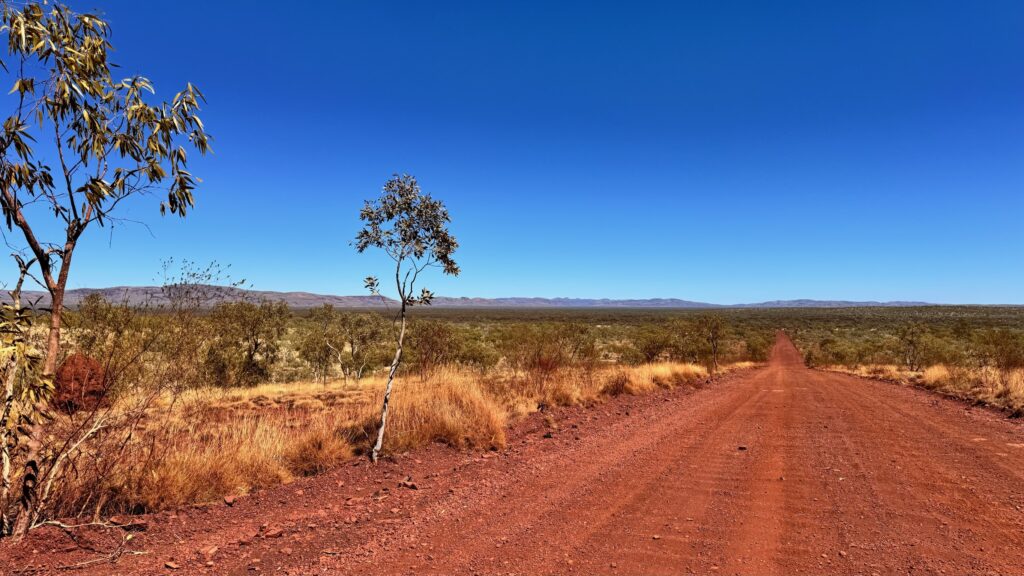
Some of you (the literati) may recognise the borrowed and converted title. For me, the North of WA is encapsulated in redness. Red earth, red stones, red metal, red dust, generated by the km long mining trains and dirt (on our shoe soles and transported to Japon). The deep earthy brown red (my colour vocabulary being perhaps less knowledgeable than my eye) is engraved in my memory. The redness is contrasted by surprising greenness at times, shrubs, small trees and spinifex, as well as by the constant deep blue of the sky, often accompanied by cotton like picture-perfect white fluffy clouds The huge termite mounds stick out regularly like friendly gnomes. The redness has a tang, a dryness of the desert, an unforgettable image of nothingness. The birdsong is constant, the quiet also punctuated by trains and heavy trucks hurtling past, though the image of the never-ending trains and road trains is more visual than auditory, as they can be seen for a long time and from afar. The buzzing swarms of flies were a less enjoyable constant sound. Thank you Julian, the purchase of the fly nets proved indispensable.
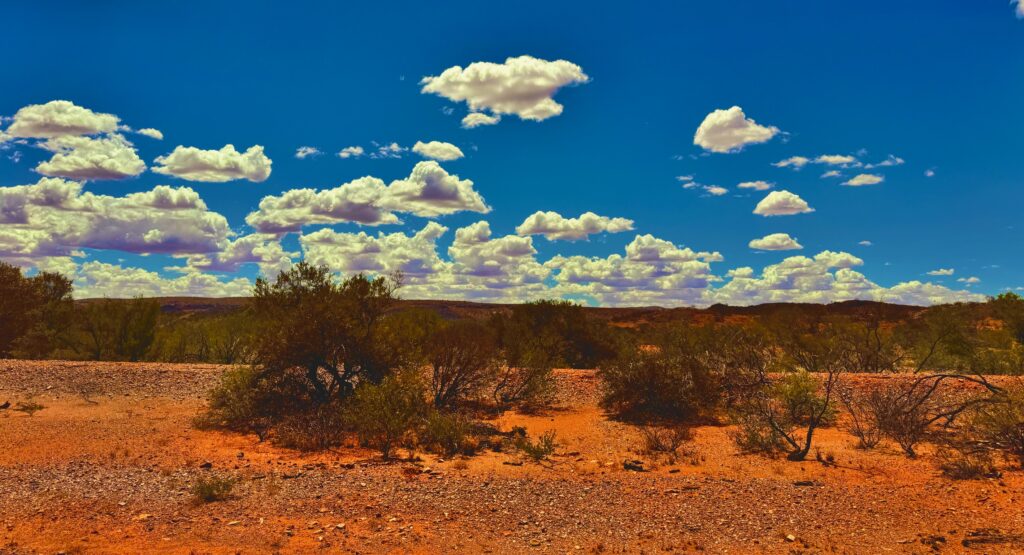
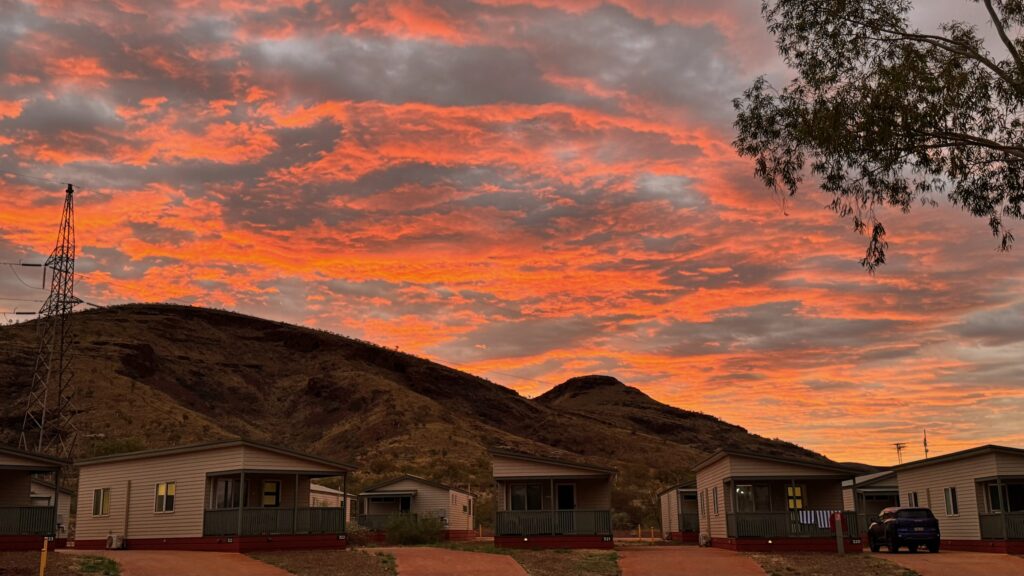
We arrived at Tom Price Tourist Park after a long day’s drive on Wednesday 18th March in honour of Dylan’s fourth birthday. We had worked out by now that the idea of a picnic lunch stop was out of the question, due to the deep heat and flies. Roland has already described the campsite, so I will limit my observations to the birdsong, the goannas, the mice in the kitchen (which actually woke Julian up), the friendly nocturnal frog in the bathroom and the gecko on the window. Sitting on the terrace was a challenge, because of the flies, fortunately they disappear with the daylight, when the mosquitos come on stage. Watching the mine bee workers, some of whom lived for temporary durations in the campsite, made us think. Rather like Zola’s blackened miners, those of Tom Price were of course tainted red. However, these workers supervise big machines rather than manipulating a pick or a spade.
The next day, we visited Kalimina Gorge in our sturdy 4 wheel drive which involved playing at bumper cars for the men. An impression corroborated by a drive later that day up the Nameless Mountain. A few days later Roland and Julian discovered the proper four wheel function on the car by fiddling with the right button. There is indeed a knack to driving on corrugated roads.
We saw a dingo from the car on our way early in the morning, no question of it wanted to have its photo taken. We had the gorge to ourselves which enhanced the magic of the experience. Kalamina is deemed to be the modt ‘culturally significant’ gorge. There was a palpable ambiance in the air. The trail was not very challenging, despite the multiple warning signs, and ended with a swim as a reward. Julian and I swam to the end. The place was magical. I remember a unique quality of stillness and quiet. It is an indescribable: a mystical place.
A short visit to the visitor centre was instructive. I learned that First Nations people make a special wax from spiniflex, an endemic prickly grass, and put it to many herbal and functional uses. I also learned that massive pythons apparently inoffensive inhabit the park, but luckily for me we didn’t see any of them. We established a routine of getting back after a long morning, followed by a late lunch and a nap. After that we could explore the very limited shops in Tom Price and found on our first day that you need some form of identification to buy a beer. You can’t even go into a bottle shop without one! We also sometimes chilled out in the campsite by the swimming pool, a good antidote to the flies who don’t like water. Lots of time for engaging and thought-provoking conversations with Julian, one of his specialities, as those of us who know him, know only too well.
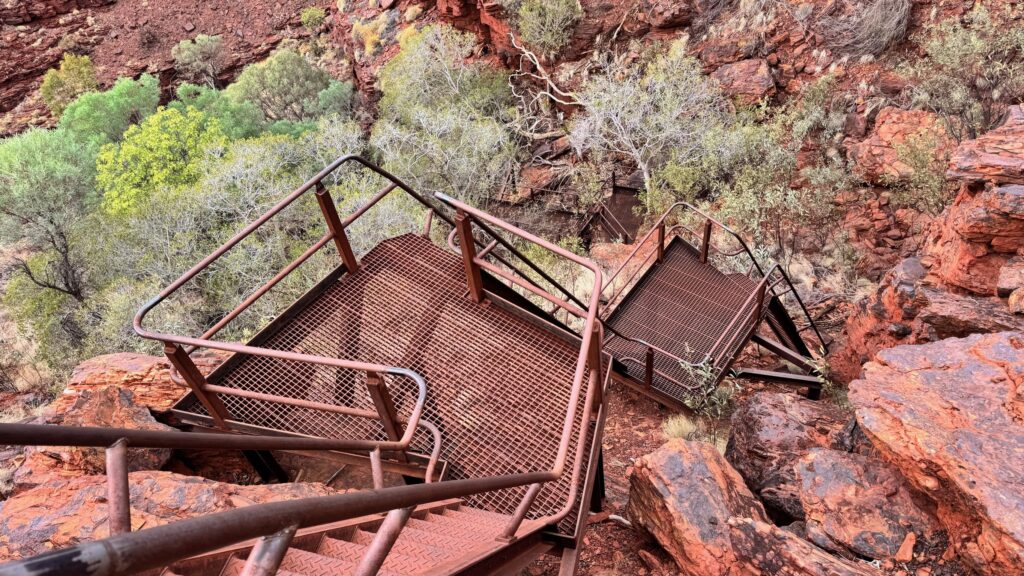
Our most challenging trail, one we remember well, was to Dales Gorge via the Fortescue Falls. Everyone else came down to the pool the easy way, by the steps. We saw our first flying foxes (bats) in ghost gum trees. We crossed over to Fern Pool where we swam, along with the dragonflie. The pool was deep and cooled us down. There is a beautiful natural waterfall at the end which only Julian managed to climb up into. We noticed a sign on the way back explaining that you shouldn’t sit by the water fall, since it is of cultural significance to First Nations people. Needless to say the brochure of Karijini Park shows two beautiful white women in the falls, which sums up the double standards. We walked back to the car on tastefully designed metal steps that merged into the landscape.
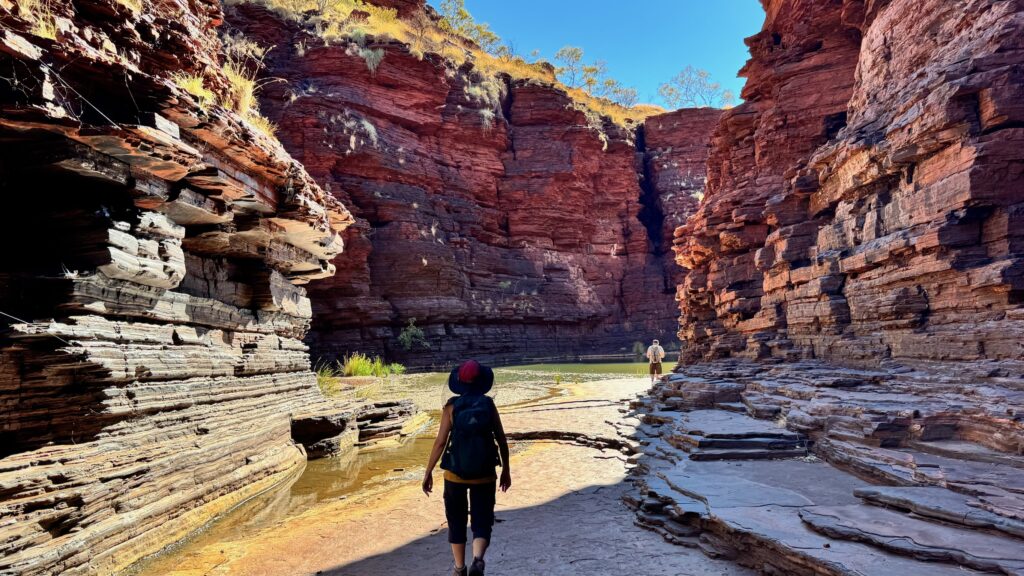
The next gorge visit to Hancock Gorge involved a different kind of hiking challenge, which was a lot of fun. Roland and Julian rock-climbed the narrow alleys and I swam through to Kermits Pool where we all swam.
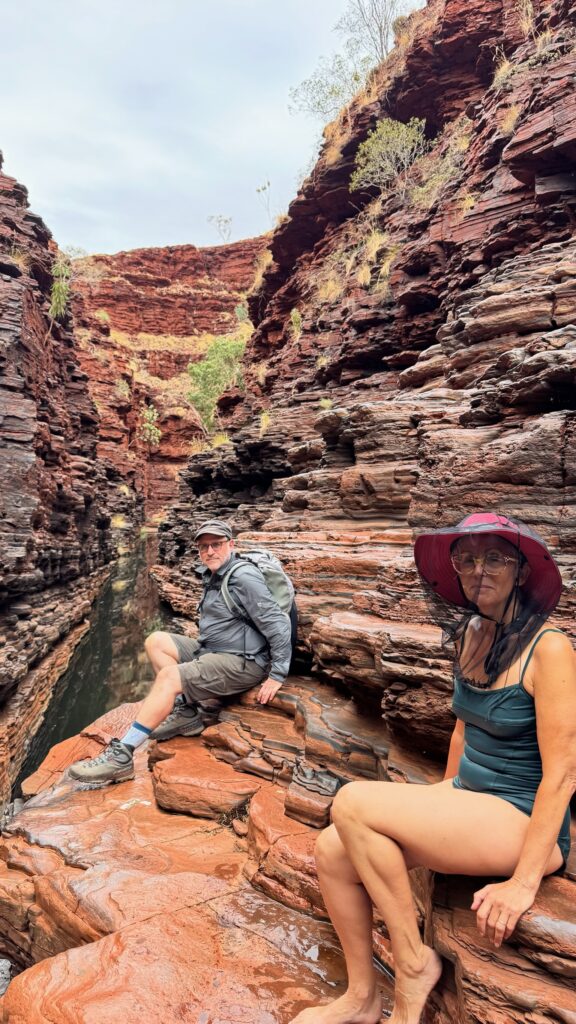
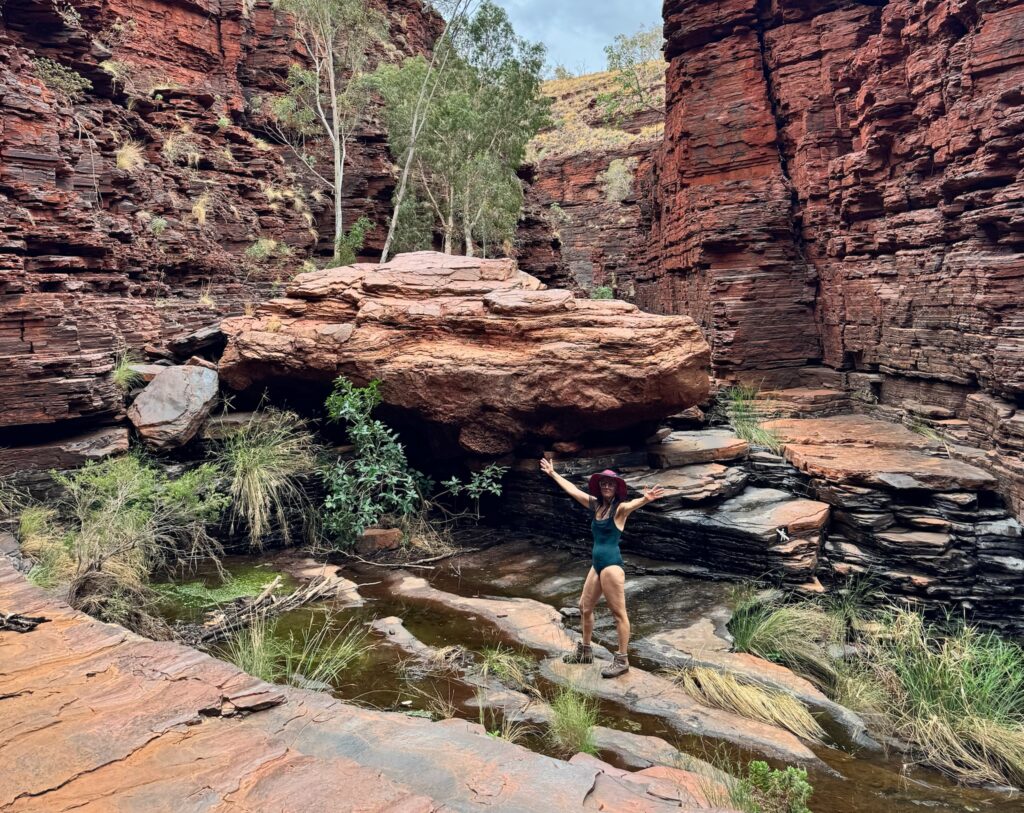
Our last day in Karijini involved less walking and more observation posts. There was a short easy walk to Joffre Gorge with an impressive amphitheatre where I struck a declamatory pose, according to the photographer’s instructions.
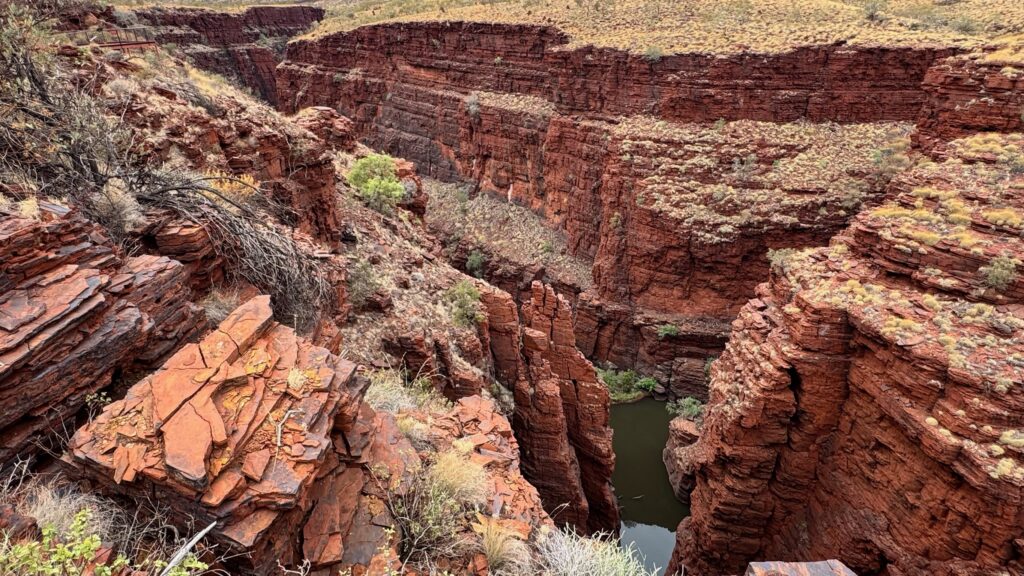
We were unable to go into Knox Gorge, closed because of a millipede infestation. For some reason, we could only find that out once we had walked down in the heat. A ranger, shutting down the area because of impending rain, kindly allowed us to proceed to the Oxer lookout, which gave us a good view of the depth of some of the gorges.
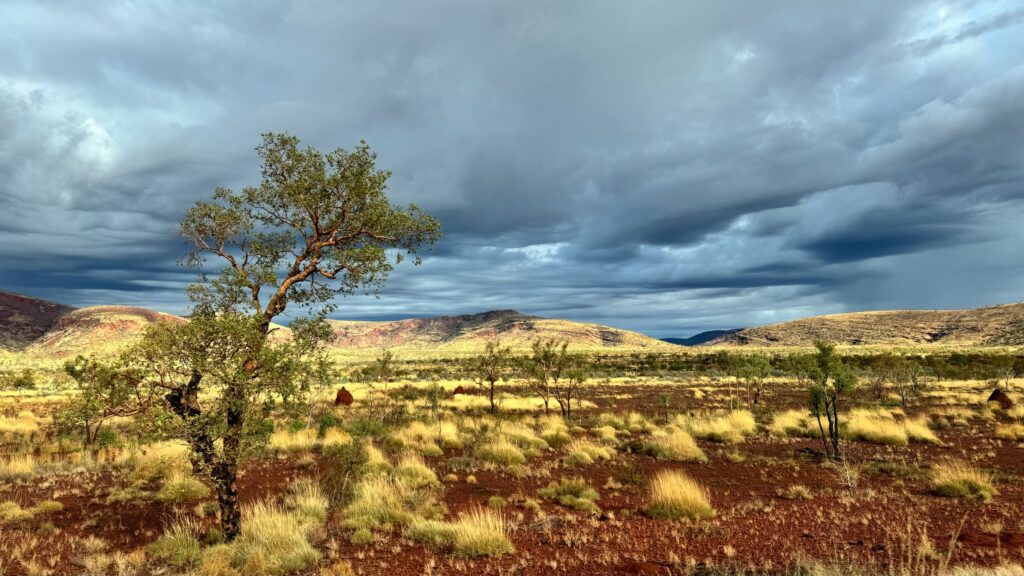
On Monday morning we had hoped to go to Hammersley Gorge, which involved 40 km on a bumpy corrugated road drive, but it was once again closed for maintenance. We continued towards Karratha, on (another) stunning landscape drive. It is both true and not that driving long distances in the desert in WA is monotonous. If you spend time on a long road trip and pay attention, the landscape changes continually, if somewhat slowly, due to the light, land, flora, the time of day, the sky and, no doubt, our concentration. Sometimes the changes are sudden and unexpected. The bush terrain is not the same all the time. The 40 km corrugated road drive along the Rio Tinto train was another memorable milestone. Once in Millstone and Chichester Park, the vistas changed. We all went for a long swim in the very warm Python pool. Only Roland was brave enough to walk up a hill to get a view: too many flies and too hot for the rest of us.
Our approach to Karratha produced a different amazement. Here was a mining town in all its affluent and yet temporary nature splendor. Karratha appears to be rich, in comparison to Tom Price. Neat comfortable houses with many cars, gardens and boats in the back drive. We found ourselves in a luxurious airbnb apartment. An outside eating place on the terrace, luckily equipped with an outdoor fan. We went to see the sunset on Fortescue Beach nearby, the beach was established for the recreational wellbeing of the mining company employees, with beautifully designed metal shelters with an aboriginal design. The only time we saw shelter on a beach, the whole time we were in WA. No doubt Fortescue wanted to ensure their workers were back at work the next day, after going to the beach.
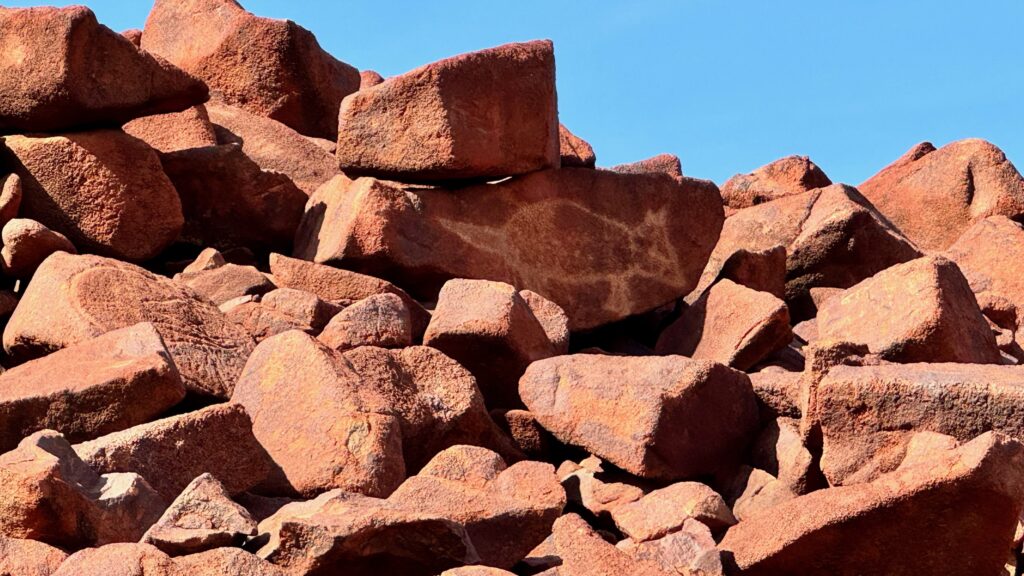
Our only (as it quickly transpired) visit in and near Karratha was to the 45 000 year-old petroglyphs. It was amazingly burning hot, even by 9h. We joined a group of people who were learning how to guide visitors so after looking at the rocks a second time, we were able to identify many more animals and symbols.
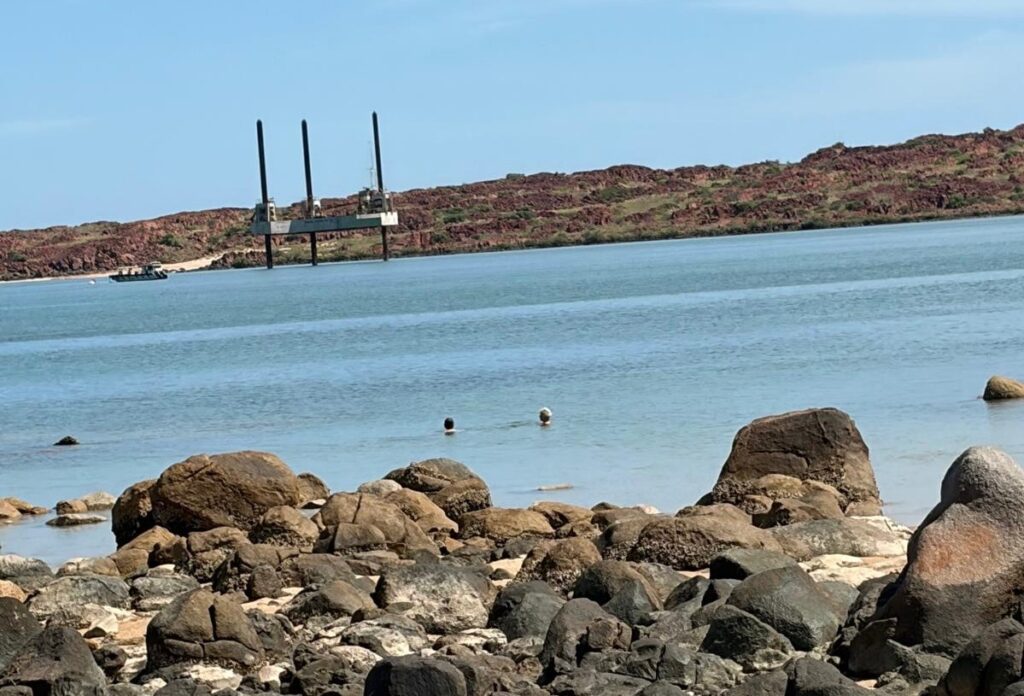
Roland and I went for a much needed swim near the factory, on a very unscenic beach, though the water was gloriously hot and gentle. The swim there summed up Karratha – the mining industry predominates.
When leaving the painted rocks (and before our swim) we were alerted by the Karratha tourist information centre to the presence of an imminent cyclone, which Roland had previously identified on his Windy app. We had phoned them to find out if we could come back for a proper rock painting visit. The woman at the centre advised us to leave, informing us that her husband was an air pilot. Our ‘what to do in the event of a cyclone’ discussion started before getting to the beach. After collecting as much information as possible, including checking whether we could return the car in Karratha (no) and taking further advice from Julian’s friend, Leon, who in a nutshell, said ‘get out as fast as possible’, we decided to drive back to Exmouth the next day and change our Saturday flight to one on Wednesday, which we were fortunate to be able to do. Cyclone discussions were ongoing when we went out to lunch in Karratha, admiring more modern metal architecture and were brave enough to walk for an ice-cream in a dry burning 40°C, which sizzled on our skin.
Sadly we packed our things later that afternoon, giving away our opened foodstuff to our next door neighbour (of Italian origin) who admired our taste in olive oil.
We woke the next morning at 4h and drove back to Exmouth as dawn broke. The road was empty and the drive was very smooth and, especially as it was all on tarmac roads.
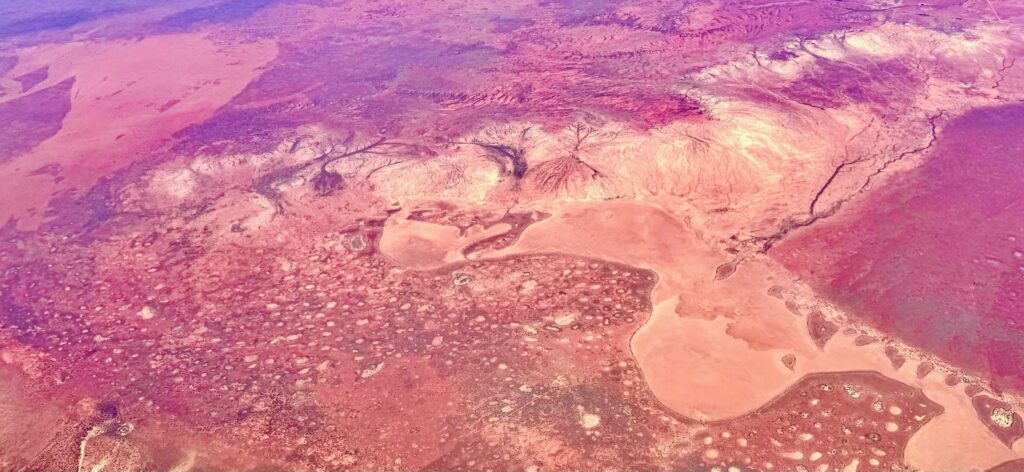
On our arrival at Exmouth mid morning, panic was palpable in the air, with petrol pumps already running dry. We saw lines of big 4 wheel drives, loaded to the eyeballs, driving away southwards. We left Learmonth in the early afternoon, after returning the car, on the, or on one of the, last (very full) Qantas flights back to Perth. As Roland snoozed on the plane, I had the luxury of being allowed to sit at the window seat, admiring the red curvaceous and chiseled mountain tops, which looked to me like the famous Bruce Chatwin songlines, as if people had drawn their journeys a long time ago.
Our return to Perth being somewhat earlier than expected, we were more than glad of Kate’s ability to adapt. We found ourselves back on familiar territory in no time at all and were welcomed back generously. We all drank a glass of red wine to celebrate our near escape. Cyclone Narelle turned out to be scale 4, one of the worst in the last 20 years, and the damage incurred both in Karratha and Exmouth was very severe indeed.
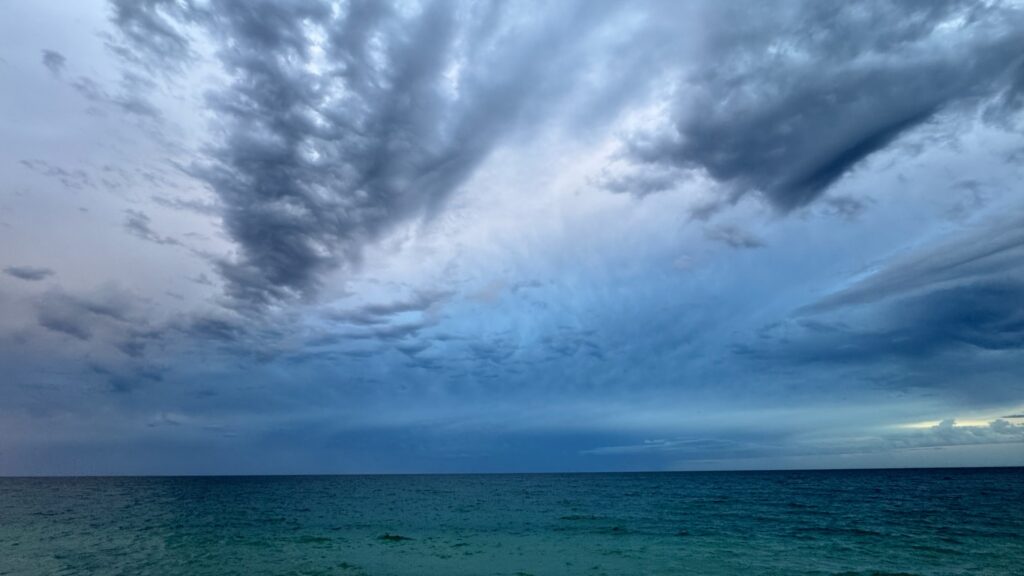
Our more than generous welcome back included Sandy’s offer to enable us to go and stay in a resort in Busselton, two hours drive south of Perth, where we drove the next day. After a delicious middle Eastern-style lunch in town, we discovered to our amazement that this involved a very luxurious appartement with 3 bedrooms and 3 televisions. After a walk along the beach at sunset with lightning on the sea horizon, the day ended somewhat bizarrely with Julian being interviewed by BBC Scotland about the banning of social media for under 16s. As he was upstairs answering questions brilliantly from a very Scottish voiced reporter, I was reminded abruptly of the interconnected world we live in.
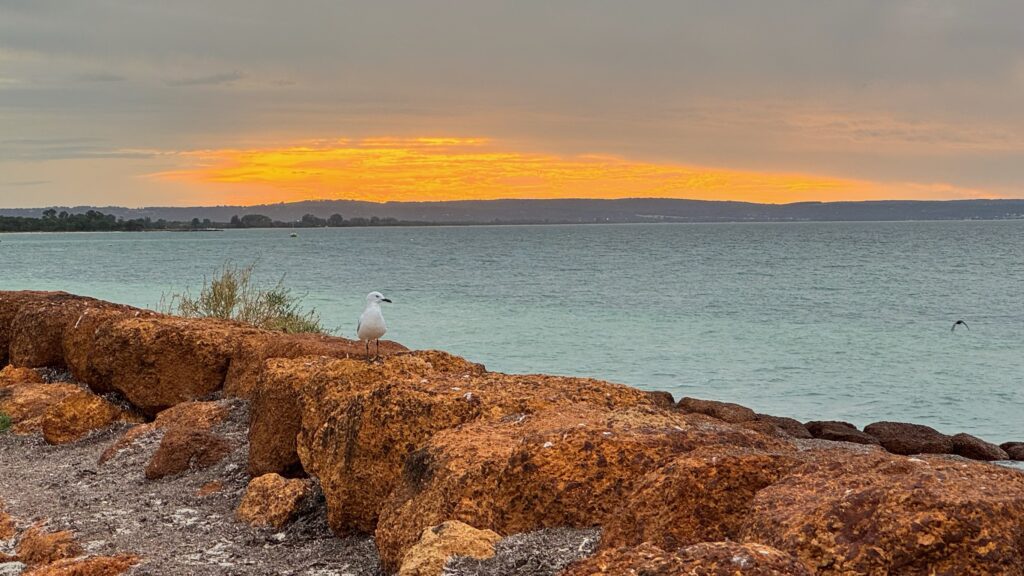
For our penultimate day away we walked along the sandy beach near Yarringup and Roland spotted a horde of black and red-footed crabs on the rocks. We saw, but didn’t hear a kookaburra. This was followed with visit a winery, the beautiful domaine Naturaliste, for wine tasting, along with a lunch platter. We saw several mobs of kangaroos on the way home. A rainy afternoon allowed us to chill out afterwards.
The next day we decided to visit Margaret River, with a farmer’s (rather pricey) market, full of aging and colourfully dressed hippies. The place smelt wonderfully of lemon myrtle after the rain. We went on an atypical shopping expedition for slippers. On our way back to Perth we visited Olivia and Neal to see their unique house (designed and lovingly built by Neal) in Myalup. We were served mouth watering cakes and finally heard the laughing trill of the kookaburra. Our desire to hear its tune made Olivia laugh, which matched the bird’s song.
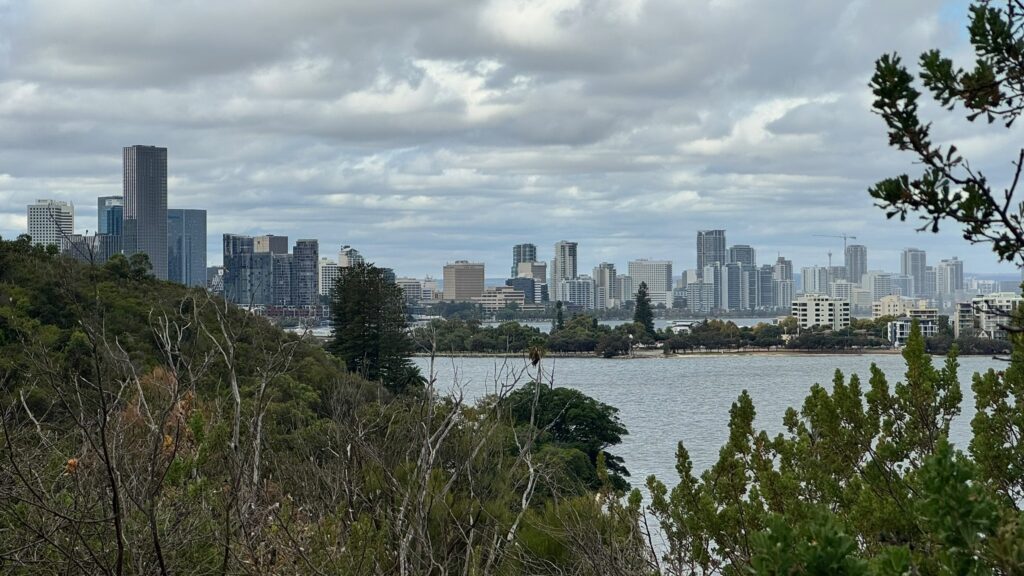
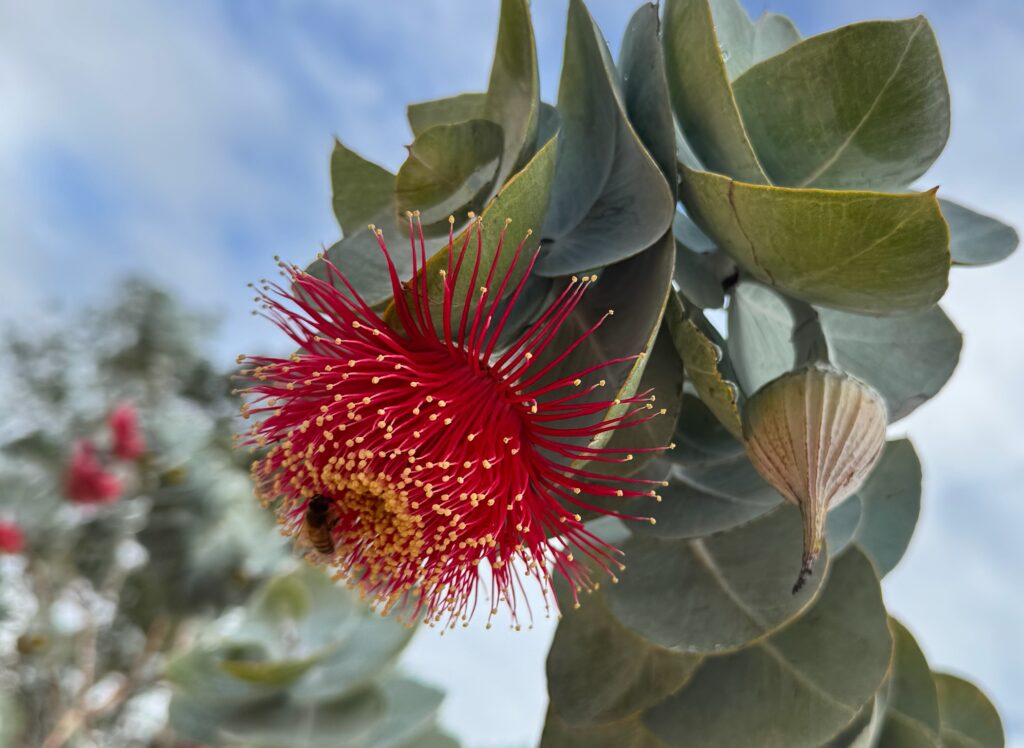
Our last few days in WA (and indeed in Australia) included an aborted (water too choppy, even for Kate) early morning swim, converted into a long walk on the beach, walking in parks close to Kate’s home and an enjoyable evening out with Sandy and Irena in Subiaco. We saw our first ‘no swimming – shark warning sign’ on the beach – a sharky day. We drank in the last of Perth, enjoying views of the city by the river, from King’s Park. This was a perfect location to end our stay as the botanical gardens showcases some our favourite flowers and trees in WA.
The red treasured earth is still on the soles of our walking boots as I write. The redness will stay in our heads, even if physically washed away on our belongings. Our red road trip to WA is engraved in my memory for many reasons, not least its redness.
Laisser un commentaire